Mad Catz' FightStick Tournament
The Street Fighter IV peripheral range reviewed.

The arcade stick can be either the beat-'em-up aficionado's closest ally or most damaging adversary. Players can grow as attached to their control stick as they do their on-screen character, learning each one's nuance and personality intimately. On-screen characters might be the visualisation of a player's thought processes, but the controller is the facilitator, the very bridge over which will is made action.
If the controller is in any way lacking, through design or defect, then the game is broken with it, as any Rock Band player with a sticky orange fret button can tell you. In beat-'em-ups, where precision and response are everything, the control stick's importance is elevated yet further. In this genre a controller doesn't need to be defective to be game-breaking. The feel in the hand, the weight and the bulk on the lap, the resisting click of the buttons and the size and slipperiness of the ball top can narrow or widen the distance between victory and defeat. And in a beat-'em-up, the distance between victory and defeat is the only distance that ever matters.
2009 is the year of the beat-'em-up's renaissance, one singlehandedly brought about by Capcom's Street Fighter IV, a game that promises not only to draw back into the fold those players long put off by the genre's increasing complexity but also a new generation of gamers. It is a momentous occasion, the passion Capcom has managed to rekindle for its flagship series both unexpected and wonderful. So it's only right that a suite of licensed controllers, built with the game's peculiarities in mind, should accompany its release. And who better to make these crucial peripherals that...um...Mad Catz?
Mad Catz (sic) is a third-party peripheral maker whose products have always been aimed, politely put, towards the lower end of the market. Theirs are the ones parents buy to shave a few pounds on the official controllers, a small saving outweighed by the misery their shortcomings impose on young gamers everywhere. But in 2008 the company made a conscious decision to shift its focus, scrapping the third-rate knock-offs and concentrating on the opposite end of the market, creating expensive products built from quality parts for the more discerning gamer.
The company's three licensed Street Fighter IV peripherals, all produced in association with Yoshinori Ono and the Capcom team, are everything you expect a Mad Catz product not to be. Sleek, stylish, weighty, and lacking in unsightly logos, they integrate seamlessly with the Street Fighter IV aesthetic. The company hired stick aficionados such as SD Tekken's Mark Julio to work on the designs, hand picking each and every component with the aim of beating the market leader, Japanese stick giant Hori, at their own game.
We've spent a couple of weeks with all three controllers, playing the final build of Street Fighter IV to help you decide which product is best for you. All controllers were tested in their Xbox 360 incarnation. The only difference between platforms is that the PlayStation 3 FightPads are wireless while the Xbox 360 ones are wired. Otherwise, the specifications and prices across all products are identical.
Xbox 360 Arcade FightStick: Tournament Edition (GBP 149.99)
In 1995 SEGA released a Japanese-only high-end arcade stick for the ill-fated Saturn console. The ostentatious stick mimicked in exact detail the entire front control panel of SEGA's iconic Japanese candy cab, the Astro City. It was extravagant and unnecessary but also arresting. The FightStick: Tournament Edition takes a similar ballsy approach, assuming the exact likeness of the Taito Viewlix cabinet's control panel for its design. The Viewlix is the official Japanese Street Fighter IV cab and so the FightStick: TE offers the closest approximation of the arcade experience at home. Indeed, as the tall price indicates, it is positioned as a travel-ready Tournament stick for expert and professional players: the Rolls Royce of the set.

The controller uses all cabinet-grade parts from Sanwa Denshii, components that the team at Mad Catz prefers to those from the other top-line Japanese arcade parts manufacturer, Seimitsu. For those of you who are interested in such things, the white ball top stick is model JLF-TP-8Y-SK-W, the eight face buttons are OBSF-30s while the smaller Start and Select buttons, positioned at the back of the stick to prevent accidental (and tournament-disqualifying) pausing during matches, are OBSF-24s.
The controller is wide, deep and heavy, weighing in at 6.5 pounds, but it is not unwieldy. Rather, the metal and ABS plastic frame sits comfortably on the lap or on a table and almost never slides about, even during the excitement of a close-fought battle. If you've never played on a Japanese cabinet or stick controller before you will likely find the loose, square gate stick strange at first. However, most serious Japanese and Western players alike prefer this semi-loose feel as it allows fluid motions, something that works especially well with Street Fighter IV and its deliberately generous input windows. Conversely, the face buttons are firmly mounted without any wiggle and are exactly as resistant and responsive as you would hope them to be.
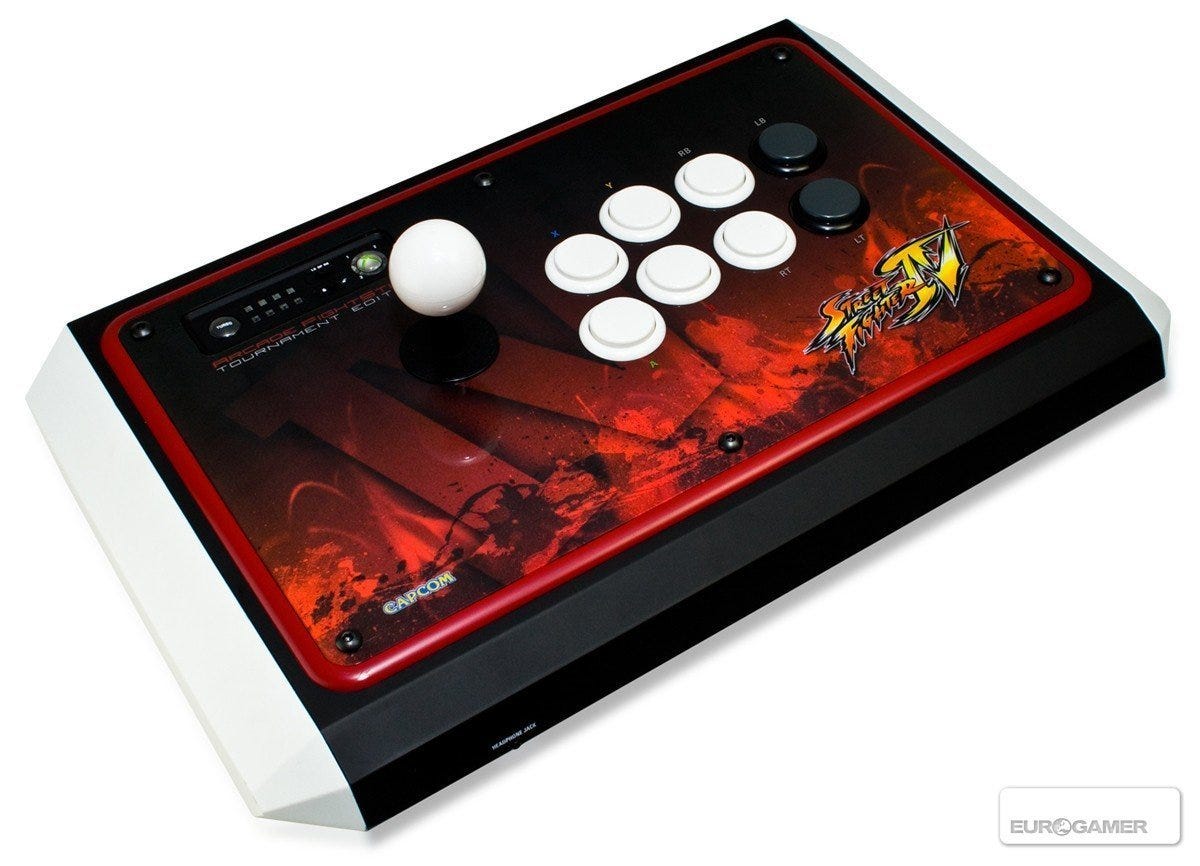
The stick, as with its cheaper cousin, lays out its buttons in the classic CPS-cab style, in two neat parallel rows. The white buttons are set up for Street Fighter play - light, medium and hard punch on the top row, light, medium and heavy kick on the bottom. The buttons are in perfect parallel allowing player to easily hit a light kick and punch simultaneously for a throw, a medium kick and punch for a Focus attack and a heavy kick and punch for a taunt. To the right of each row of white buttons is a single black button, which is set up by default in Street Fighter IV to mimic all three punches or all three kick buttons being pressed simultaneously, the input required to pull off Ultras and other more powerful variations of special attacks in Street Fighter IV.
A small, recessed panel sits at the top left of the controller's top. This houses with pleasing tidiness the Xbox 360 Dashboard or PlayStation 3 Home button in addition to a three-way switch that toggles the stick function between the left-thumb stick, right-thumb stick and D-pad. A tiny micro-switch can disengage the whole panel, again negating the possibility of an accidental pause during a match. Finally, the panel houses a button for enabling the stick's turbo mode, a feature which can be assigned to any button on the stick and which means you can hold down a button rather than having to tap it repeatedly. While frowned upon in beat-'em-up circles, the feature is certainly useful if you're planning on using the stick to play shoot 'em-ups and the like.
The back of the controller features a pop-out compartment used for storing the stick's USB cable. As the cable sits at three metres this is a useful tidy-all, especially for players who plan on taking their stick around with them whenever they leave the house. While some might bemoan the lack of a wireless feature, issues of latency and, of course, the danger of batteries running out at a crucial moment no doubt tipped the decision to stick to a wired set-up.
There are few complaints with this controller. It is, in almost every way that matters, a Hori-beater, more fully functioned and thoughtfully designed than most of its key Japanese rivals. The main issue then is price. Costing more than the console it runs on, the FightStick TE's straight USD 149.99 to GBP 149.99 price conversion from the US to UK market as unfair as it is predictable. But this is a product aimed at players for whom money is of smaller concern than build quality and choice of components and, in this respect, Mad Catz has turned out one of the finest sticks of this generation.
Demand is high for the peripheral (not helped by Capcom's Seth Killian's irresponsible urging of people to 'pick one up for eBay') so pre-order immediately or expect to pay an even higher premium on the resale market in a few weeks' time. If you can get hold of one, this is a controller to carry with you through life, a joystick in every sense of the word.
10/10