Left 4 Dead 2: Specials, Weapons and Tactics
Out of the frying pan and into the face.
It's early September in Seattle, Washington, and on every television channel, the Republican Party and the health insurance lobby are teaming up to murder the plucky British NHS in wall-to-wall attack adverts. Meanwhile, on a series of HD displays in Valve's Bellevue offices, Tom Bramwell, Eurogamer editor, and Chet Faliszek ("F as in Frank, A-L-I-S, Z as in Zebra, E-K," he says with a practiced efficiency), ostensibly a writer at Valve although I suspect he does a lot more besides, are teaming up all by themselves to murder waves of infected, while I wait patiently for my rescue behind a locked door somewhere in the distance, having been covered in bright green acidic goop by a Spitter, and then ridden off a cliff rather abruptly by a Jockey.
Left 4 Dead 2's new specials don't disappoint, and they don't waste much time in thinning the ranks of the survivors. In fact, the whole sorry situation serves as a reminder that, while some rather fundamental changes have been made during Valve's second zombie apocalypse, many things (me stuck in the closet, Tom toying with whether to let me out again because I'll probably only cause more damage to my own team) have remained the same.
It was always going to be a tricky job building on Left 4 Dead's framework. Not only did Valve's blue-collar splatterhouse get so much right in the first wave of its murderous infection, it did so in such an economical manner: the weapons and enemies were pared down to the most entertaining of bare minimums, while the handful of solid campaigns were designed to be swiftly memorised and then exploited, both by the game's own fanbase, and the developer's now legendary AI director, the most charismatic string of code since Nintendo managed to get the fireworks to go off at the end of each Super Mario stage.
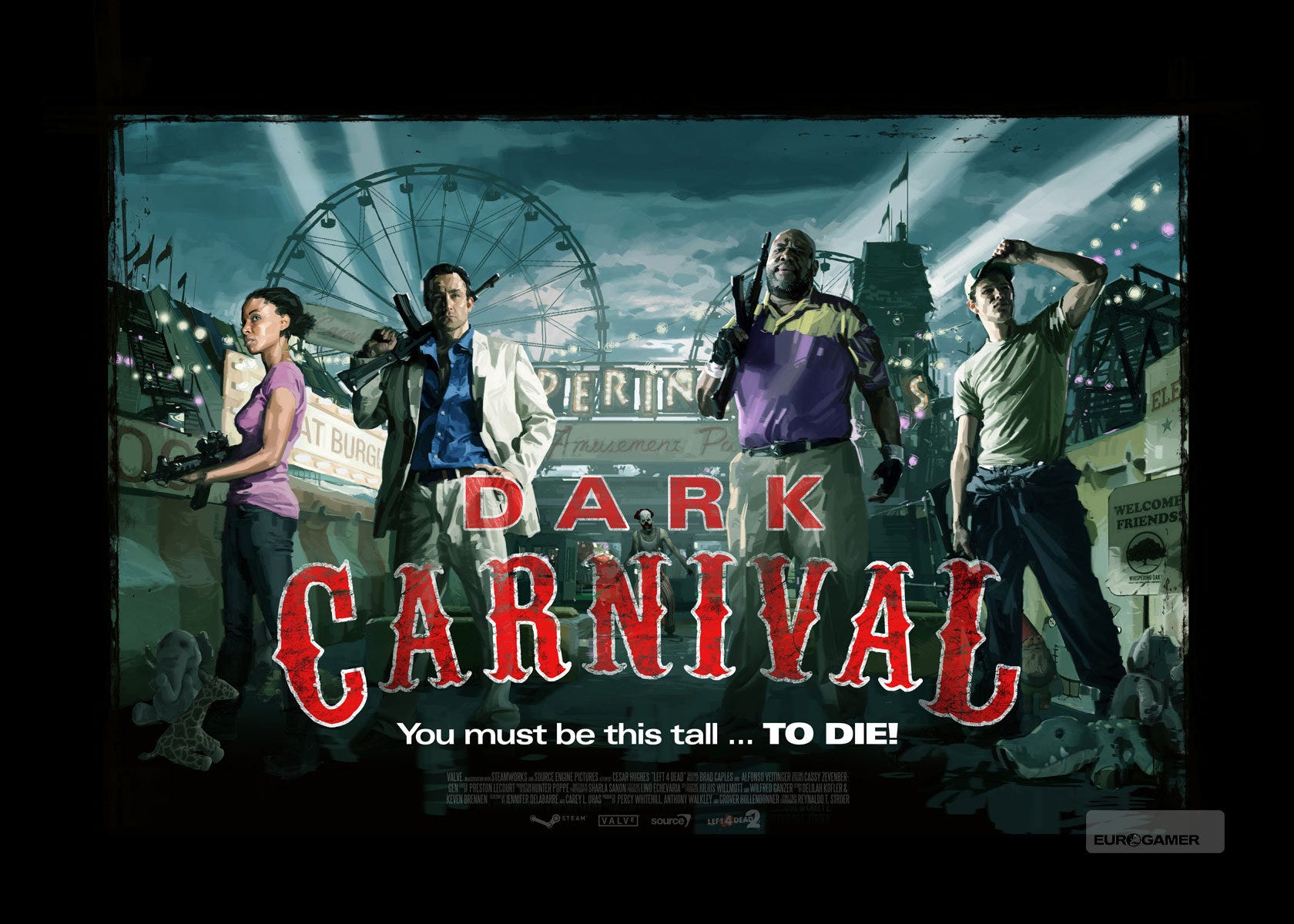
Melee weapon types differ from map to map, depending on the context. Axes are often found buried in trees in the swamp, for example, whereas you're more likely to pick up a night-stick in an urban location.
Left 4 Dead may have broken its levels up into grindhouse B-movies, and announced the arrival of its set-pieces with brilliantly heavy-handed orchestral swells and squawks, but deep down this wasn't a game that aspired to cinema as much as it did to the world of sports, as a well-balanced team activity with a grim understanding that real fun is as likely to come from restrictions as it is from freedom. And, after all, sports tend not behave nicely when there are sudden changes to the underlying rules. (I'm not counting Formula One, here.)
So Valve has been canny with its tinkering. As we play through sections of both the Swamp Fever and Dark Carnival campaigns (detailed by Tom in greater detail in his alternative hands-on), besides discovering that Faliszek is a master of the short-form morale booster - typical examples include, "Eugh, I don't think there's a lot of hope now," and "You guys really don't fill me with confidence," - we also encounter a game where the pace is as brisk and snappy as it ever was, but which is now also capable of springing delightfully horrible surprises on you at every turn, whether it's a new weapon to mess about with, or a fresh special infected giggling and moaning in the darkness, itching to do you harm.
And those specials are clearly the standout addition this time around. All three newcomers are distinct and gleefully terrifying, and all three add regular bursts of chaos to the endless waves of the horde, while fitting into the line-up so seamlessly they feel like they could have been there from day one. The Spitter, who lobs pools of bright green acidic gunk around the map, damaging anyone who strays into it, and the Charger, a lop-sided hulk who blasts through at regular intervals, grabbing a team member and then running off, before pounding them endlessly against the ground, have already been revealed, but we're getting a chance to see the third and final addition, the Jockey, for the very first time. Announcing himself with a sound that hovers uneasily between an asthmatic chuckle and a wretched, ragged-throated heaving, this saggy, balding creep wearing the remains of a shredded Die Hard vest leaps unexpectedly onto a player's head before steering them off into the distance or over a cliff, seemingly unpredictably.
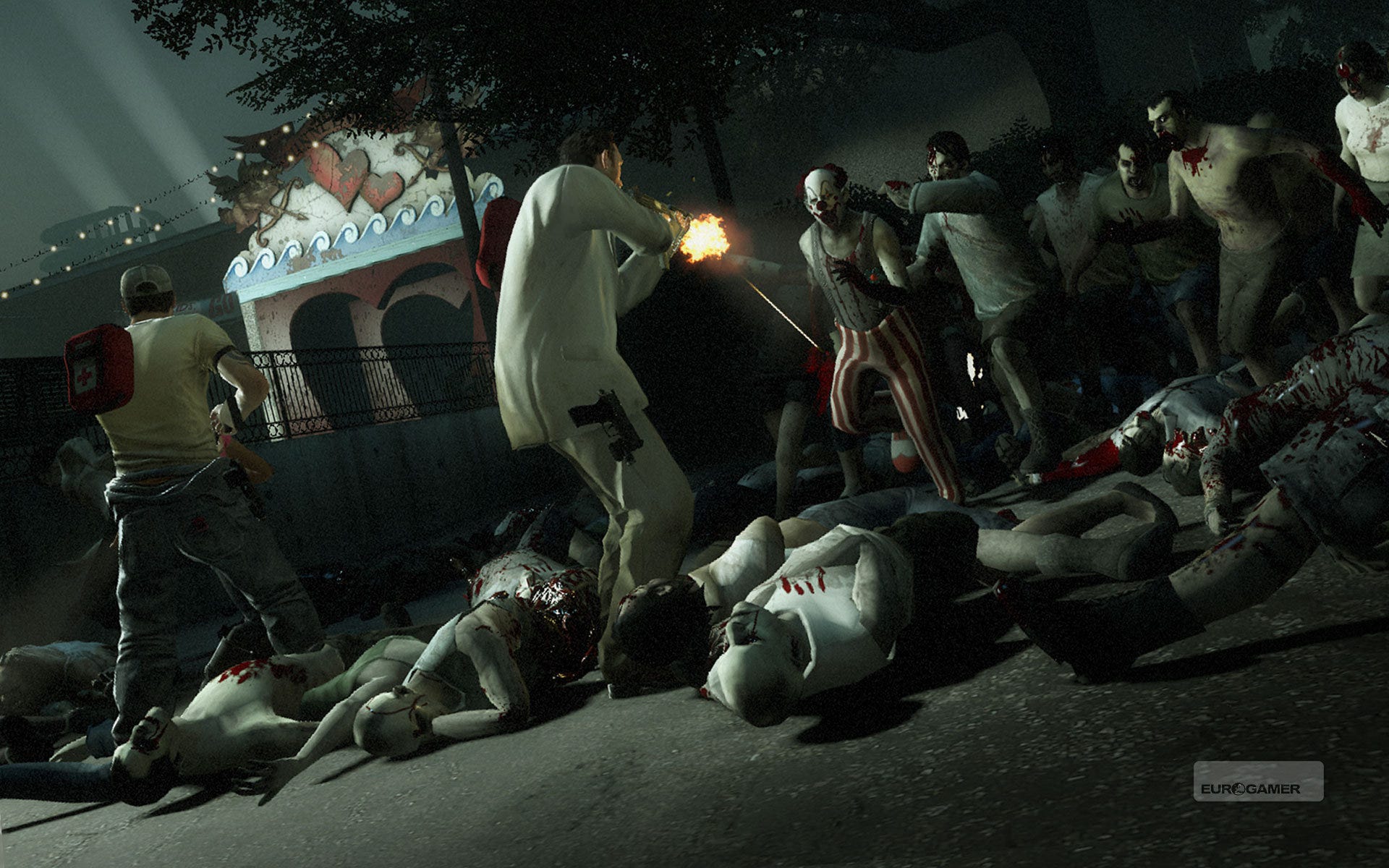
You haven't lived until you've seen a Charger attack - after which, with a pleasant synchronicity, you'll probably be dead. Grabbing you with one hand and then smacking you up and down against the floor, there's something unpleasantly toddlerish about Valve's latest addition.
Except it's probably not as unpredictable as it initially sounds. One of the more interesting underground tweaks to Left 4 Dead 2 is that the specials are now genuinely aware of each others' presences, much as you are in Versus mode, meaning they'll regularly combine their strategies for maximum destructive effect. And so the Jockey becomes the natural ally of the Spitter, waiting until there's a rich pool of toxic goo nearby before powering you helplessly into it. Or maybe he'll ride you out of your carefully chosen safe spot and right into a Tank. Or maybe a Tank will knock you down to allow a Spitter to cover you in acid, all the better to take out any team-mate who tries to revive you.
Valve is fairly open about the fact that one of the primary uses for the new specials is to close any remaining strategic loopholes players may have been exploiting - which is why the Spitter is such a powerful anti-camping weapon, and the Charger can bust up highly-organised teams who work too tightly together, pulling them apart, and running off with crucial members - and yet, in the interactions between them all, the development team's created something much more promising than an underhand balancing patch: they've built a far more tactical enemy, with a wealth of new malicious tag-team options open to them. Throw in tweaked behaviours for some of the existing specials - the Witch can now wander around daylight maps, becoming an even more disastrous presence, for example - and you've got something fresh and unpredictable at the heart of an otherwise pleasantly familiar experience.
And this time, the specials are joined by what Valve terms, with typical smirking neatness, "uncommon commons": distinct members of the horde who are a little bit more powerful than most of their flailing one-shot allies. Ranging from riot police officers, who are capable of getting back up after their first knockdown, to the squeaky-shoed clown who alerts the rest of the infected to your location if you leave him alive long enough, and the powerfully unpleasant feral hillbillies of the swamp who skitter about, bent double, and will temporarily blind you with gunk if you let them, they provide a second level of unpredictability to the game, each of them with their own buff - one might be fire-proof, perhaps, or resistant to bullets from a certain angle - waiting to be uncovered and catalogued by the Valve faithful.
The common horde remains, of course, with new damage modelling meaning you can separate heads from necks, lop off arms, donut them through the chest, or even - most satisfyingly - take their legs out as they race towards you, and the inclusion of melee weapons makes them a much more tantalising prospect than before. This more intimate take on combat brings with it a smart risk/reward dynamic all of its own: to use a melee weapon, you're going to have to let the horde get in close where they can cause real damage.
That in turn requires you to fundamentally alter your tactics from the first game, which was often an arms-out stagger to keep space between you and the enemy. On the plus side, however, melees are so comically rewarding to use, it's impossible to do so without giggling: often thin on the ground, and replacing the pistols when equipped, the melee options on offer range from the already iconic frying pan, fast on its way to rivalling Freeman's crowbar as the thinking FPS player's blunt instrument of choice, to axes, night-sticks, katanas, an electric guitar, and a mean cricket bat.

There's more of a narrative this time for those who want it, but breaking up the action with cut-scenes still appears to be against the rules, thankfully.
Sound effects, from the power-chord blast of the guitar to the Warner Brothers-styled hollow clang of the frying pan, double the satisfaction of doing someone a nasty injury, and, like the uncommon common you'll probably be battering with them, each melee has its own little secret quirk - axes, for example, are the only weapons which will allow you to fell a Witch from behind with one blow - another layer of secrets waiting to be uncovered and exploited. Add to that the changes made by the game's new day/night cycle, which sees the horde becoming more agitated whenever the sun's out, and an expanded traditional arsenal, swelled most brilliantly by the grenade launcher - deadly at a distance, absolutely disastrous up-close - and you start to get a picture of just how much even seasoned veterans are going to have to get ready to learn all over again on this outing.
There are other changes which are harder to gauge during a single afternoon's playthrough, of course, not least increased emphasis on story, which sees all the campaigns stitched together into one blood-soaked road trip across the South, and the fact that the AI director can now muddle specific parts of the level geometry around depending on how well you're playing, and call in weather effects like sudden summer storms that bring on the horde. But even if you're starting to tire of putting Francis and Zoey through their paces in the original game, Valve looks to be creating a sequel that balances continuity and complication in a very tempting manner.
In amongst the limb-lopping and the lucky headshots, the grand-slam calibre backchat, and the endless waiting around in closets (that's just me, generally), it isn't just the mechanics that are getting a refinement. Two games in, Left 4 Dead's visual identity is really starting to flourish: with its working class heroes, dungaree-clad infected, and endless bayous, Valve's sweaty thrill ride is emerging as a wonderful hick melodrama, detailed in everything from the high-school coaches and Fancy Dan conmen of its new character rosters to the white-trash detritus left behind in the wake of the apocalypse - the plastic lawn furniture sprawled around the streets of its cities, and the partially-destroyed clapboard motels and rusty pick-ups lolling in ditches.

Spitter goo suggests a promising line in Mountain Dew endorsements.
And there's a flexibility to it as well, its world capable of producing moments of eerie prettiness, as the evening light breaks through the grey mists of the swamp, picking out spectral stumps of trees and rotting spars of walkways, or throwing in bursts of over-hyped spectacle whenever the game ramps up for one of its final gauntlets, pitching you into a headlong race towards your escape vehicle, where bridges collapse and fighter jets flash past through the sky, filling the air with flame and smoke as the soundtrack rises to a ridiculous crescendo before lapsing back into creepy silence.
Crescendos and then silence: that was the heartbeat of the original Left 4 Dead, and it's the heartbeat for the sequel, too. With new tricks, new toys, and tweaks beneath the surface which Valve hopes you won't even notice, the murderous infected may have headed south for this outing, but there's no sign yet that they've started to go downhill.
Left 4 Dead 2 is due out for PC on 17th November via Steam, and at European retail for PC and Xbox 360 on 20th November.
You may also like...
-
Ultimate Marvel vs. Capcom 3 Vita Review
-
Sony admits "dropping the ball" with Demon's Souls
-
Grand Slam Tennis 2 Review
-
Skyrim patch 1.4 performance tip: make a new manual save
-
One Piece: Unlimited Cruise SP Review
-
App of the Day: Superman
-
Who Killed Rare?
-
Next Xbox has tablet-like touch-screen controller - rumour
-
Gotham City Impostors Review
-
Mass Effect 3 FemShep trailer debuts
-
Epic's Sweeney on graphics tech: "the limit really is in sight"
-
Valve admits hackers accessed Steam transaction log
-
CD Projekt: Witcher 2 intro cinematic "the most expensive asset we ever created"
-
Sony: The Last Guardian is making "slow progress"
-
Double Fine Adventure passes Day of the Tentacle budget
-
Blizzard legally opposes Valve's Dota trademark application
-
Skyrim patch 1.4 now live for Xbox 360
-
Kingdoms of Amalur: Reckoning Review
-
EA announces starry Syndicate voice cast
-
David Braben discusses consumer Raspberry Pi release
-
Sony confirms LittleBigPlanet Karting development
-
The Darkness 2 Review
-
Namco Bandai to publish new Star Trek title
-
Cheapest places to buy Kingdoms of Amalur: Reckoning
-
Amnesia: The Dark Descent follow-up teased


Comments (17) Latest comment 2 years ago
Comments threads automatically close after 30 days, but please feel free to continue chatting on the forum!
Comment below viewing threshold Show
The old ones are all there too!
Comment below viewing threshold Show
It'd be nice if they were somehow complementary rather than seperate games otherwise it'll fragment the community a bit. Ive just started making a survival map for L4D1, do I wait for 2? will it work on both? will 1 be 'dead' when 2 comes along?
It'd be nice to install 2 over the top of 1 - like an expansion. I'd like to play through the new L4D2 with the original cast, and it'd also be nice to play the original maps with the new characters and zombie specials. Im sure someone will mod this eventually, but i dont know how 'legal' it'd be.
Comment below viewing threshold Show
I'm thinking with all the exciting new special infected its going to be an even bigger nightmare of people playing the special infected side then leaving the game.
Comment below viewing threshold Show
...which is what made L4D1 so good.
Comment below viewing threshold Show
+1, despite the 'which is what made L4D1 good'. Versus hardly posed dynamic threats. I've played against all sorts of people, and even the best had a single strategy they constantly used. Some had a back-up strategy, but that's it. That is why Left 4 Dead 2 is so attractive. It promises that Versus is going to be unpredictable in the frames of the familiar.
Comment below viewing threshold Show