Katamari Forever Review

Infinite Circle?

Version tested: PlayStation 3

The field is empty. It is night. There are no paper clips, tin soldiers, scraps of sushi, teddy bears, bicycles or classical guitars to roll up here. Instead, a lone man sits at a bench, straining through the gloom to read a book.

Hills roll off into the distance around him, their shape and form suggested by ten thousand pinpricks of light: lantern fireflies bobbing in a silence unbroken by the flitting of their tiny, spastic wings. Your Katamari rocks in the breeze as YMCK strike up a mournful chiptune ballad. The wind sighs and the reeds bow their heads in sympathy. Then, just as you begin to feel lost in an absurdist joke, the King of all Cosmos pops into frame and, in his stoner/child patois, begins to explain.

One week earlier, when showing off how high he could jump, the king bumped his head on an asteroid, in doing so clouding his memories. It's in one of these half-rememberings (first seen in the second game, 'We love Katamari') that you find yourself now. "Look, someone studying having trouble reading..." the king says, pointing to the man on the bench.

"We can't remember, so he can't see," he ponders before exclaiming, "Metaphor!" at his unintentional cleverness. "Zip the lit crit..." he rebukes himself, next delivering the mission briefing: "Make glowing Katamari with fireflies. Help him = help us. Ah! The power of metaphors." The task established, you start rolling up the bright insects. Deliver the resulting ball of light to the reader within three minutes and he will be able to see and the King's memory will be restored. Metaphor!

The Katamari series is ripe with metaphor. From the almost impossible to please father figure (or is he a god?) of King of All Cosmos to the very act of rolling up humanity's detritus and firing it into space, the game's messages are manifold. But, in this celebration of the series to date (in Japan the game's known as 'Katamari Tribute'), you wonder if the original, clearest message has been broken forever.

You see, for all the silliness, Katamari Damacy was at heart a didactic condemnation of the developed world's rampant consumerism. Takahashi never wanted to make another Katamari game. Not only had his point been made elegantly by the first game, but also the core idea had been fully explored, its sequence of levels moving from rolling up the tiniest of objects in a Tokyo bedsit, to finally absorbing countries themselves in the bombastic endgame.
1

Fail and you'll trigger a minigame in which your disappointed father throws rocks at you.

So Katamari Forever, by virtue of its existence, is a conflicted product. It's a game that decries consumerism but which is itself riding a consumerist bandwagon alongside spin-off albums, hipster T-shirts and colourful merchandise, all of which clutter yet further the world it came, in its own kooky way, to save.

"Metaphor!" as the King of All Cosmos might shout before pointing out that the above paragraph is the same size as 46 antelopes and telling us to 'zip it with the lit crit'. And fair enough because, for a great many players, the mixed message is as invisible as it is irrelevant.

For these players, answers to questions such as: 'Does the game fix the camera issues of its Xbox 360 predecessor?' and 'How do the six-axis controls integrate with what was already a finely-balanced scheme?' are far more pressing. Moreover, it may be a little unfair to burden Katamari Forever's evidently conscientious creators with philosophical criticism. After all, taken as a raw product, their game is a fulsome celebration of what's gone before, and while it may not surpass its inspiration, it certainly throws a good party in its name.

The core stages are divided into two categories. Those issued by the amnesiac king are reimaginings of levels seen in previous titles, albeit presented under a good-looking black and white crayon filter. A new character, RoboKing, sets the other half of the game's challenges that, while reusing series assets and level layouts, are generally new.

Novelty is introduced by framing the game's basic collect 'em up challenge in different ways. In the original game, the goal was always related to size: grow your Katamari by 5 metres in two minutes, and so on. By contrast, in Forever, you'll often need to judge objects by a variety of other criteria.

One level asks you to create a ball of great value so you search the town for cash registers, diamond rings and expensive perfumes, ignoring the larger, everyday items that are only worth a few hundred Yen apiece. In another you're asked to grab as many animals as you can, raiding a zoo for new animal types. In yet another you must soak your Katamari with water and use it to paint life and greenery into a dusty desert bowl.

In other words, Namco changes the metaphor in order to broaden the scope and possibility of the design. Quite how significantly the metaphors have changed is illustrated by one later mission in which the king gives you 300 ,000 Yen to spend on picking up items. Everything in the level has an attached cash value and you can only 'roll up' as much as you can afford.

Of course, in design terms, it's just another way to limit player resources in order to frame a fresh collect 'em up challenge. But the bald consumerist target illustrates just how far from Takashai's initial message we've come.

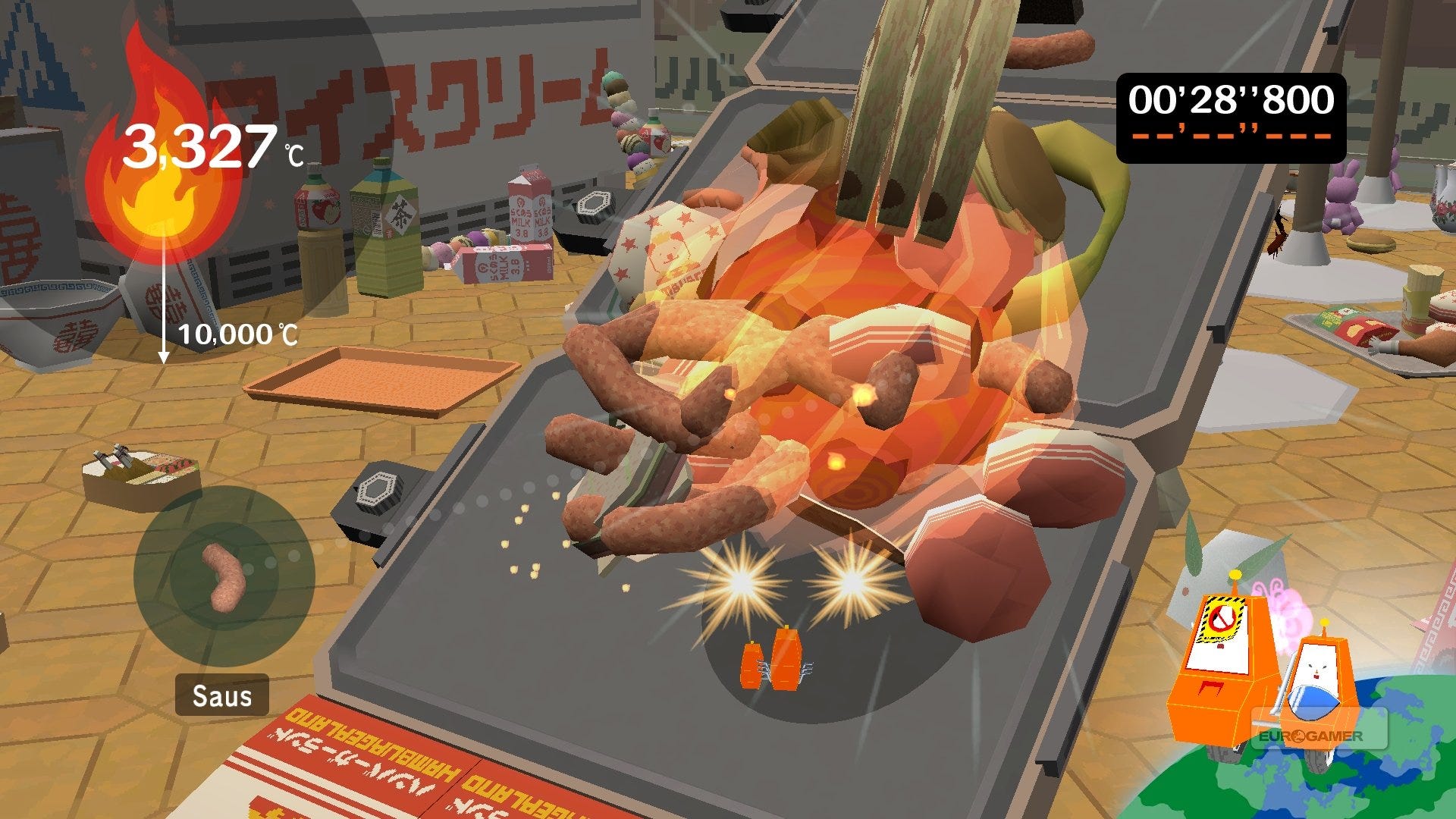
Interspersed with new approaches to the core idea are more traditional stages, which give you, say, eight minutes to grow your Katamari ball from 30 cm to 800,000 metres. It's here that the game settles into its most satisfying rhythm as you move from rolling up paper clips to mountains in a short space of time. Each level has a number of 'cousins' who must be found, as well as 'present' boxes which unlock cosmetic items with which to adorn your characters.

The only new ideas introduced are a jump move and a new pick-up that temporarily turns your Katamari into a magnet, attracting all right-sized items in the vicinity to stick to the ball. The jump is welcome, easing as it does the keen frustration of being stuck in-between objects too large to roll up. However, the flick-the-six-axis execution method is far too vague so most players will end up resorting to the precision of the R-trigger instead.

Beyond of the individual stages, Katamari Forever is a let down. The rotatable planet around which the game's various destinations were positioned in previous games is gone, options now selected from an awkward pop-up book interface that adds nothing to the hub experience.

2

A range of unlockable graphical filters give the game's simple textured objects a new lease of life. 1080p support and 60fps help.

That said, the integration of leaderboards is smart and seamless (moreso than in the previous Xbox 360 title) and turns each level into an arcade-style challenge between friends. Even so, the weary proposition of once again tracking down all of the Prince's cousins and filling in the blanks on the collection pages of all the world's objects offers nothing fans of the series haven't done before.

The only rewards for extended play and effort are to be found in the unlockable novelty play modes such as the double speed 'Katamari Drive' and the time-limit free 'Eternal Katamari'.

As ever, the game's at its best when it allows you to slip into the calming repetition of the cleaning act, the catharsis of de-cluttering the game's environments broken only but the jabbing warning siren that fires for the final 30 seconds of each stage's time limit. In these moments the wonder and creativity of the first game still shines bright.

But elsewhere, the game's Japanese title is more applicable than its Western one: this is a tribute to Namco's game of the decade, a Greatest Hits compilation that, in pulling random stages and ideas from across the series lacks the coherency and streamlined form of its inspiration.

Its value for money is significant: there is a lot of bulk here, much of it excellent. But its wider value to gaming, to Takahashi's message and to the series it celebrates, is diminished. Like a balloon deflating, Katamari Forever feels like the series' final exhale, all puff and energy now gone from the idea. Metaphor!

7 / 10

Read the Eurogamer.net scoring policy

Comments (73)

Comments for this article are now closed, but please feel free to continue chatting on the forum!

  • Loading...hold tight!