Brian Fargo. It sounds like the name of an Old West gold prospector. It's true that this veteran of the 1980s California development scene - founder of Interplay, and so publisher of the Fallout games - doesn't really look that part, preppy and trim in his Orange County casual-smart-casual. But he can't resist opening his unveiling of his studio's latest game by schooling us kids in a potted history of the great gaming gold rush.
Hunted: The Demon's Forge is the new game from inXile, the studio Fargo founded with other refugees from Interplay's sinking ship, in part to revisit its glory days - its first project was to remake his classic role-playing game, The Bard's Tale. Hunted is being published by current Fallout stewards Bethesda Softworks and is, in Fargo's words, "bringing the classic dungeon crawl back".
This genre, Fargo tells us, has its roots in Dungeons & Dragons and the earliest days of computer programming. He namechecks Lord British (doesn't even think to call him Richard Garriott), Wizadry (which he personally became addicted to in the early eighties), Bard's Tale, Ultima, Might & Magic and Dungeon Master. He sprints into the nineties and notes a trend towards action in Ultima Underworld, the first Elder Scrolls game, Hexen and Heretic.
It's all useful context, if only because the game Fargo and his colleagues Matt Findley (president) and Maxx Kaufman (game director) proceed to show us bears little surface resemblance to any of the above. It's a muscular third-person action game designed around two-player co-op play, with brutal melee combat, ranged shooting through a tight over-the-shoulder camera, a clean display, scripted set-pieces and a cover system. Apart from some fairly standard dark-fantasy trappings, it looks like a lot of games Fargo doesn't mention: Uncharted, Gears of War and Army of Two spring to mind.
It's not as much of a non sequitur as you might think. As Fargo's already said, the dungeon crawl - a genre he thinks of as distinct from the role-playing game, although the two often join hands - has been on a crawl of its own towards action gaming for its entire existence. And the action game is the current home of co-operative play, which, Findley expounds later, was part of the dungeon-delving experience in its earliest days, and a part inXile is keen to resurrect.
"The origins of the genre do come from D&D, and D&D was a co-op gameplay experience, right?" Findley argues. "It was me and my mates sitting on the couch, against the DM [Dungeon Master], and we were collectively deciding how we were going to go and do things. So it seems like a very natural fit for us."
It's absolutely the essence rather than the details of the old-school dungeon crawl that inXile is going for, however. Although there's a little light character progression invovled, you won't ever be concerned with stats or dice-rolls, and you won't be rolling your own spin on either of the heroes - curvaceous, bloodthirsty elf archer Elara or Caddoc, a calculating, scarred lump of muscle and testosterone behind a shield.
"I think if you spend the first 20 minutes of gameplay rolling up your character it's going to be a little hard to feel like an action game," says Findley. "And plus we really believe in character development and characters with strong personalities, so they almost had to be our characters to begin with."
The pair banter crudely in rough British accents in the placeholder voice-over as they enter the town of Dyfed, sent on a mission there by a mysterious spirit called Seraphine - which is about as much of the plot as inXile is prepared to reveal at the moment. The scene, rendered in the familiar moody sheen of the Unreal engine, is reminiscent of Dragon Age - a deserted medieval village under lowering skies, and a crazed grey-skinned orc ripping out some poor soul's heart. "That's no bloody good," observes Caddoc, sounding oddly like Bob Hoskins.
"We are creating a dark and gritty world, that's kind of the underlying theme," says Kaufman. "And it just gets darker and darker as you progress through," adds Findley. "Both from a story point of view and from an environment point of view... It kind of goes from messed up to really messed up."
It's foreboding, atmospheric, detailed, although the art and production design isn't going to win any prizes for originality - from the way the leather straps, scabbards and pouches of Elara's skimpy costume frame her pert backside to the crunchy sport-metal soundtrack, from the long fangs of the slavering orcs to the claustrophobic fog of the depth-of-field effects.
There is, however, an agreeably blunt, no-nonsense air to proceedings - cut-scenes are more like cut-aways, ruthlessly efficient in their exposition and hard-bitten one-liners - as if nothing should spend too long delaying the slaughter. And there's a pleasing mixture of novelty and nostalgia in seeing this absolutely straight fantasy portrayed in a style more commonly applied to concrete, railguns and butch militarism.
Fargo admits that they're not looking to rewrite the fantasy rulebook, stylistically. "The beautiful part about fantasy, traditional fantasy, is that you look at an orc and you kind of know what it does, and if a dragon comes flying over head you kind of know what it does, there's a certain sense of these things from all these years... there's a language, I guess."
Why aren't there more fantasy action games like this? "That's a very good question," Fargo says. "Early on when we very first started this project, we know Mark Rein over at Epic pretty well, and he was like, 'I don't know why everybody else isn't doing more of these.' The thing about fantasy is, it's not small, it's not a niche, right? World of Warcraft has done OK. It's one of the tent-poles." He shrugs. "I think these things just sort of come and go."
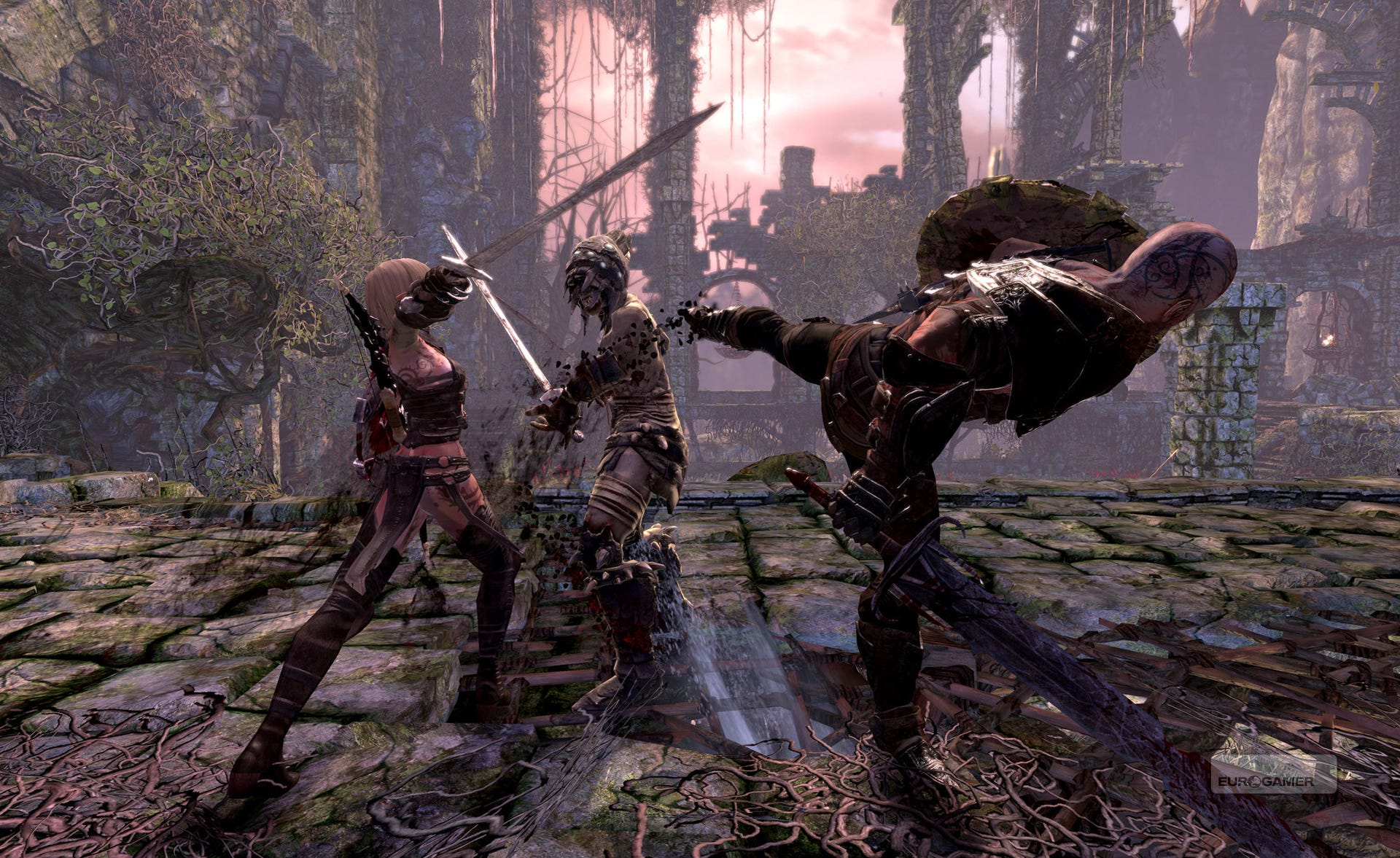
Back to the action, and we're in a cavernous barn, battling waves of orcs, with Findley and Kaufman manning the two characters. Elara snipes with her bow in almost-first-person from cover or a balcony, snapping instantly to her sights when taking refuge behind a wall. Caddoc wades into the fray, tossing shields that degrade with every hit to pick up a new one from a fallen foe.
The enemies are designed to force the two to work as a team, playing to their strengths as melee and ranged specialists. inXile is keen to point out that the game enables what it calls "co-op at a distance", allowing the characters to fight together from opposite corners of the map and avoiding mechanics that force them to be in the same place. If one falls in battle, the other doesn't have to schlep over to perform battlefield CPR - you can just aim at your companion and toss over a regenerative vial pick-up.
The same's true of the spells the pair learn; both get access to magic as the game progresses, trading crystals they find with Seraphine for new abilities at checkpoints. Caddoc learns a levitation spell that elevates enemies to make a clear target for Elara across the room, and there's a "battle charge" system of temporary buffs that can be fired at your team-mate to power them up for a difficult scrap.
"We didn't want people to feel tethered," says Fargo. "It's fun to open up the environment to use strategically." Although they're shy of coming out and saying it, this is one area where the inXile team clearly feels it's been able to improve on the prevalent mechanics in co-op action gaming.
"We've played them all extensively," says Findley of their rivals, picking his words. "What we found was a lot of weaknesses that we designed around. I'd hate to call out another product, but I think if you look at the things that we've done with the co-op design, it'll be pretty obvious which ones we didn't like." And the affable big man roars with laughter.
"The other big idea that makes our co-op different is the fact that our characters are not carbon copies of each other," he points out. "We've ended up with this idea of switching at checkpoints; no one has really done that before because the characters are exactly the same. You don't have to switch."
This is where the way Hunted straddles the character action game and the co-op RPG makes things a little sticky. Playing through the campaign in single-player or co-op, you'll be able to switch between the characters at will to enjoy both perspectives on the admirably meaty combat. But you, as a single player, will "own" both characters and be able to make talent-tree purchasing skills for both, with all crystals shared between both. It's a different situation either to being able to step into the cloned boots of an identikit future warrior, or to bringing your own individually nurtured RPG characters together to fight alongside each other.
InXile's solution is fair, if not that easy to explain. An elaborate match-making system ("we've been researching dating sites") will bring players with sutiable play-styles, a preference for a particular character, or a game save at around the same spot together. Joining a host's game, you'll either be able to bring your own character in or use theirs. In the former situation, you make your own advancement choices but the host earns an equivalent pool of crystals to spend later; in the latter, the host makes the choices for you, and you get crystals to take home to your own game. Co-op is jump-in, jump-out, and available both online and locally.
Back in the fray, Elara and Caddoc ("there's a bit of sexual tension, but also a little sister, big brother thing") are pinned down by a catapult in an open clearing, a giant viaduct towering over them and framing a misty mountain vista - just because it's a dungeon crawl, it doesn't have to be dank. Vocal cues bounce back and forth letting you know what your partner is up to - handy if you don't have voice chat - and visual cues help figure out a solution to the situation, a stray catapult missile shaking a scaffolded statue to indicate that it's unstable.
Caddoc pushes it over and into the viaduct, spectacularly toppling the whole edifice on top of the catapulter. It's only one way past this area, though, we're told. "We've set this up so there are multiple ways to play it," says Fargo. "That's very RPG-ish, right? But it has nothing to do with statistics. We're trying to pull the things that give a sense of depth."
Paramount among those things are loot, secrets, riddles and exploration, and despite the blockbusting action focus of this demo, we're reassured that these are all high priorities for the Hunted team. There'll be a good deal to discover beyond a straight run through the main story, from lore - a "death stone" lets you hear the histories of corpses, filling in a 500-year saga - to puzzles. The latter will be 40 per cent easy, 40 per cent challenging and 20 per cent "very, very difficult", with naturally some tasty weapons and gold ot be had for your perserverance.
Just like they used to make. Hunted's a gold rush as old as them thar hills, then, even though it presents itself as the model of a modern major videogame, complete with blood-smear health guage, crunching cut-away execution moves and pithy script. Although its title and look locate it firmly in the musty dungeon of fantasy, its brisk action and smart co-op mechanics could genuinely find a new audience for the oldest game in the book. There's something tremendously comforting about that.
"It's the genre that created the industry," Findley sums up. "In the beginning, these were the only games that existed."
Hunted: The Demon's Forge will be released for PC, Xbox 360 and PS3 in 2010.
