Version tested: Xbox 360
Let's cut the crap. Cut the platform advocacy, cut the ranting of Internet storm-troopers on behalf of multinational corporations who don't care if they live or die. Cut the agonised wailing and gnashing of teeth over whether something is "game of the year" or just "really good".
Let's cut the crap, and talk about Halo 3, the videogame - not Halo 3, the monumental "event". Let's talk about the next instalment in one of the most likeable and well-crafted science fiction shooter series ever created - the third part of a trilogy which, despite its occasional wrong steps, has held our attention for six years. Let's talk about that.
Evolved Again
Halo 3 picks up exactly where we left off at the end of Halo 2's abruptly terminated narrative. Returning to Earth to "finish the fight", the Master Chief dives through the atmosphere and makes a right mess of a nice stretch of jungle - and it's there that we pick up the controls, only minutes after the end of the previous game.
It's not just the story which continues directly from Halo 2, either. Pretty much the entire single-player game is a direct continuation of the winning formula we saw in the Master Chief's second outing. Bungie clearly thinks it perfected the much-vaunted "thirty seconds of fun" in the previous game - so why change the formula radically now?
We'd struggle to come up with any grounds for disagreement. If Halo 2 had flaws - which it certainly did - then they weren't with the basic heart of the game. The fundamentals of run-and-gun gameplay, pure and unadulterated, were close to perfect in Halo 2. The problems came instead from the context in which those gaming moments sat; the truncated storyline, the unsteady pacing, the graphics engine that pushed a little too hard at the Xbox hardware.
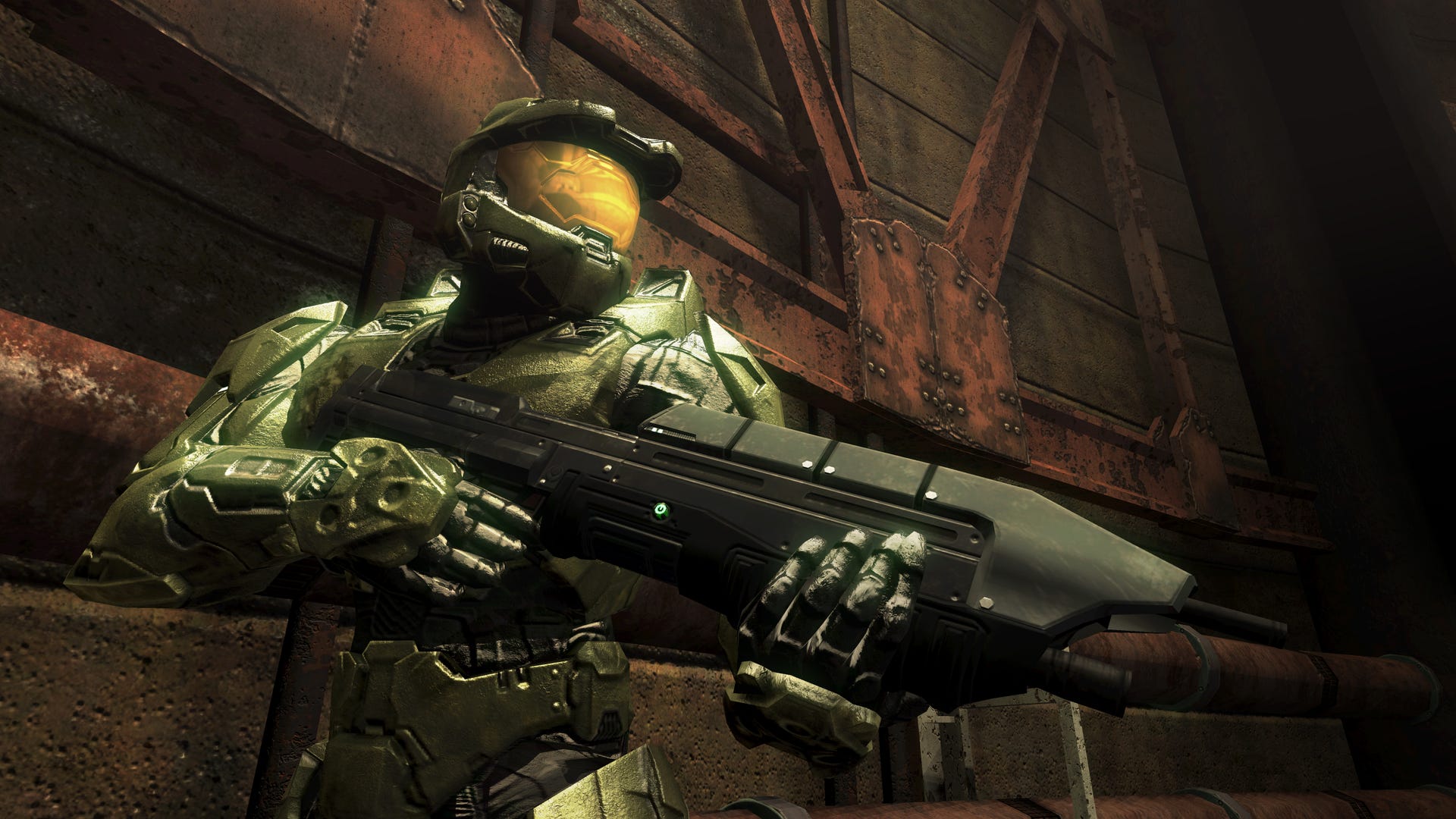
Back on Earth, hard as nails and ready to finish the fight - the Master Chief is basically an interstellar Begbie in green fibreglass pants.
Halo 3, then, will be an instantly recognisable experience to any veteran of the previous Halo campaigns. From the lovely piece of design at the outset where the game determines your look-inversion preference in-game (a staple since the original Halo, and still no less wonderful for it) through to the physics of the world and the majority of the weapon arsenal, almost everything is familiar.
Even the biggest set-pieces have a homely feel to them. The highlights of the game's encounters include taking down the massive, four-legged Scarab tanks by boarding them and wiping out their crew, and frantic battles against Gravity Hammer wielding Brute leaders, both of which are lifted directly from Halo 2 - but are no less dramatic and enjoyable for it.
None of which is to suggest that Halo has stagnated, by any means. In spite of the overall familiarity, there are new touches and tweaks in evidence at every turn. Minute alterations to the weapons balance are obvious from early in the game, including the reintroduction of the first game's assault rifle - and a vital rebalancing to ensure that dual-wielding isn't the ultimate solution to any combat situation any more.
The most obvious change is the addition of Equipment - a class of item which is held independently of other gear (you can only hold one piece of equipment at a time). Equipment can be dropped at any point to create an area effect, and essentially creates new options for you in any given encounter. With a portable Gravity Lift, for example, you could create a bounce pad to hop onto a higher area; or you could erect a Bubble Shield and pop out from it to snipe at foes, sitting inside to regenerate your own armour.
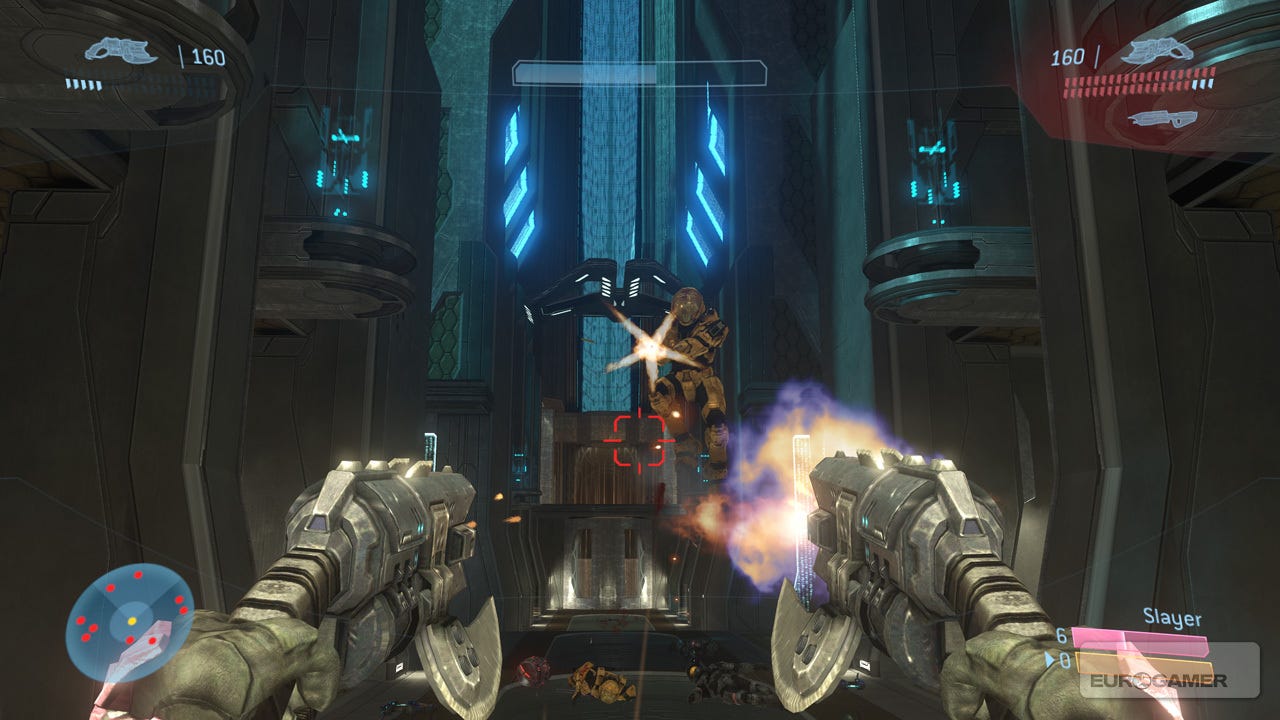
Dual-wielding is still handy, but some carefully considered weapons balancing means that it's no longer necessarily the tactic of choice.
These new items spice things up in the campaign, certainly, but it's a fairly modest change to the single-player gameplay. Their true role in the campaign is simply to introduce you to the various equipment items, which go on to serve a vastly more important role in multiplayer matches.
More important for the single-player game, arguably, is the ability to rip rocket launchers and chainguns off gun emplacements and carry them around with you. This pops the camera back into a third person view and slows down your movement speed, but turns you into a devastating walking death-machine - one of our favourite types of machine, we might add. Superb for clearing areas fast or taking down vehicles, it's an option which adds to the slightly more tactical, considered approach that Halo 3 quietly encourages.
Destination Earth
So far, so good; you could, if you were trying to review this game in a 200 word box in a newspaper, probably reduce the last section to "more of the same, but with some well considered tweaks which we like a lot". On the strength of Halo 2, that alone should guarantee a copy in the hands of every first-person shooter fan on the planet.
However, that doesn't really touch on the real meat of why Halo 3 is a better game than its predecessor. Like we said earlier, Halo 2's failings weren't in its fundamentals - they lay, rather, in the context. So while Halo 3 certainly tweaks, polishes and buffs up the fundamentals, where it really sets itself apart is in that all-important context.
The narrative, for example, flows through the game smoothly and efficiently, delivering revelations with practised grace. The player is pushed from encounter to encounter with a clear view of what you're doing, why you're doing it and how you should go about it. At its best, the game's superb use of marine chatter, radio communications and scripted events give you the genuine sense of being a key player in a much wider war effort. Even at its weakest, when it falls back on traditional cutscenes, Halo 3 is rarely short of dramatic.
In the interests of a spoilter-free review, we're not going to discuss the plot - but it's worth mentioning that one story aspect doesn't survive the gap between Halo 2 and Halo 3. The Arbiter, the second playable character in Halo 2, sees his storyline all but eliminated from the final game in the trilogy. He is reduced to the role of an AI-controlled NPC, fighting alongside you on several missions - while the personality clash between the Arbiter and the Master Chief, built up so well in Halo 2, is reduced to one pointlessly brief scene. Playing as the Arbiter was an unpopular decision in Halo 2, perhaps because the "noble enemy" role sullied the straightforward, gung-ho nature of the rest of the narrative; but it still jars a little to see an interesting storyline fizzle out like this. Only a little, though.
Ripping gun emplacements off and wandering around firing them from the hip is one of the most satisfying things we've ever done in a videogame.
Voiceovers, a key part of delivering the narrative experience, are universally superb - and occasionally laugh out loud funny, with your fellow marines delivering plenty of lines that are heavily influenced by online gaming culture. The music, too, is downright excellent, and perhaps even more bombastic and energetic than the game's previous symphonic scores. The distinctive Halo themes are woven throughout the most epic combat sequences, setting our spines - and subwoofers - tingling with anticipation throughout.
Graphically, however, the game is impressive only in a muted sense. Here, too, comparisons with Halo 2 will be made, and justifiably so - Halo 3 feels very much like an improved version of the Halo 2 engine, not a cutting edge next-generation visual feast. The primary technical improvements are not graphical enhancements - although higher definition textures, lovely sky animations and lengthy vistas can combine to form impressive scenes in places.
Instead, the focus appears to have been on making sure everything runs smoothly throughout - taking the Halo 2 engine, which regularly pushed against the constraints of the Xbox hardware, and giving it room to breathe on the vastly superior Xbox 360 platform. Texture pop-in is a thing of the past, spotted only a handful of times in our play through the campaign. The framerate, both online and offline, is so smooth and steady you could rest your pint on it.
Improvements to enemy AI aren't as notable as improvements to your squadmates' intelligence - they're now much more fun to fight alongside.
We sense the influence of multiplayer - with its requirement for consistent framerate and a level playing field - in many of the graphical decisions Bungie has made. It's not that the game is ugly - well, aside from the human faces perhaps, which look flat and unnatural and are the most obvious relics of the last generation here. For the most part, though, the art direction is superb, with a huge range of different visually unique levels and environments to fight through.
It's just that, compared to games like last year's Gears of War, Halo 3 is an underachiever in graphical terms - but to our minds, any negative here is easily cancelled out by the joy of high framerates, no loading delays and an almost complete lack of any graphical glitches. It may not be gold, but it's the most perfectly polished silver we've seen.
Third Rock
Speaking of polish, much has been made of Halo 3's testing process - a hugely advanced foray into the science of entertainment, which analysed mountains of data on player behaviour and allowed the developers to tweak and streamline their levels on that basis. Okay, so the idea of a giant focus-testing lab is about as far from the romantic ideal of the visionary genius as you can get - but there's no denying that it works, and it works damned well.
Early levels in Halo 3 - right through the first two thirds of the game, in fact - are among the most perfectly designed, streamlined and considered first person shooter levels you will ever play. Each level provides the illusion of choice and of a vast, navigable play-area, while carefully funnelling you through set-piece after set-piece using subtle cues and clever design tricks.
New additions to the vehicle line-up do not, sadly, include m0t0rb1k3s - will a slightly mental two-man dune buggy do instead?
Each encounter is balanced to provide a challenge without becoming frustrating, and we never managed to get lost or stuck - a sentiment mostly echoed by everyone else we know who's had their hands on the game. It manages to straddle the tricky middle ground between being too easy and being frustrating, providing a challenge without inducing controller-hurling rage. The Heroic and Legendary difficulty modes remain nicely balanced for players at higher skill levels, with arguably the best experience to be found on Heroic, thanks to somewhat more intelligent enemy AI.
There is a caveat to all of this praise, however. Simply, the game falls into the same trap that both of its predecessors have done - it doesn't feel entirely finished, with the incredible polish of the early levels fading to a more lacklustre shine as you approach the end of the game.
This was something of a showstopper before - literally, in the case of Halo 2, which simply felt like later levels had been chopped out entirely, and more figuratively in Halo 1's case, with the team opting for the much-derided backtracking levels to pad out the game. Thankfully, it's by no means as bad this time around. Bungie is now certainly better at finishing games, but it is also better at not finishing them.
True, Halo 3's later levels aren't up to the standard of early levels, with frustrating map design and unfair checkpointing becoming more common as you get past five or six hours of play (the full game clocks in at around eight hours on Normal difficulty). Never once, though, does it ask you to backtrack significantly, and the whole thing comes to an ultimately satisfying and enjoyable conclusion.
The Spartan Laser is huge, clumsy, takes ages to fire - and is bloody brilliant for one-shot kills, if you've got the requisite skillz (or luck).
The incredible attention to detail and response to player feedback also carries over into the game's multiplayer aspect. Whereas Halo 2 was accused of focusing on multiplayer to the detriment of the single-player experience (let's not forget that a huge number of Halo 2 players never took the game online, and the same may well hold true for Halo 3), this third instalment finds a perfect balance. The singleplayer campaign is full and satisfying; and nobody who plays online is likely to come away feeling short-changed.
Whereas some publishers use beta tests as promotional tools, our gut feeling is that Halo 3's multiplayer beta earlier this year was an exercise in large-scale data gathering - and that data has been put to good use. Each multiplayer map in Halo 3, each weapon and each game mode has been tweaked and polished, its rough edges sanded down so that the carnage flows with a balletic grace that improves on Halo 2 in every way that counts.
This Is Spartaaaaaaaans
A huge range of game modes are provided by the almost infinitely configurable match settings, and old favourites like Capture the Flag and Oddball can be refined to your exact specifications easily. Want the ball carrier in Oddball to move faster than the other players? No problem. Want everyone armed with Spartan Lasers (a new weapon that kills in one shot but takes a few seconds to fire)? Go for it. Low gravity deathmatch with melee weapons only? Be my guest.
Being able to configure Halo multiplayer games is nothing new, of course, but Halo 3 takes this to new levels. The ultimate example is the Forge, an unusual sandbox mode which allows players to collaboratively edit the configuration of the level in real-time - even while games are being played. Items can be added, removed or moved around, and the resulting configurations saved and uploaded to the personal space provided for each player on Bungie's servers - space which can also be used to upload clips of your favourite moments from the game, complete with your own camera angles and editing, if you so desire. We're looking forward to YouTube being inundated with videos of ludicrous Halo physics experiments; just another feather in the cap of the Halo phenomenon.
The real triumph of Halo 3's online modes, though, lies not in the huge range of modes and options - wonderful though they are. Rather, it's in the painstaking work which has gone into perfecting the online game, integrating new ideas like Equipment - which is especially interesting in team games like Capture the Flag - into the much-loved gameplay without breaking the delicate balance that makes Halo multiplayer fun.
Some of the multiplayer maps will be familiar to existing fans of Halo's online carnage offering - but there are plenty of new arenas available as well.
For what it is, it's hard to find fault with Halo's online play. It doesn't set out to be all things to all men, but what it does set out to do - namely, to provide an extremely fast-paced online FPS with a huge range of different match options - it does flawlessly. What more can you ask from a game? Players who enjoyed Halo 2 online will flock to the sequel, and rightly so. It's more of the same, but bigger, better and bolder.
Stepping back and looking at the game as a whole, it's clear that Halo 3 is exactly what Bungie would want it to be - the best game in the Halo series to date. We have criticisms, certainly - the slightly rough edges on some of the later levels being the outstanding complaint - but none major enough to detract from what is the finest game in one of the world's best-loved franchises.
If we are to nitpick, though, we do hit upon a useful caveat for some players. Simply put, Halo 3 is a completely pure first person shooter, with no pretensions to any other gameplay style. There are no puzzles to be solved, no character or weapon upgrades to be considered, and aside from a few notable sections, remarkably few vehicles to be driven around.
Did we mention that the laser is good at blowing things up? Don't sob about the Warthog, worry more about the hole he just drilled in your skull.
You shoot bad guys, and that's it. If that's all you want to do, Halo 3 is perfect, or as near to damned perfect as this kind of game is going to get. For those who preferred the more cerebral moments of the likes of Half-Life 2 or Bioshock, though... Well, caveat emptor.
There is a moment late in the game, when the Master Chief wryly states that his escape plan from a tough spot is to "shoot my way out - just for a change", when the irony may cut a little close to the bone for some players. But just as you wouldn't criticise football for being too focused on kicking a ball, it's not valid to complain that Halo is too focused on shooting aliens. Nonetheless, we're aware that this game might not be everyone's cup of tea, despite the immense hype machine surrounding it.
And yet, hype machine aside, cutting through the crap about console wars and the like, what we find in Halo 3 is quite simply this - the best game yet in one of the best FPS franchises of the era. Better than either of its predecessors, Halo 3 still can't quite escape the category of flawed masterpiece - but this time around, the flaws are so minor that even the most churlish of reviewers would be hard pressed to mark the game down.
10 / 10
