Guitar Hero 5
Rocking all over again.

My favourite moment in Guitar Hero: World Tour - just ahead of the evening I finally conquered Joe Satriani with unholy backwards-run fretboard skills that I have never been able to summon again - was when Jimi Hendrix suddenly appeared on stage and tapped my painstakingly created avatar on the shoulder after an exemplary performance of The Wind Cries Mary. Naturally, she freaked out, jumped up and down a bit and ran backwards off the stage.
Five years ago, I could not have imagined a digital Jimi Hendrix appearing in a rhythm-action videogame. For me, the endorsement of real-life artists (even ones who aren't dead, like Paul, Ringo, Slash and Matt Bellamy) cements Guitar Hero and Rock Band as a legitimate way of enjoying music in the eyes of the wider world, as well as in my own.
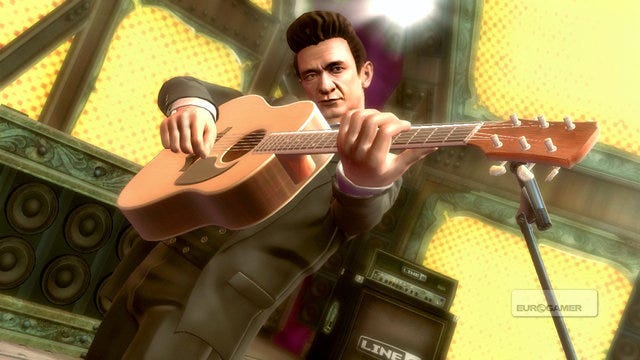
Guitar Hero 5's celebrity appearances aren't quite as thrilling - Kurt Cobain, Bellamy and Johnny Cash are fine and all, but they're not Hendrix - but in every other respect the game takes significant steps forward. It would be easy at this point for Neversoft to release glorified song packs ad infinitum, but instead the developer is continuing to show respect to Guitar Hero followers by broadening and polishing the series without overcomplicating or changing it.
Immediately noticeable is the toned-down visual style. Guitar Hero 5 is not as bright, loud and shiny as World Tour and its predecessors. The performance animations have just a little bit of grain to them and the colour palette is calmer. Characters no longer look like they're coated in Vaseline, the lighting effects are better, the rockers' character design and animation remain exemplary: they still own the stage with guitar-smashingly vibrant, energetic performances. Guitar Hero's art style has come across as self-consciously extreme in the past, but that criticism no longer applies.
Party Play multiplayer, the biggest new gameplay addition, is a revolution. Put the disc in, and within about twenty seconds the game starts playing random songs. You can join in with any instrument, whenever you like, with one button press: no menus, no arguing over songs, no having to back out in order to change the difficulty. The game can act as a jukebox whilst you're sitting around talking, or painting your living room, until You Give Love a Bad Name pops up and you bellow for five minutes. Such frictionless fun makes Rock Band's nightmare signing in and out seem archaic.
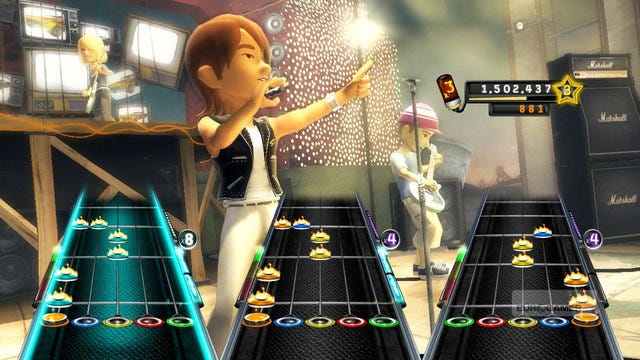
There are other multiplayer modes, too, a wealth of them, mostly geared towards having between four and eight players competing online. All songs are unlocked from the start, whether in quick-play or competitive multiplayer, and you can play them in an impossible variety of ways. Momentum ups the difficulty every time you hit a section perfectly; Elimination kills the lowest-scoring player on any particular section; Streakers is all about maintaining your cool as your streak counter climbs steadily higher. Setlists can include multiple different modes, and you can change everything from the lobby without having to quit out and start again.
Guitar Hero 5 also remembers all of your settings - difficulty, band line-up, right- or left-handedness - in single and multiplayer, which makes picking it up for a few quick songs less fiddly. Once you've picked your line-up, it stays that way until you change it again, so you never find yourself looking at Johnny Napalm's ugly face instead of your own custom-created singer in Career mode. If you play regularly with the same people you barely have to spend any time in menus, ever. You're only ever about four button presses away from a song.
The character creation and customisation tools are still brilliant. You can adjust every tiny detail of your rock star and all their various instruments, even replicate the custom pickups and Floyd-Rose tremolo on your own real-life guitar. It's a little heartbreaking that the faintly ridiculous Gibson-Activision lawsuit will prevent the iconic manufacturer from ever backing a Guitar Hero game again, but you can create an identical replica with a different brand on the headstock.
The single-player career has undergone a bit of a makeover. It's now unified across all instruments and across band and solo play. The tier system is familiar, but new venues unlock at a much faster pace; there are always at least ten or twenty songs to work on, so it's no longer possible to get stuck on one. It also doesn't suffer from the endless repetition that has always plagued Rock Band's World Tour mode, especially in the early stages.
Challenges add a new spin to songs in Career. Over and above the usual five-star rating system, there is an instrument-specific challenge for each that usually highlights a particular feature of the song. Guitar challenges might require you to tap all the solos, or use alternate strumming all the way through, or simply maintain a long streak. Vocalists might have to nail certain sections perfectly, or score as much as possible when in star power, and drummers might have to hit a certain percentage of kicks or perfect key drum rolls. You're rewarded with Gold, Platinum or Diamond depending on how well you do, bringing the possible stars to be gained from a song up from 5 to 8.