Gears of War Review

Fenix the fight!

Version tested: PC

Billed by its creator as a game that would "place gamers directly in the shadows of a ravaged world, surrounded by the beautiful remnants of a destroyed city and the horrific dangers that hide in the rubble", Gears of War is designed to be a crowd-pleasing blockbuster. From the chainsaw bayonet to the exploding crossbow bolts, from the giant spider clawing at your helicopter to the elusive, sibilant stirrings of cloaked monsters buried deep below the earth in an ocean of golden death. It's an almost ceaseless chain of brutal skirmishes and firefights fought by tank-like muscle men who eat gravel for breakfast and sound as though they chew on wasps when they polish their armour, which isn't very often, because they're too busy washing their hands in blood. But despite its ludicrous, comical violence, its likeably primitive caveman cast and its brilliant graphics, the reasons it works are almost entirely distinct from the qualities of the action films to which its impact is often compared.

The story is so basic that it would barely cover a pamphlet, let alone a screenplay: the world is at the mercy of ground-dwelling Locust warriors, and you have to stop them. So they come out of the ground, and you kill them, which gets you closer to your objective. That's it. The triumph here is understatement, rather than execution: dialogue sequences and cut-scenes are cheesy and largely installed to break up the pace, but the fact it leaves a lot of questions unanswered gives it the closest thing it has to mystique. A lot of the clashes you face have their own timbre and recognisable characteristics, but they all follow the same script. This would make a good ride at Universal Studios, but it won't make a good film unless they have a big old think about it.

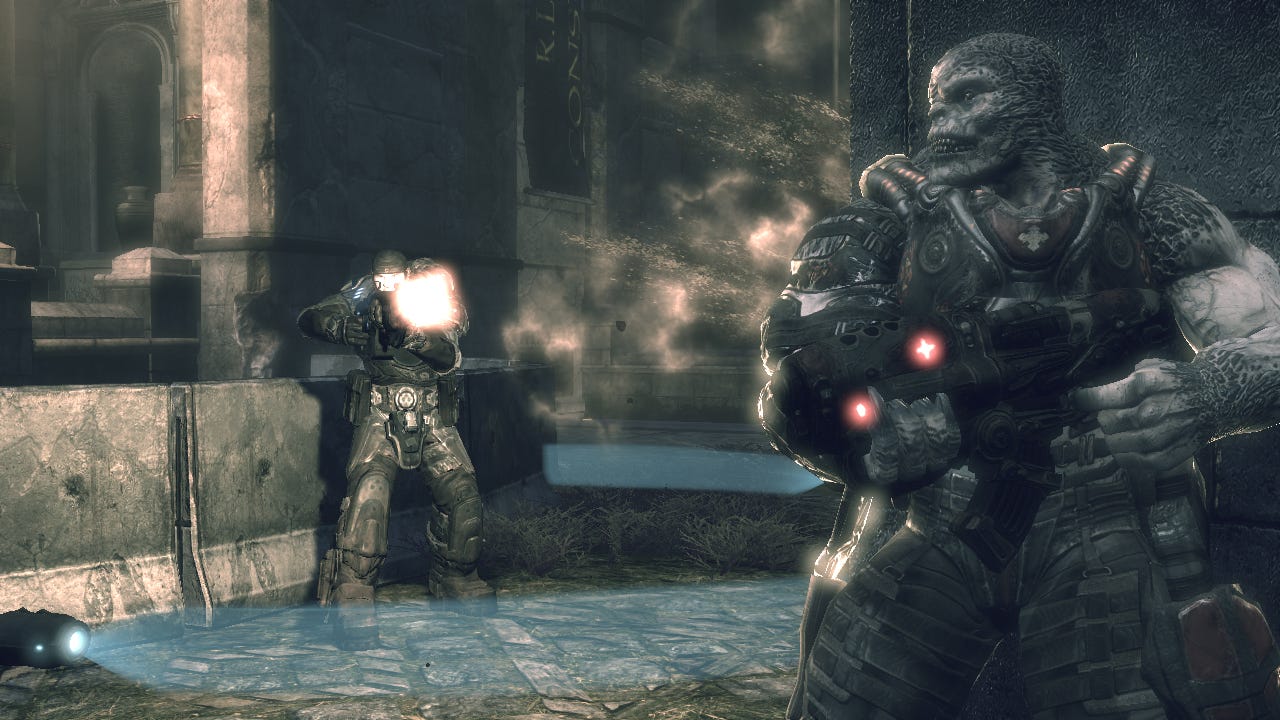
And yet it is good, because Epic has streamlined the traditional third-person combat mechanism, given you an adhesive bum and concentrated on the world you inhabit. If Halo is Combat Evolved, this is combat by intelligent design. Every battlefield is engineered to support the game's delightful central mechanic: locking yourself to the backside of a cover point with the spacebar and then pressing mouse2 to lean over the top and fire. From your first encounter on a bridge between opposing wings of a desolate prison to the final boss fight, it's all about gluing yourself to cover points and making every second of exposure count.
1

The blood trails and splatters are unlike anything you've seen since you last shot holes in a ketchup bottle.

Sera feels like a hostile place. When the ground rumbles, it means an Emergence Hole is opening, and Locust forces are about to pin you down until they're dead. You can toss a grenade in to close one quickly, but that's only if you can get close. Otherwise you're in for a rough ride. When night falls, you have to engineer a passage of light between cover points, because the bat-like Kryll will cut you to pieces as soon as you step into shadow. But Sera has retained her dignity. Ravaged though she may be, she's actually your biggest ally; a convenient network of cover points calculated to support efficient marksmen, helpfully stocked with ammo packs and beefy guns.

It's beautifully, addictively simple, and the basic cover-to-cover combat is built upon excellent weapons. Your main assault rifle, with its chainsaw bayonet melee attack (the most absurdly and brilliantly violent finishing move since the best days of Mortal Kombat), is a gratifying mainstay, while shotguns, sniper rifles and that crossbow - with a bolt that sticks into enemies and then blows them to pieces a second later - work hard to own the slots in your limited arsenal. The best thing about the guns though is active reloading. When you press 'r', a reload bar appears under your gun in the top-right, and by pressing 'r' again as a cursor lashes across it you can affect your rate of reload. Time it so that it locks to a narrow white marker and you slam in another clip almost instantly, giving you a burst of higher-powered ammunition. Mis-time your active reload, though, and you jam your gun, wasting valuable seconds.
2

Enemy AI isn't tremendous, but it doesn't have to be. Leaning against things is the star.

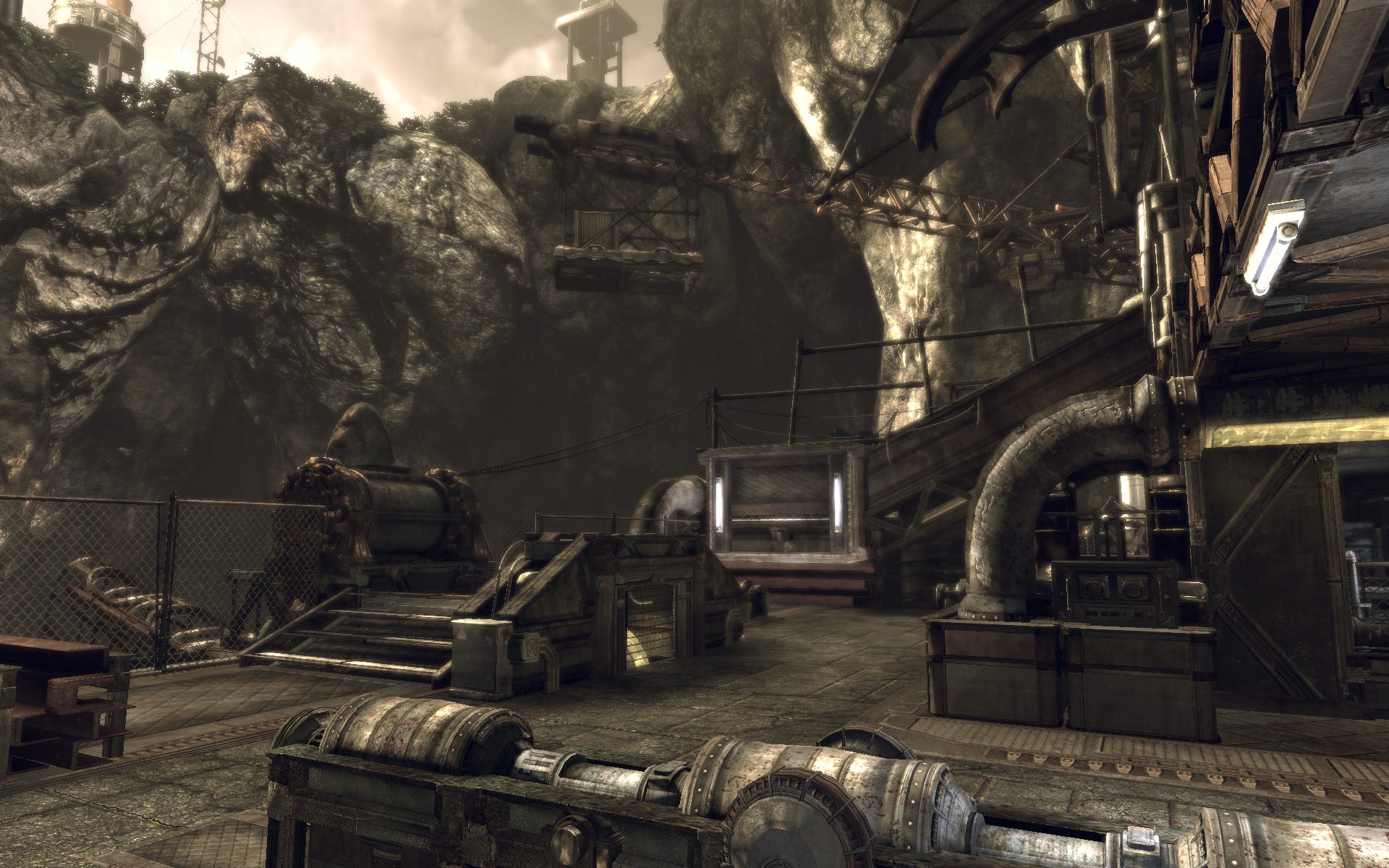
Coupled with cover-to-cover action, this gives Gears of War a satisfying fluidity and totality of combat control that even the best first-person shooters in the overstocked PC genre rarely achieve. And it never gets old, because the solution to each skirmish is down to the layout of your surroundings, while the fun is derived from the mechanics. Nowhere is this more apparent than in the new PC-exclusive section introduced to bridge the gap between events in Acts 4 and 5. Rocket-launching Boomers on raised platforms, turret gunners in narrow, sand-bagged corridors, Theron Guards in leafy parks, Seeders without the Hammer of Dawn... It doesn't matter if adjacent battlegrounds look alike; providing the cordons, crates, rubble and enemies are stacked differently, it will play out in a distinctive way. Epic has stumbled on a formula that only needs basic tweaks from scene to scene to remain engaging.

Gears isn't without its novelty moments, either - and while the over-zealous signposting and prompting is a legacy of dumbed-down console design, it's hard not to smile as you direct your squad-mate Dom through a plague of Kryll using a searchlight, or watch an indestructible adversary dance to death under the laser beam of an orbital death-ray.

The transition to PC has been extremely kind, too. Although you can plug in a dual-stick controller and play it like a console game, the introduction of keyboard and mouse control improves the combat no end, adding a greater degree of precision to an already largely flawless game of trigger-tugging. Although you will have to succumb to Microsoft's Xbox Live for Windows model with its attendant gamertag and "Guide" concepts - whether you're on XP or Vista - you can do most of the things you want on a free account, and there is an undeniable satisfaction in accumulating those Achievements and gamerpoints we all pretend we don't care about. Upon which note, your targets are much the same, but there are now 33 hidden Cog Tags to uncover rather than 30.

You're also still allowed to play online co-op without paying for the subscription-based "Gold" account. This is something well worth undertaking, too, because the mounting absurdity of Marcus and Dom's situation becomes extremely comic, and it's a hard game to watch without wanting to poke fun (not for nothing, after all, is all the grunting and grimacing lampooned with affection by all those who play it). The PC version also adds an Editor, which has the potential to deliver even more free content to support the game's enjoyably different multiplayer modes. As an online shooter, Gears can't really rival Team Fortress 2 or Counter-Strike for depth, tactics and poise, but it's a natural extension of the offline game's hardest fire-and-move scenarios.

Not that it's ever lonely. Throughout the offline adventure, you're accompanied by at least one of your fellow "Gears", partly to support the excellent co-op mode - playable online, of course - but also to give the world a sense of balance. One of Gears' biggest strengths is that you never feel as though you're more than evenly matched. You can understand how the Locust overran the general populace - they spring from almost anywhere and they cut people to pieces with menace - but their strength is in numbers that their delivery mechanism's vulnerabilities place in jeopardy. As a small cluster of die-hard soldiers, you're equal to them in a skirmish, and that's how the game plays out.

3

The Brumak danced with you on Xbox 360, but he flirts with you throughout the new PC chapters. What a tease.

One downside to this approach is that you are sometimes pegged back by your comrades' failure. When Dom, Baird or Cole Train take too many bullets, they sag to their knees and need to be revived by running over to them and pressing the action button, but you can usually ignore this and soldier on without them. Except sometimes you can't - if they're slaughtered by Kryll, or blown to pieces, you have to restart from the last checkpoint, and this happens a bit too often for my liking.

Gears on PC overcomes one of the Xbox 360 version's issues by separating the roadie run control - a sprint move shot low-down by a handheld camera, which is excellent - from the button used to take cover, but there are still times you will run and snag on a piece of scenery, and the game's excellence in combat comes at the cost of manoeuvrability, the lack of which may come as something of a shock to fans of Quake and Half-Life. There are also sections designed to fracture the relentlessness that serve better to frustrate - a laboured journey in an armoured car that sounds good on paper but bores in practise, and a mine cart ride (yes, it is 2007) that could have been removed without hurting anybody, spring to mind most readily. And while mostly your adversaries scale up interestingly, the laziness of the exploding, monkey-like lambent wretches or the flying eyeball Nemecyst isn't easily overlooked.

4

Mark Rein did my tech support, you know. I'm such a player.

On Xbox 360, Gears was also accused (albeit only subsequently) of feeling unfinished. Ironically, the absence of narrative coherency in the latter stages and the stunted conclusion worked in its favour, dramatically, and the added PC stages walk the tightrope of existing exposition quite impressively without blunting the enjoyably inconclusive finale. Which is to say that they literally bridge the gap between one place and the next (amazingly, you turned some pressure valves - "I am your father" it is not), but they don't plug any of the holes. You still end the game with plenty of questions.

With all that said, Gears of War remains a triumph. It is an almost relentless march of unpretentious, cartoon violence that serves as a satisfyingly brainless alternative to the complexity of its contemporaries. Whether played alone or with a friend, it's essential gaming - different enough to defy direct comparison, and versatile enough in what it attempts to sustain an otherwise predictable campaign. While other games lurk unconvincingly in the shadows of action cinema, desperate to be counted alongside the films they pillage, Gears achieves all their strengths - gratifying spectacle, comic violence and rugged activity - by concentrating on what makes the best games work: simplicity, skill, and more than a little bit of absurdity.

9 / 10

Read the Eurogamer.net scoring policy

Comments (90)

Comments for this article are now closed, but please feel free to continue chatting on the forum!

  • Loading...hold tight!