Gears of War 2 Review

Going underground.

Version tested: Xbox 360

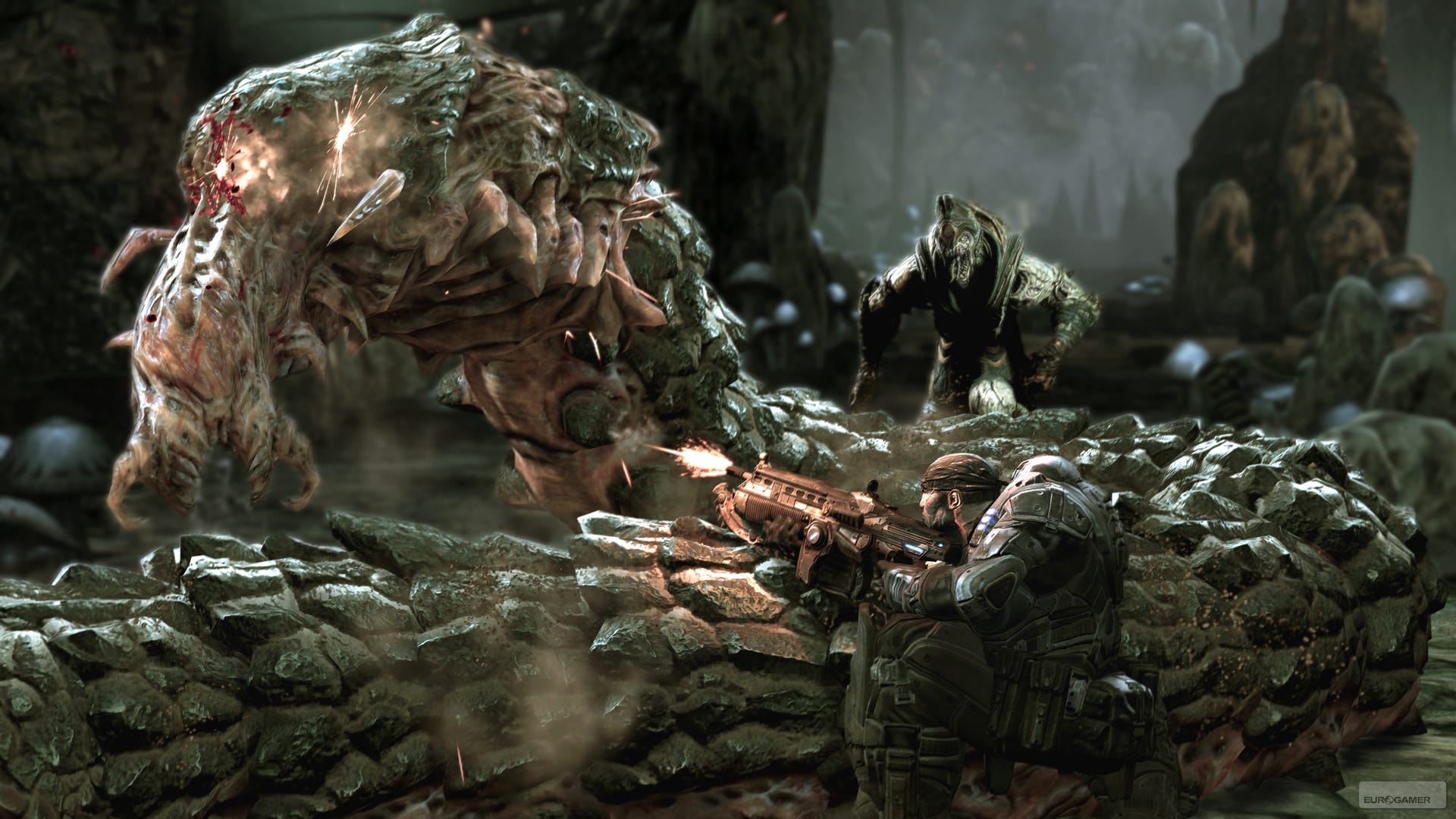
Let it be known that the Rockworm is our friend. Sure, he's large and unfriendly. And he's a family-sized centipede covered in stone cladding, so he's never going to be prime romance material. And he looks like just another thing to shoot at - and Gears of War 2 already has no problems on that front whatsoever. But for his twenty or so minutes of screen time, he's actually there to serve a more interesting purpose. His slow crawl and bulletproof hide mean he's a perfect piece of movable cover, and his hunger for the glowing fruit that hangs from cavern ceilings means you can steer him around by shooting down chunks of bait. Before you know it, you're using him to glide past enemy gun emplacements for easy headshots. So who cares if he's got sticky mandibles where his face should be? Yay for the Rockworm.

As well as all that, as you're beginning to suspect, he's also a handy tell. Because rather than reinventing an experience that was already ticking over fairly nicely, Gears 2 builds on the first game's framework at every opportunity. The game's opening teaser - an exhilaratingly familiar fifteen minutes in a Locust-infested hospital - could have been sliced out of the original title, but from that point on Epic's designers head for ground less beaten, switching pace, scrambling objectives, and mixing up the scenery. There are new vehicles, including the mutant offspring of an Advance Wars tank and a white-trash monster truck, a handful of weighty additions to the arsenal, and a few fresh enemies. There are even new moves - including a range of charmingly brutal finishers, the option to use downed Locusts as shields, and the frantic chainsaw duels.
1

All hail the Rockworm. Burn your Companion Cubes.

And yet, while all of these elements are entertaining additions, it's ultimately the careful staging rather than the new toys that defines the experience. Our friend the Rockworm may resemble Iron Maiden cover art, but there's an undeniable touch of mirror-world Miyamoto to him; a willingness to explore the slightly outlandish potential of creatures and environment. It reminds you, once again, that beneath the grunting dialogue, the Tabasco-strength attitude, and the David Icke narrative of mankind hassling nasty lizard types, Gears of War has more going on upstairs than it gets credit for.

Primarily, this is a game built for co-op. Marcus and Dom now split up officially and unofficially at more regular intervals, and rather than a chance to explore different-yet-similar corridors, there's a greater sense of co-dependency to these sections, with separate mini-missions that often dovetail cleverly. If you're playing alone the game is entirely linear, but each confrontation has been tweaked to provide for a range of different tactics, allowing you to slowly get the best results from the varied cover, sadistic enemy placement, or the simple promise of experimenting with new weapons like the Mortar, which allows you to strike from afar but requires a fairly good eye for estimating distances, or the Mulcher, a worryingly enjoyable mini-gun that chews through almost anything with vivid efficiency but renders you almost immobile.
2

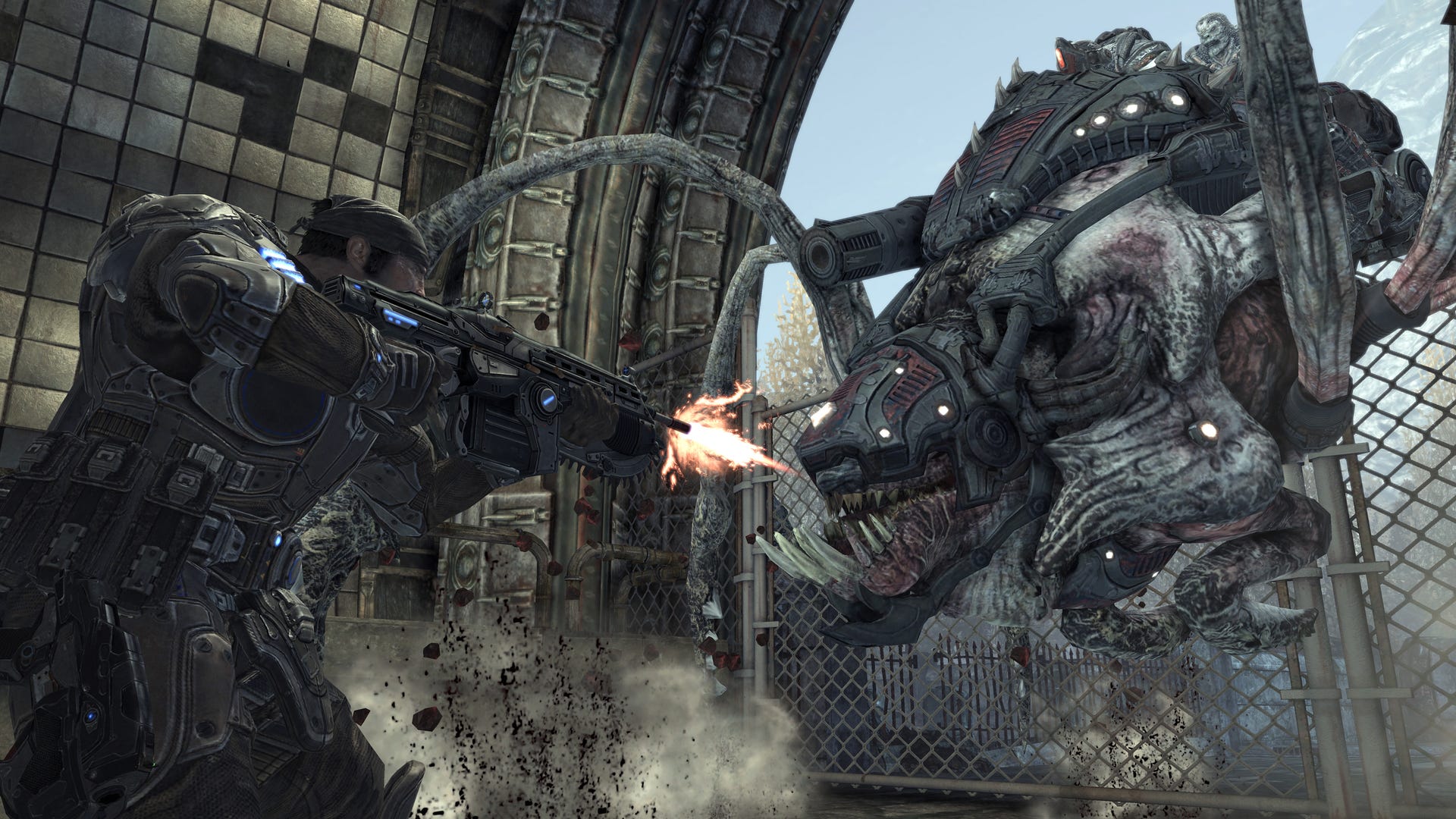
New characters help the story along this time, although this isn't one of them, obviously. It's a lot funnier overall, too.

Often there are fairly heavy clues as to how to proceed - as ever, the sight of a sniper rifle stacked against some crates means that it's shooting gallery time, and when the ammo starts to pop up all around you during a lull, you can tell there's something big lurking around the next bend - but you rarely have to follow the game's lead too closely. As in Halo, replaying an encounter with different tactics often leads to a surprising outcome. And even if that thing around the next bend isn't necessarily something new, it's probably going to be something clever, like a brutally creative configuration of old foes, or a taxing arrangement of cover. There's always a twist, always a nice slice of spectacle, and while the corridors and trenches may seem familiar, you're going to have to mix up your tactics this time to get by with any style.

It's an inventive approach that's echoed in the game's settings. Each of the five acts manages to be distinct, and yet consistent, with a broader colour palette, and a wider range of landscapes than the first game's. As it gets more experimental in its surroundings - and at least one level I'm not allowed to talk about is surprisingly experimental - its structure frees up as well. The first Gears could often fall into the trap of shunting you into a box and pouring in the enemies, before coaxing you into the next box and repeating the experience. This time the design is a bit bolder, allowing you lengthy periods where there's nothing at all to blast or chainsaw, and offering up the odd assault course, a simple puzzle, or even a chance to take in the scenery instead. These calculated low points turn out to be one of the game's best tricks, ratcheting up your anticipation until you're shooting at shadows; luring you deeper into its labyrinths before springing the trap. It's often easy to tell you're being softened up for a shock, but that doesn't make it any less effective.

As Gears 2 finds its feet in terms of pacing, the storytelling only benefits. Narrative may not have been a strength in the first game - it had a primitive tale to tell, and it did so in a confused manner - but with the sequel's twists and turns, a solid and intriguing yarn is emerging. And the link between story and level construction cannot be overstated: the gameplay variety eases you into the narrative, while the sombre mystery allows the designers to explore different kinds of gameplay, until, for one particularly effective section in the middle, Gears 2 barely resembles a shooter at all.

Yet even when the battles finally erupt, and even if its gunfights are more populated and intense overall, this is also a gloomier experience. Grim, menacing, and frequently subterranean, Gears 2 explores a darker world to the strangely cheerful hard-rock splatter of the original. It's still gorgeous to look at, covered with gloss and flaking rust and benefiting from some truly moody lighting, but Epic's beauty queen has taken on a harder edge. As the plot ambles towards its conclusion, the weight of the game's surroundings and the distinctly downbeat narrative are tangibly claustrophobic. Above all else, one of the biggest surprises is how uncomfortable it can make you feel, as story and setting come together to provide memorable moments in amongst the muzzle flashes and kerb-stomping.

3

Brumaks are finally here - and there are a lot of them about, too.

Of course, as any veteran of late-night Gridlock sessions will know, the campaign was only half the experience with the first game, and Gears 2's multiplayer is equally excellent. The new maps tend to be more complex and multi-levelled, and as a result may take a bit longer for players to learn, but the fresh modes slot right in amongst the old favourites. Submission is a typically inventive take on Capture the Flag (the flag has a heartbeat - and gibs), and Wingman, where players partner up to take on other couples, is as close to deathmatch as Gears is ever likely to get, but with a tense, enduring interdependency that will probably end more than a few friendships.

The real star, however, is Horde, a ballistic assault on your worst score-rush tendencies that transforms maps into Gears-flavoured Mutant Storm: weapons spawn, then a wave of enemies hits, then more weapons and then another, tougher, wave. Although some maps are more suited to this than others - Day One's open-plan city intersection is particularly effective - Horde is a weighty slab of fun that can turn almost any of them into a time-sink, and the leaderboards are likely to be as compelling a reason to stick with Gears 2 as the levelling system has been for Call of Duty 4. Epic says it will monitor the game closely for exploits this time around (fair enough, we'll see), but we can confirm shotgun rolling is largely a thing of the past - incoming bullets now slow you down, and unless you're fighting somebody extremely stupid, you'll be dead before you're close enough to pull off any cheap tricks.

4

The move from eight to ten players in online matches has made the maps more claustrophobic.

Like the original, on one level, Gears 2 is a brilliant advertisement for Unreal Engine 3, glorying in soft-body physics, glinting textures, and massive explosions. Even after a year of non-stop eye candy, Epic's series provides some of the most fiercely pretty visuals you'll get the chance to look at, even if its world is so charmingly ugly. Yet on another level, the game's a calling card from a developer that continues to mature in design as well as technology. The first game slowed down the crazy pace of Unreal Tournament - forcing you into using the environment every bit as much as the weapon-set - and the sequel continues to build on that with ease, but alongside the bare mechanics, Gears of War 2 shows a new interest in stories and varying the action. Best of all, it has the native intelligence to bring both aspects together.

9 / 10

Read the Eurogamer.net scoring policy

Comments (393)

Comments for this article are now closed, but please feel free to continue chatting on the forum!

  • Loading...hold tight!