Fatal Frame IV: The Mask of the Lunar Eclipse
Bad moon rising.

Rarely has a such a great series been dogged by such careless disregard. Passed around no fewer than four publishers for its first three incarnations, the fact the Fatal Frame series - known as Project Zero in Europe when it bothers to show up here - never gained more than a loyal cult following has been a perennial source of frustration for survival horror fans.
As if that wasn't bad enough, Nintendo has elected to deny Western gamers the Wii-exclusive fourth chapter in the series, The Mask of the Lunar Eclipse.
Thank goodness for the internet, then. Undeterred, a talented group of fans set about developing an unofficial English-language patch which, remarkably, also manages to circumvent region-locking shenanigans, giving import gamers peace of mind that they can go ahead and buy the game without having to consider shady hardware modifications.
Having gone to all that effort, one would assume that the collaborative efforts of Grasshopper Manufacture's Goichi Suda (aka Suda 51) and series developer Tecmo must be amazing. But it's actually surprising how little has changed in years since the original. The setting shifts and the cast changes, but essentially Fatal Frame is still content to be Ghostbusters with a magic camera, frail high-school girls and a penchant for knee-high socks.
Still, with a tone as unremittingly bleak as ever, this is about as far from Dan Aykroyd and Bill Murray as you could imagine, focusing on a bizarre ritual that robbed a group of young girls of the memories of a kidnapping and the events surrounding it. Set 10 years after the incident, three of the girls return to Rougetsu Island ("the island nearest the underworld"), followed by a detective who's still investigating the man behind the mayhem.
Broken down into chapters, Fatal Frame IV takes a similar approach to its predecessor, with each of the main characters starring in rotation and gradually peeling away the layers of obfuscation. The air of dark mystery remains an engaging hook, although some may find it a little over-familiar - particularly grizzled survival-horror veterans who eat crazy conspiracies pieced together via flashbacks and endless journal fragments for breakfast.
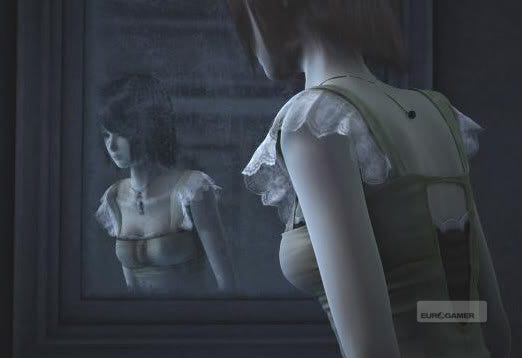
It's clear from the outset that the developers are content to stick to what they know and repeat the creaking formula. Whereas Silent Hill's recent reinvention, Shattered Memories, was bold enough to discard the shackles of the genre's ancient history, Tecmo strides back into the old frontier, shirt tucked into its stonewashed denim [knee-high socks, surely? - Ed].
The stark truth is that much of the experience is a sluggish chore in terms of control and quest design. Comparisons with Silent Hill are unavoidable - both are third-person games which involve exploring darkened, abandoned environments with a torch - but the two control systems could hardly be more different.
For one thing, you can't simply point the torch beam in Fatal Frame IV freely and fluidly like you would naturally. Aiming your viewpoint is excruciating, forcing you to slowly and steadily point in the direction you want, gently tilting the Wii remote up or down as required. Forensically scouring every location takes an order of magnitude longer than it should as a result - a process also hindered by treacle-slow turning speed and a 'running' speed best described as sedate.
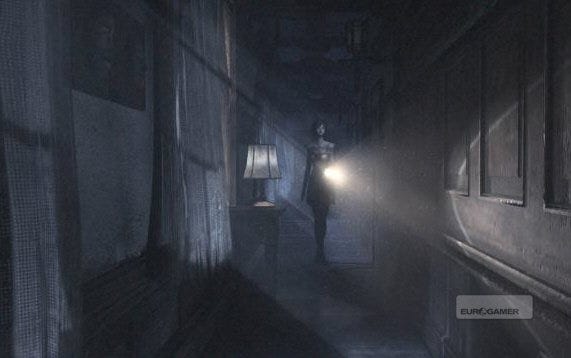
Helpfully the game has introduced a new Item Filament meter in the bottom right of the screen, which gradually intensifies when you're in the direct line of sight with something worth picking up. Annoyingly though you can't even see the item of interest until your torch beam has passed over it, so you still have to painstakingly modify your aim, often inch by inch, until it finally appears. Simple processes such as walking room to room and picking up items turn into numbing chores, taking you out of the game and grinding away your affection with slothful routine.
Combat is no better. Once spirits announce their arrival you whip out your Camera Obscura, the view switches to first-person and you then train your reticule on them and try and get the best-possible shot once the power meters fill up. Timing and positioning become all-important, because without a close-up shot you won't do much damage, so you're often forced to wait until the very last moment before capturing a picture to send ghosties reeling back in shrieking agony.