Episodes From Liberty City Review

Happy choppers.

Version tested: Xbox 360

It's nothing if not strange to be reviewing the same thing for the second time in a fortnight, but then Rockstar has sent us down strange roads before. The Ballad of Gay Tony is the same now as it was last week, but the fact that it is also available on a disc it shares with The Lost and Damned, and which doesn't require the original Grand Theft Auto IV to play, asks different questions of a review.

It's possible, for example, that you're considering whether to buy this having never bought or played GTAIV - in which case your impressions may be mixed. The Liberty City of the current generation is a vast, colourful and varied environment, brimming with the series' trademark satirical humour and eccentricity, but whereas 18 months ago it seemed a technical marvel, 18 months on it's merely at the handsome end of competent, and drops frames more noticeably than an epileptic optometrist. And the core of GTA is very much still going to icons on the mini-map to receive a briefing and then driving somewhere to do some shooting, or similar.

Mechanics are solid but unspectacular, and lack the finesse intervening games have standardised. The cover-based third-person gunplay, for example, is sticky, and awkward in close quarters, and you never feel as comfortable as you do in comparable action games when you're moving around on foot. Sometimes, as when jumping or navigating buildings, it's as though the programmers spent so long making the world around you operate properly that they struggled to accommodate your need to touch it. The driving physics have also proven divisive. With that said, modern GTA is less frustrating than it was on PS2 and Xbox in many respects; you can even restart missions without having to go off and buy your guns again. Progress!
1

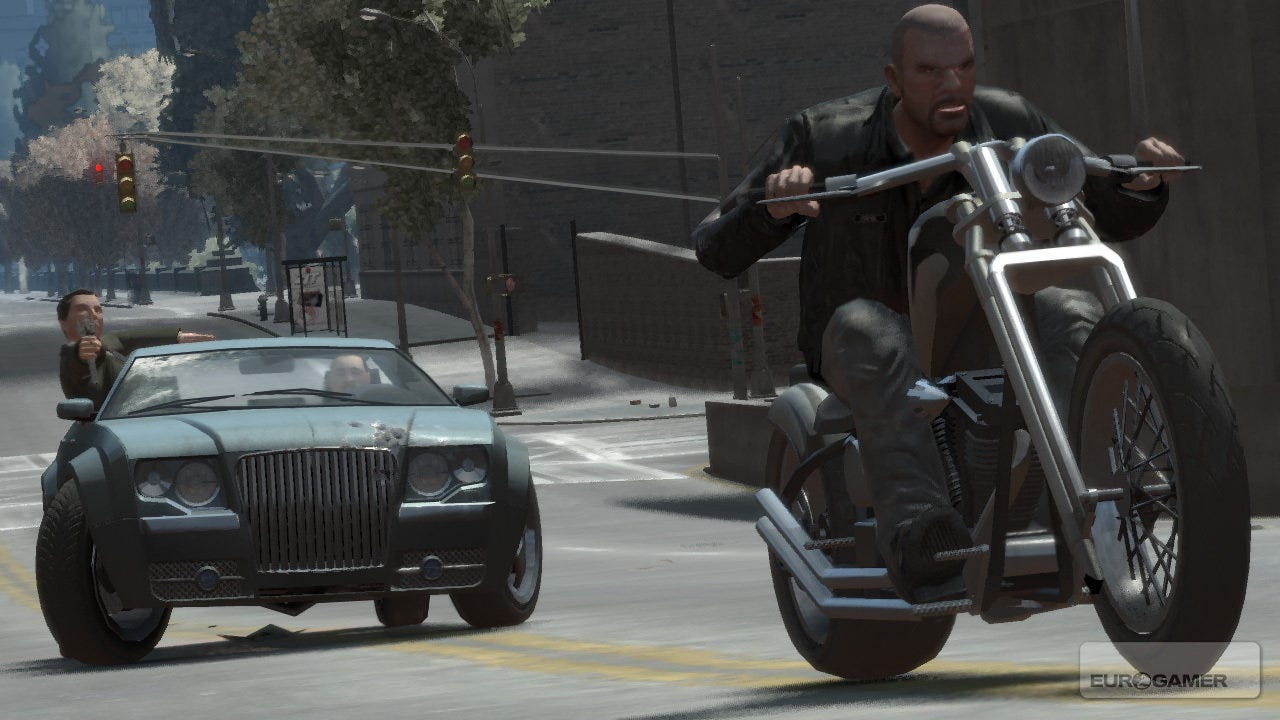
The Lost and Damned's motorcycles are perhaps its strongest characters. When I first lost Johnny Klebitz's Hexer in the river I was grumpy for several minutes.

One thing that hasn't changed throughout GTA's 3D history is Rockstar's approach to the framework of the game and its systems. Everything you can do is introduced as if by a serious man with thick eyebrows: the camera points at something, and a box of text appears to explain how it works. Learn. Not for Rockstar, then, the in-line tutorials that blur the lines between fiction and mechanics in other, more self-conscious action adventures. Given the sometimes-negative press the GTA games attract, perhaps someone somewhere decided very early on to make the line between reality and the game world as whopping as possible.

But let's face it, you probably have played GTAIV, so you know all this. Whatever your situation, the two discrete episodes included in this bundle complement one another very well. The Lost and Damned, first released in February, tells the story of a violent power struggle within the Alderney chapter of The Lost Motorcycle Club, and the perils of trying to live by an ageing creed - that, in the words of one character, "Life is pain, and through this life of brotherhood we can give pain the finger." The Ballad of Gay Tony, meanwhile, focuses on how wicked it is to jump out of helicopters wearing a parachute.

The Lost and Damned is moody, atmospheric and at times nostalgic and thought-provoking (not to mention very well written in places - chapter leader Billy Grey is never short of poetic justification for his actions, including a rather good one about the unifying, "centrifugal inertia" of the biker lifestyle). The Ballad doesn't care so much for character development; it's sillier and less predictable, a game more interested in what might happen if you shoved half of Bolivia up the nostrils of a Middle-Eastern playboy than whether said playboy has a past or a future and how they contribute to his behaviour.

The contrast is significant, and this proves to be a strength of Episodes From Liberty City. While it sometimes felt a bit weird in Grand Theft Auto IV to sit through a downbeat cut-scene about broken promises, sacrifice and revenge and then go off and sit in a comedy club or blow up police cars, Episodes has no such trouble: come this way for grainy fonts, leather, driving motorcycles in formation and pain; come this way for explosive shotgun shells, rainbows and golden helicopters.

One thing the two games - a fair description given that each lasts as long as the average blockbuster FPS campaign - have in common is a range of common deathmatch multiplayer modes, although there are some other, episode-specific ones. The Ballad probably does best out of these, simply by giving parachutes to players in the free-play mode. One of the main game's side-mission types is base-jumping - the practice of leaping off a skyscraper or out of a chopper and then deploying a parachute - and online you and some well-drilled friends can race together to complete several of these in sequence and post a score derived from the time this took and the precision of each landing.

2

The Ballad rates you for each mission, distributing more gamerpoints to people who tick more boxes and letting you replay missions later to achieve this.

Between the two episodes, you shouldn't expect much change from 15 hours of gameplay, assuming you decide to stick around for some of the many diversions beyond the main story missions. The Lost and Damned invites you to take part in motorcycle races and gang wars, while The Ballad lets you dabble in club management and, er, gang wars, as well as jumping off things. There are other things to do if you look hard enough, and an impressively deep and tailored soundtrack for each lifestyle, along with a lot of TV and radio content (including three extra radio stations for Gay Tony in this disc version), all of which is quite admirable considering the episodes' origins as downloadable content.

But then, Rockstar seems to have built The Lost and Damned and The Ballad of Gay Tony with their eventual unification in mind, so perhaps that's not surprising. It's also not surprising that while the two are heavyweights in the world of downloads, they are pretty much the sum of their parts in the big-hitting world of games-on-disc at the tail end of 2009, and priced accordingly. But the distinct personality of each component means that while this is still a nearly-two-year-old game in many respects, it's also a game of many more flavours than its contemporary opposition, and it's hard to imagine a Grand Theft Auto fan finding the experience disappointing.

8 / 10

Read the Eurogamer.net scoring policy

Comments (72)

Comments for this article are now closed, but please feel free to continue chatting on the forum!

  • Loading...hold tight!