Disney Epic Mickey Preview

Retaking the Mickey.

Here's a fact you almost certainly didn't know about Warren Spector: he is exactly the right height to stand upright on the top floor of an old Routemaster double-decker bus. The curving roof brushes the top of his tidy crop of grey hair and frames the compact games designer, creator of Deus Ex, perfectly.

"I'm an old dog. I don't do new tricks," he says.

Really, Warren? You could have fooled us. When you're famous for dark, sophisticated and violent adventures, taking on the challenge of reinvigorating the world's most recognisable cartoon character - and what must be one of the most valuable intellectual properties in existence - in an all-ages videogame seems like the definition of a new trick. Not to mention a difficult one to pull off.

But what Spector means is that he only makes one kind of game, and just because of the radically different style, format and commercial pressures surrounding his first work since leaving Ion Storm in 2004, you shouldn't assume that Wii exclusive Disney Epic Mickey is going to be any different. It will be a genre hybrid - "Is it a platformer or an adventure game or an RPG? Well... yes," he says. It will offer multiple play-styles, multiple solutions to problems, a character and a world that change according to your decisions and actions. But it will also have a contained, level-based, linear thrust. When it releases late next year, Epic Mickey will be - surprisingly, but also inevitably - a Warren Spector game through and through.
1

Spector on Wii exclusivity: "I'm enjoying working on a platform where gameplay is it, it's all there is."

That isn't how it began life, however. Spector is happy to give credit to the think-tank of Disney interns who hit upon the poignant ideas at the heart of the game. It was they who determined that to make Mickey relevant again, you had to take him back to his earliest cartoons, the reasons anybody loved the character in the first place. It was also they who picked the emotional counterpoint for the game's story of revival and redemption: Walt Disney's first creation and Mickey's "elder brother", the forgotten Oswald the Lucky Rabbit. Created while Disney was working for Universal in the twenties, it took a mercy mission (and presumably a large cheque) from Disney CEO Bob Iger to secure the rights to use Oswald in the game.

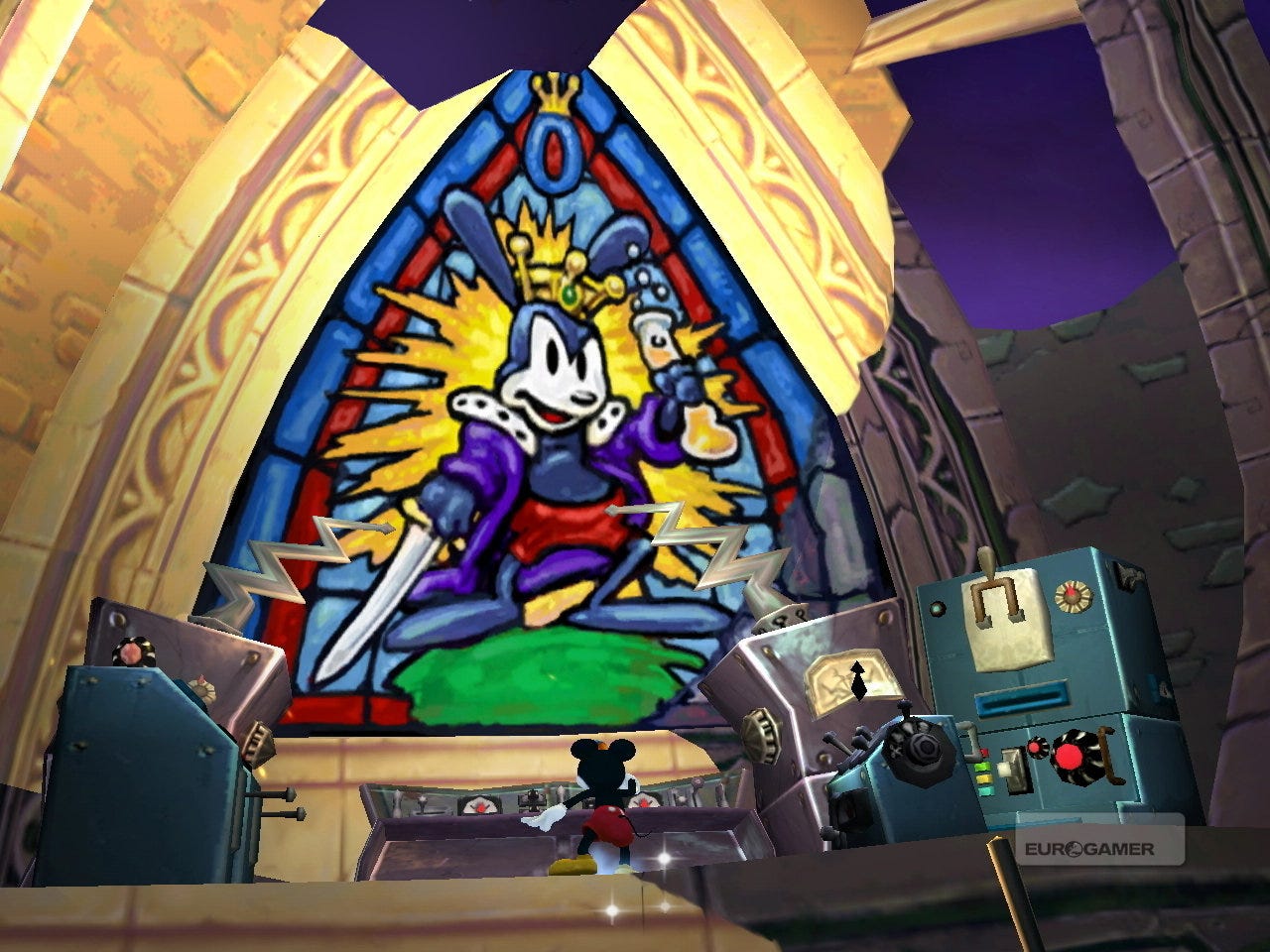
Oswald lives in the Cartoon Wasteland, a surreal world where neglected or never-used cartoon concepts languish, waiting to be remembered and loved again. The rabbit is bitter, resentful, wondering why his father Walt rejected him and why he languishes as a historical footnote while the Mouse went on to become the biggest star in the world. He's also lonely, and has made twisted animatronic versions of Mickey's family - Donald, Pluto et al - to keep him company.

Mickey is plucked out of bed one day by an animated stream of black gloop - possibly something to do with the principal villain of the piece, the Phantom Blot, an insignificant antagonist of yesteryear who seems to have taken on a horrifying new form - and dumped in the Wasteland. The Wasteland has been devastated, broken up, twisted and rendered partially inert by events that, Spector hints darkly, are Mickey's fault. The hapless mouse needs to regain Oswald's trust, heal the Wasteland and find a way out - not just because it's the right thing to do, but to save himself from oblivion and, worse, irrelevance.
2

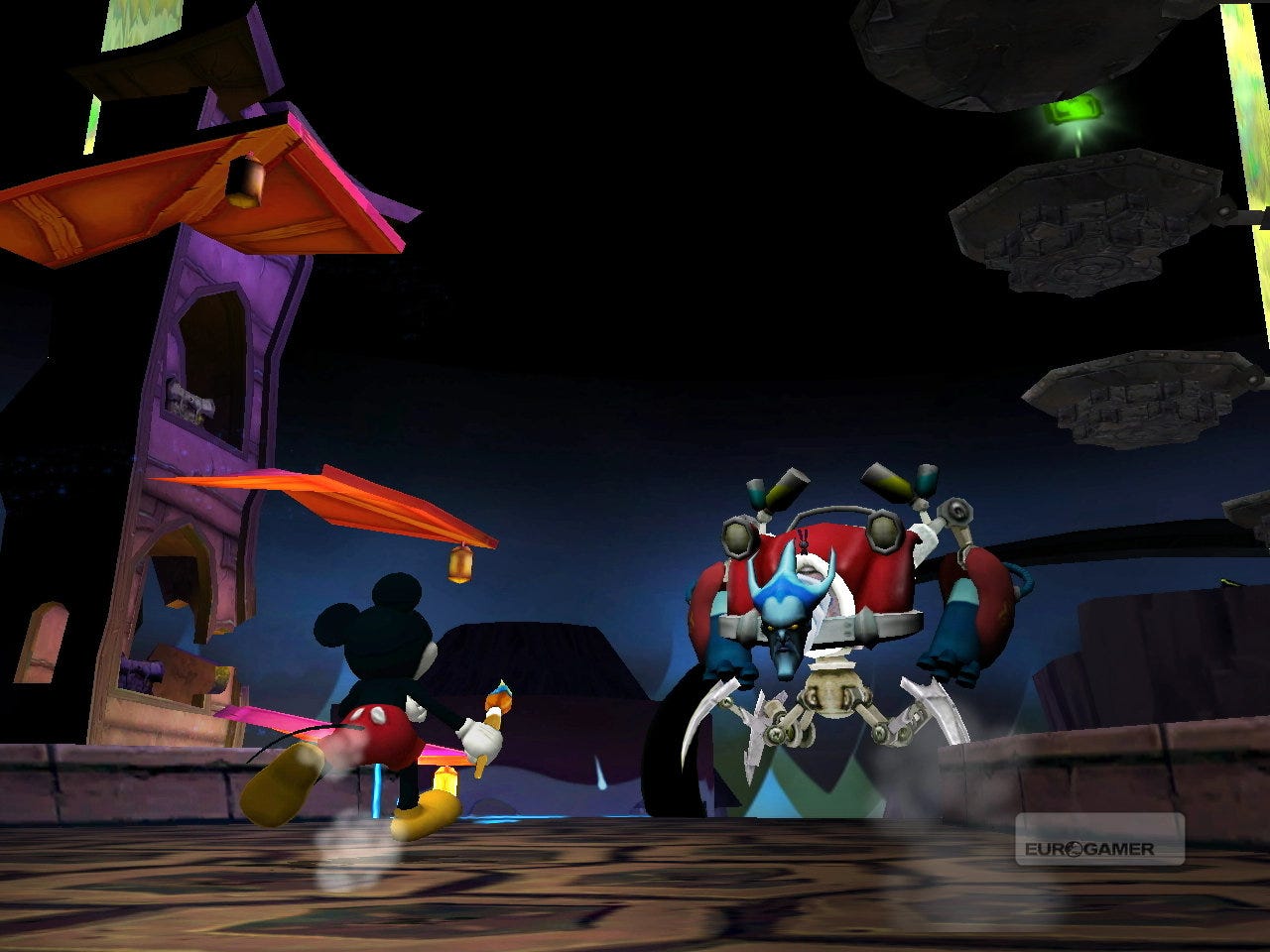
Spector equates using thinner to erase parts of the world to chopping down grass in a Zelda game: it can reveal both good and bad stuff.

On a corporate, Disney level, this might be the most remarkable thing about Epic Mickey. It's tantamount to an admission by the entertainment giant that its most famous creation, as recognisable as he is, had become next to meaningless. "He's kind of frozen in place," says Spector. "He's a statue. He's an image, an icon. He's not a character any more."

Epic Mickey's remedy to this is twofold. The first part is to return him to his roots, in the distinctly thirties style in which he's drawn, and in the primal focus on animation by the team at Spector's studio Junction Point. "There's been a conscious effort to make him more human, more grounded... I wanted to remind him that he's a cartoon character," says the designer. He shows videos of Mickey's in-game model composited onto classic cartoons, aping the elastic, expressive, somehow graceful stretching and scampering of the original drawings with amazing faithfulness. It's there in the in-game footage we see, too, and is already easily the best cartoon animation in any non-Nintendo game of recent years.

The second part of Mickey's rebirth is more daring - and it's where Spector's personal philosophy of game design comes in. Essentially, Junction Point aims to let the player decide what character to imprint on the icon, the empty vessel that is Mickey Mouse. You decide who he's going to be.

This won't go as far as a moral dichotomy; "I don't want to make Mickey evil," Spector says, and at the end of the day the Wasteland is going to get saved, and Oswald is going to be redeemed. It's a question of who's on his side, whether he's the "lone hero or the beloved saviour".

The two directions you can take Mickey in - mischievous "scrapper" or virtuous "hero" - have their basis in his two main interactions with the game world via the paintbrush he carries with him. He can use paint and thinner to create or erase, restore or damage respectively; you do this by using the Wii remote to point where you want throw or apply them. The twisted, inert part of the Wasteland can't be affected, but everything else - made as it is out of ink and paint - can: platforms can be conjured out of thin air, obstacles removed, objects reshaped.

The element of choice doesn't stop there, because paint and thinner are both limited resources - you won't just have to choose which to use, but when to use it. And the consequences of your choice might be deeper than you think. For example, erasing a bookcase to get at what's behind it doesn't just remove the physical object from your world, it removes the information in the books.

Mickey evolves according to your preferred interactions; using more thinner increases his personal, destructive powers, and gives him a meaner demeanour, more dynamic animations. So does choosing to trade the scattered parts of the robot Donald Duck with a collector, rather than opting to rebuild him. Spector is a little more vague on the benefits of choosing a constructive path, but it seems to revolve around helping others - for example, the floating "gremlins" created by Disney and Roald Dahl in the forties for a film that never saw the light of day - to gain their help in return.

It will be possible, but hard, to change your path from scrapper to hero and back. Spector says he has experimented in the past with setting choices in stone, or alternatively giving the player complete freedom to change their style, and "neither really works".

3

In what we've seen, characters talk in text and garbled toonspeak, and Mickey himself doesn't utter a word. Zelda again...

There will always be multiple ways to solve any problem in Epic Mickey, with Spector going as far as to assert that you'll be able to get round all the game's bosses without fighting them, if you can simply figure out what they want. Nor will it always be a simple choice between paint and thinner, as other tools, or "sketches", come into play. Draw a television and it will distract any being in the game world; draw a watch, and it turns the world sepia and slows down time. These sketches, Spector says, are exploration tools in the Zelda mould, but can also create interesting emergent behaviours when used together.

We're taken through a demonstration showing multiple routes to a single level - its fractured, colourful 3D exploration strongly reminiscent of Super Mario Galaxy, if not quite as pretty or as head-spinning. (There will also be traditional 2D platforming levels, each taking direct inspiration from a specific, classic Mickey cartoon.) At one point, Mickey has to negotiate a large spinning fan, and we're shown three of a possible five solutions to this problem - he can use the watch to slow it down and step through, simply erase it, or free a gremlin elsewhere in the level who will help him to stop it.

It's Mickey's broad range of interactions with the rest of the game's cast, right down to its simplest enemies, that are the most exciting and unusual aspect of this exciting and unusual platformer. Dealing with other beings in ways that go beyond simple, physical slapstick is unusual in a cartoon game - in fact, it's unusual outside sandbox RPGs - but even the silly Spatters, blob-like minions of the Phantom Blot, can be distracted or befriended as well as erased.

4

Storytelling is done in a stylised 2D storyboard look, emphasising that this is a world composed of forgotten concept art.

Mickey will also encounter his old foes Black Pete ("a running gag and a formidable foe"), the Mad Doctor from the cartoon of the same name, and Oswald's children - a horde of baby bunnies who love Mickey "a little too much", mobbing him, slowing him down, directing him into danger and causing chaos when they meet the Spatters. Then there are the Beetleworx, sinister manifestations of the Wasteland's twisted, inert side, who are immune to both paint and thinner. How you deal with them remains a mystery - Spector will only say that it's "a different kind of challenge".

In motion, Epic Mickey looks lively and solid, a polished example of a licensed cartoon adventure - but not a whole lot more. Its aesthetic isn't as stark as the leaked concept art might have suggested, and its flexibility and depth aren't immediately apparent beneath the busy, colourful action.

But seeing the breadth of choice, the player's freedom of action demonstrated - and hearing Spector talk about it - does mark Epic Mickey out as a trailblazer. It's not that these things have never been attempted before in videogames, but they've never been attempted in a game like this, or with a character like this. That Disney is letting Spector take the all-ages platform game in this direction is remarkable enough. That it's letting him (and the player) have their way with its precious mascot is more remarkable still. That it's chosen videogames - in as interactive a form as they currently come - as the arena for Mickey Mouse's rebirth is the most thrilling risk of all.

The Walt Disney Company is an old dog too. Warren Spector might not be learning new tricks, but he's certainly teaching them.

Disney Epic Mickey is due out exclusively for Wii in autumn 2010.

Comments (38)

Comments for this article are now closed, but please feel free to continue chatting on the forum!

  • Loading...hold tight!