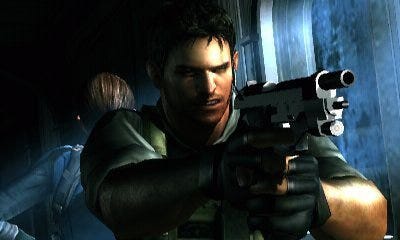
Capcom showcases Resi 3DS tech
Scaled-down PS3/360 engine behind it.
Capcom has revealed new details on its 3DS tech, confirming that the same Framework MT engine used on PC, PS3 and Xbox 360 has also been deployed on Nintendo's upcoming stereo-3D handheld.
Japanese journalist Zenji Nishikawa posted the details on Watch Impress (thanks Andriasang for the translation), including confirmation that Resident Evil Revelations has been designed and coded from the ground up exclusively for Nintendo 3DS.
The 3DS itself may well feature a little-known vintage 2006 graphics chip (the DMP Pica-200), but remarkably little is known about the full make-up of the console, in particular the CPU. There's still a huge amount of speculation on the level of performance developers can actually extract from the new hardware. While Capcom is happy to showcase its own achievements on the handheld, the team also reveals that Nintendo NDAs prohibits it from talking about the hardware make-up of the system itself.
Graphics demos of the GPU suggest that while the Pica-200 may be lacking compared to more modern GPUs such as the IMG chips found in the newer iOS devices, it's still a decent performer - one tech demo from PC benchmark specialists FutureMark actually runs at an 800x600 resolution. 3DS titles operate at a native resolution of 800x240 (effectively twin 400x240 images side-by-side, one per eye). Obviously the fewer pixels the GPU needs to handle, the faster it can process each frame.
Despite the lack of programmable pixel shaders, the fixed render pipeline is capable of some pretty impressive stuff. Capcom says that the mobile version of its Framework MT engine operates in a very similar manner to its HD counterpart. As we noted in our hands-on with the 3DS hardware at E3, the assets seen in the Resident Evil demo are based on the HD equivalents from Resident Evil 5, although they have clearly been downscaled in terms of geometry and texturing. However, as the 3DS screen and the native resolution is so small relatively, the overall effect is remarkable.
With that in mind, it's clear that effects such as high-dynamic range rendering and colour-grading - powerful features in the full Framework MT - have been translated to the mobile screen very well indeed.
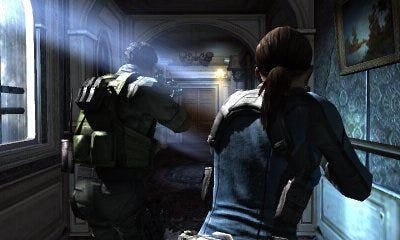
See the difference that HDR and colour-grading makes. On the left we see the basic image, on the right, you see the effect engaged.
Key ingredients in the make-up of the demo scene are more subtle effects such as the normal maps and self-shadowing. While clearly far more primitive than the versions seen on the PS3 and Xbox 360, they add a great deal in terms of adding texture, depth and realism.

Self-shadowing (top) and normal maps (bottom) add significantly to the depth and texture of the scene.
Also intriguing is that Capcom is planning to support the 2D mode of the 3DS hardware with additional graphical features you won't find when stereo 3D is engaged. Both motion blur and anti-aliasing are in place when the depth slider on the 3DS is set to the minimum. In 2D mode, running at a 400x240 resolution, far more in the way GPU resources are available to make these effects possible.

Depth of field has also been implemented on the 3DS rendition of the engine (top), but some effects such as anti-aliasing and motion blur (bottom) only kick in when the stereo 3D mode is disengaged.
Away from Resident Evil Revelations, the Watch Impress article also tells us much more about future developments of Capcom's Framework MT engine. First up, there will be no PSP version of the mobile tech, but it may well be deployed in future on the successor. Secondly, Capcom has already developed a cut-down version of the tech known as Framework MT Lite that allows for cross-format PS3 and Wii development. It's also been confirmed that the extremely impressive stereo 3D conversion of Super Street Fighter IV for 3DS runs on the mobile iteration of the platform.
Returning to the HD versions of the engine, Capcom says that the forthcoming Marvel vs. Capcom 3 uses a new 2.1 iteration of the tech (Lost Planet 2 used 2.0) and it's the first time an external developer has made use of the engine. The capabilities of the engine platform itself continue to be refined: the upcoming PC version of Lost Planet 2 features exclusive DirectX 11 features such as more accurate water simulation and tessellation - the process in which LODs are generated dynamically, with additional geometry detail created on the fly the closer you get to an object (and diminished the further you are away).
Console-side, Capcom continues to evolve its existing technology, and is currently experimenting with the inclusion of deferred lighting into the next major revision of Framework MT.
You may also like...
-
Gravity Rush Review 48
-
Sony patents method to interrupt your gaming with an ad 107
-
Wii U Aliens: Colonial Marines is best-looking version because of console's "more modern tech" 74
-
Kingdoms of Amalur: Reckoning needed to sell 3 million to break even 65
-
Activision vs. Vince Zampella and Jason West: Inside the game industry trial of the decade 70
-
Skyrim gets mounted combat in new update 54
-
Arma 3 in-engine footage shows off lighting tech 18
-
App of the Day: Go Robo! 2
-
Ghost Recon: Future Soldier Review 132
-
Minecraft overtakes Black Ops on XBL activity chart 25
-
Dirt Showdown Review 89
-
Minecraft total sales hit 9.2 million 8
-
FIFA has a new world champion 8
-
How the Darksiders 2 delay benefits you 9
-
Tony Hawk's Pro Skater HD soundtrack listing revealed 18
Comments (28) Latest comment 2 years ago
Comments for this article are now closed, but please feel free to continue chatting on the forum!
Comment below viewing threshold Show
My only concern is battery life. I really hope this thing pushes at least 6 hours, otherwise it's going to be a little annoying.
Comment below viewing threshold Show
I get the feeling the 3DS might well be the first Nintendo handheld I've bought myself since the Gameboy Advance.
Comment below viewing threshold Show
My slider will always be in 2D.
Comment below viewing threshold Show
No. Glasses free 3D is the future.
But it's still good to have higher quality 2D for when 3D isn't required.
Comment below viewing threshold Show
True, but we don't know for sure whether the user will actually want to turn the 3D effect off in the first place. According to various reports, the 3D works remarkably well and doesn't cause strain, even with glasses.
Comment below viewing threshold Show
Sony and Microsoft will have to bring there next gen machines out sooner rather than later as you should,nt really have hand helds on the market looking as good as home consoles imo
Comment below viewing threshold Show
I'll be getting this for sure though.
Comment below viewing threshold Show
The only thing that concerns me is that I have a terrible time with even remotely extended sessions (just 10-15+ minutes) on small screen devices. I can almost count the number of times I've used the PSP I bought a couple of years ago, on two hands, and I've also done preciously little gaming - or video watching - on my iPod Touch.
Maybe it's time to visit an optician - even though I have no problems with eye strain or headaches in other areas.
Comment below viewing threshold Show
Any non-Microsoft (or non-Nvidia Cg) 3D Api won't have “pixel”shaders; it is a Xbox-ism.
So the Pica-200 doesn't have “pixel” shaders, as it is an OpenGL compliant card; but the fully featured Pcia-200 does have fragment shaders (which is the correct/orignal name for pixel shaders) as part of a bespoke programmable vertex and fragment shader feature set, which retains fixed pipeline functionality.
But I think any journalist claiming the in-game graphics; not the cut-scenes of the 3DS are going to be significantly better than an N64's graphics (but using true colour mode, instead of the N64's 256 colour index mode) are likely to be back tracking fast at the launch.
Hopefully Nintendo will break the bank and deliver great h/w this time like DF team are suggesting, but I'll be shocked if they aim any higher than the PSP's graphics in 3D.
Comment below viewing threshold Show
An N64? Really? You do actually remember what N64 games looked like don't you? Absolutely nothing we have seen so far would suggest that it will be N64 level. For starters the 3DS ports of old N64 games look vastly superior to their original versions.
Such as...
N64: [link url=http://www.chronicgames.net/images/games/nintendo%2064/lylat-wars-screenshot-002.jpg
]http://www.chronicgames.net/images/games...[/link]
3DS: [link url=http://images.eurogamer.net/assets/articles//a/1/1/4/1/3/3/4/star.png
]http://images.eurogamer.net/assets/artic...[/link]
If you can't see the vast difference there (and this isn't even the best looking 3DS game)... well... I don't know what to say, you'd either be being deliberately obtuse or there is something seriously wrong with your eyes.
Comment below viewing threshold Show
Agreed, it will look better than the N64 in 24bit colour, but it won't likely be as good as the Wii; and I even suspect it will fall slightly short of cube based on the kid icarus video.
I really hope it would be the performance of the Wii in a handheld, but I just doubt that will happen from Nintendo's successful formula.