Check Out 360's 1080p Smooth Streaming Tech Now


We'll have reaction to the gaming and hardware announcements from Microsoft in due course (including an ODST vs Halo 3 tech feature we've been planning for some time), but in the meantime, the focus turns to the 1080p streaming technology revealed for Xbox 360 last night.
The idea here is that 'Smooth Streaming' allows for an instant start to watching your video with no perceivable buffering, with the picture quality dynamically changing according to the bandwidth conditions. Should you have access to a sustained five megabits of bandwidth between you and the server, Microsoft promises a full 1080p video stream with 5.1 surround sound. If those conditions change for the worse, the stream dynamically switches to a lower quality, lower bandwidth version without skipping a beat.
Initial reports from the E3 conference suggested that this technology would be a US only affair for users of the NetFlix video streaming service, but PR blurb from Microsoft this morning suggests that Smooth Streaming is set to be rolled out on the new, improved Zune video service that sees the Xbox Live video marketplace expand from coverage in eight territories to eighteen.
So, just how good is it? Will it stand up to real life internet conditions? Is it all just PR hype or has Microsoft actually delivered something here? Well, this is where things get seriously cool. Not only can you see the technology in action now, you also get to test it out on your PC in the comfort of your own god-forsaken hovel. Smooth Streaming is a part of Microsoft's Flash competitor, Silverlight, and was actually introduced a few months ago. There's a very cool online showcase you can view right here, right now. And here's a pic of the player. Graphs, frame rates, bandwidth meters... it's the stuff of dreams!
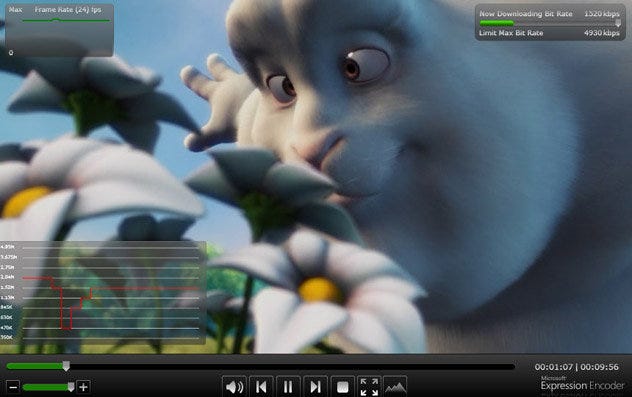
Once Silverlight is installed, the demo gives you some very cool feedback on the state of your internet connection, the current download speed, along with the frame rate of the playback. This last aspect is as much about the swift performance of Silverlight’s PC high def decoder as it is about the streaming itself. While we find that low bitrate HD via h264 offers a significantly higher quality level compared to MS’s VC1 codec, it has to be said that Adobe’s Flash implementation of the h264 decoder is much slower than it should be so Silverlight on PC has a clear edge here. Even a reasonably modest PC should be able to stream 1080p at the required 24FPS with no frame drops. Regardless, decoding performance won’t be an issue on Xbox 360 (the VC1 decoder is mature), and the streaming experience should be much the same as you see in the demo, assuming you have a fairly decent PC for testing purposes.
So, dynamic streaming then. Some say that this is how OnLive works in delivering a sustained HD gaming experience, and chances are that it does play a part in some way, shape or form. However, the difference here is that Smooth Streaming is still buffering video behind the scenes. From the off, it streams at a low bitrate and stores up video before ramping up the bandwidth to suit your connection. It'll be pretty much unnoticeable in real life conditions owing to the fact that movies tend to start with logos and idents, and who really cares if these are not in 1080p? More pertinently, the smooth streaming buffer gives the server plenty time to dynamically change the video quality - and with its required ultra low latencies, OnLive can’t conceivably have that level of luxury.
Coming back to Smooth Streaming, one of the coolest things about it is that it's guaranteed to scale with your internet connection. Picture quality will improve as internet technology gets faster. It's already built into the tech. And as we move towards ultra-fast line speeds and bandwidth gets cheaper, Microsoft can simply up the current 5mbps bandwidth ceiling and introduce even higher quality encoding.