Brink
When is an online shooter not an online shooter?

The machines are taking over. Microsoft's star attraction at E3 2009 was a virtual boy you could talk to. Our games consoles know how fat we are, how far we've walked and what's good for us. One reason Valve is able to turn out two Left 4 Deads in two years is that it has programmed an algorithm to direct the gameplay. And Splash Damage and Bethesda's multiplayer shooter Brink is a structure rather than a game - a collection of content the shape of which will be decided by the software, and its observation of players.
I'm being a bit disingenuous. The reason Left 4 Dead and Brink feature so much automation is really because the people are taking over, not the machines - the people being other players. These are games that blur the line between solo and multiplayer gaming, that can't afford to be as scripted and didactic as a straight single-player experience. They have to be flexible and fast on their feet, able to swap human players for bots at a moment's notice, simultaneously linear and endlessly replayable.
Brink goes several steps further than the co-op-focused Left 4 Dead, blending just about every modern FPS gameplay style into what Splash Damage hopes will be a seamless whole. Co-op, competition, class-based team dynamics, experience-based character progression, dynamic objectives, factional warfare and sci-fi storytelling all meet on The Ark, the futuristic floating city that's mankind's last refuge after an environmental disaster. There, the conspiracy-theorist Resistance is struggling for control against the autocratic Security, and players can take either side.
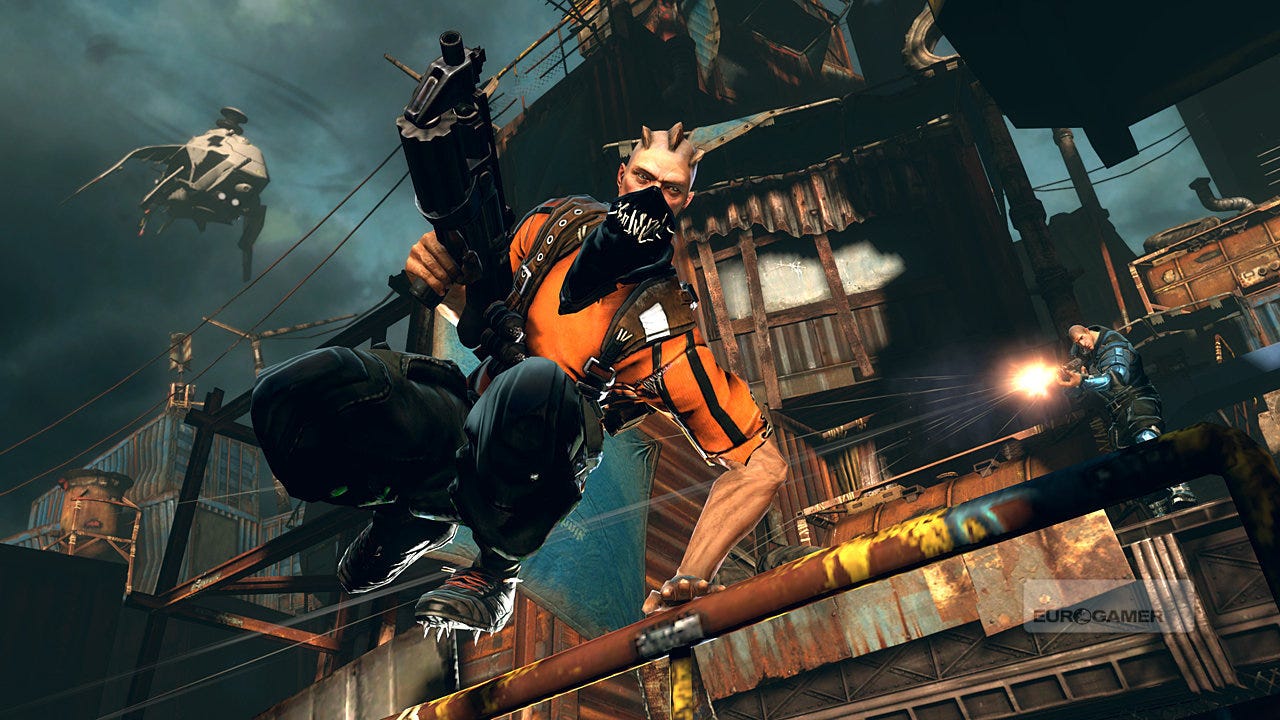
The character-customisation options are extensive - as long as you want to create an edgy, war-painted macho man in street clothes and body armour, in the game's distinctive, exaggerated, hyper-real style. You can't exactly call it pretty, but it is striking, and the environments - ranging from smooth sci-fi monumentalism to ramshackle, filthy container cities - are simply bursting with colour and detail over huge draw distances.
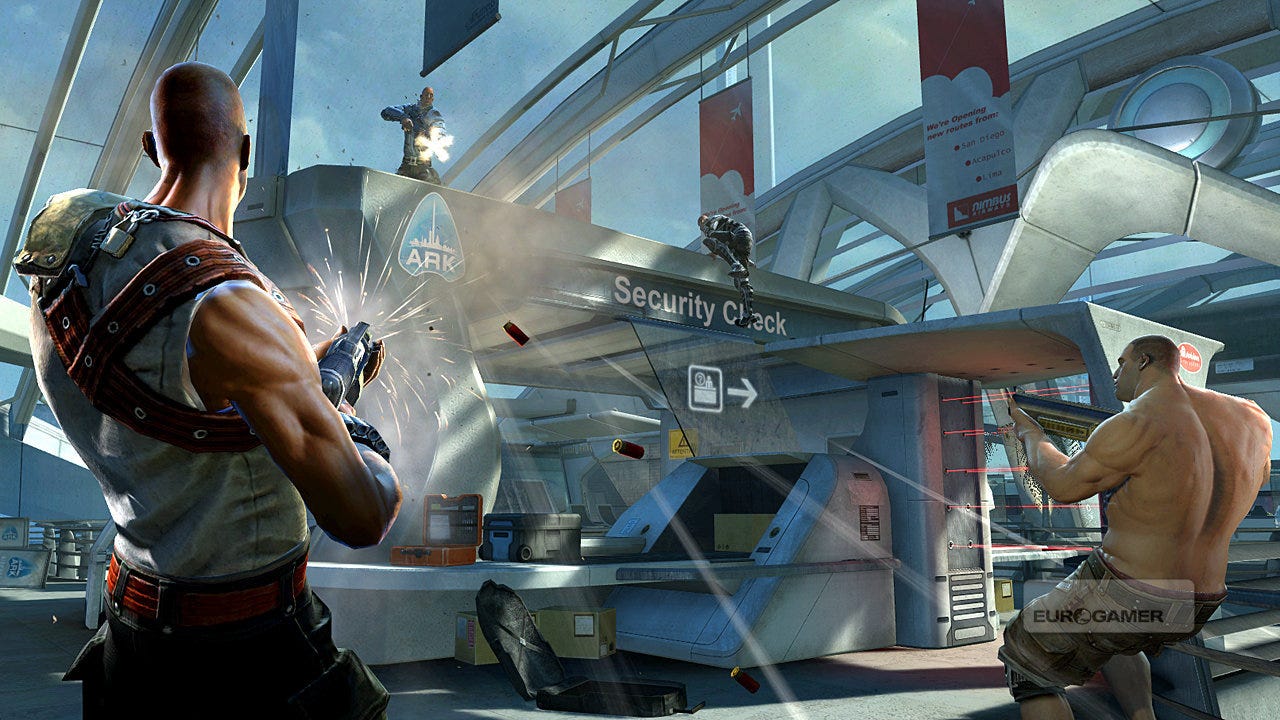
One character will be sufficient for all four of the game's classes, which can be switched mid-game, along with weapons loadouts, at command post terminals on the maps. They're fairly standard archetypes: Soldier (tough assault unit), Engineer (explosives, gadgets and hacking), Operative (stealth) and Medic. You'll advance them separately by earning experience and new skills in that particular role, but your character will also gain global abilities from general play.
"We're all big fans of MMOs, and we really want to give shooter players that kind of experience, that kind of depth, that kind of endless horizon full of exciting opportunities," says creative director Richard Ham, a single-player specialist of Syphon Filter and Fable II fame hired by the Enemy Territory developer to balance out its multiplayer expertise.
"All the classes have a very large number of abilities you can level up and pay experience points to learn, and on top of that there's a fifth class of general-purpose abilities that anybody can have no matter what. So you'll always hold on to spider-s... oh." Ham stops himself from saying "spider-sense" just in time, whether that's down to trademark issues or internal secrecy we're not sure, but it's an intriguing insight into the kind of skills Splash Damage has planned, either way.
"Umm... you'll always hold on to that no matter which class you're choosing. So there's a lot of control, you can make yourself the ultimate Medic, focus everything on to that, really eschew all other roles and still have a really rich experience because there's always something to do within a class. Or you could go really broad and really general."
Both Ham and senior game designer Ed Stern are keen to point out that classes won't feel too limited at the start, however. "Even if you are absolutely new to the game, you can do everything that that class requires," Stern points out. "There have been some games where it's like, really? I'm just a guy with a knife? I have to play for 20 hours before I can plant explosives? That's ridiculous."
Plunging us into an extremely loud demo in a soundproofed theatre on Bethesda's E3 stand, Splash Damage boss Paul Wedgwood starts with some navigational basics, introducing Brink's S.M.A.R.T. button - which stands, neatly, for Smooth Movement Across Random Terrain. Essentially, this is means a contextual acrobatic command that's supposed to lift some of the physical limitations of shooter maps, making it easy to sprint, climb, vault over and slide under obstacles, modifying the single-button press with nothing more than a look up or down as appropriate. Splash Damage has obviously been paying attention to Mirror's Edge, and even hands-off you can tell that movement in Brink has a more solid, physical feel than many online FPS games, as well as more freedom.
We then join a Security team invading a Resistance-held container city, with the goal of escorting a bomb-defusal robot across the map and disabling a Resistance weapon. Wedgwood plays with one live friend, the rest of the Security team and all of the enemy being handled by AI. He's at pains to point out that it will be possible to play everything in Brink offline and solo, but that maps like this one could also take the form of full eight-on-eight multiplayer matches.
"Everything in the game has got to work from every possible direction for every kind of player in every possible context," says Stern. "So effectively, they're all multiplayer assets. It's very complex for us making the environments in terms of routes and so on, but hopefully very simple for the player, because it's all completely consistent. That's really one of the big goals of the game, in that we're trying to get rid of this different mindset for single-player and multiplayer - it's like, well no, that's silly, we're beyond that now.