Brink Preview
Splash Damage on the edge.
Whether he's cranking up the surround-sound for a thundering game demo, or just talking - something he does at speed and without pause, reeling off a five-minute answer to one question that covers the next three you were going to ask and two you hadn't thought of - Splash Damage's Paul Wedgwood likes to, in Public Enemy's words, bring the noise. At 9.30am on the morning after the night before, that causes a few winces. Although, to be fair, it looks like it's hurting him more than it hurts us.
Wedgwood doesn't lower the volume for a second, though. When it comes to Brink, the goatee-bearded head of the Bromley studio that grew from a PC mod community is a tireless salesman, a regular PT Barnum. Perhaps he feels like he's still got a lot of explaining to do, and perhaps he's right.
Brink is part of a growing trend for games that seek to blur the line between single-player and multiplayer. Since Halo 3 extended a lobby system and support for four players across its entire campaign in 2007, and Valve turned a simple survival shooter into the endlessly replayable standard-bearer for co-op gaming a year later with Left 4 Dead, developers have started to question why they needed two methodologies to make one game. Even the conservative heartlands of the Japanese industry have started to explore the idea - see Capcom's Lost Planet 2, out next week.

Brink is made with a heavily modified version of id Tech 4 which, in everything but perhaps frame-rate stands up very well against Rage's Tech 5 showcase across the hall.
Brink, though, is probably the most extreme example of this approach to date, and as a specialist in competitive multiplayer design, Splash Damage is coming at the problem from the other side. Its objective-based campaign episodes have their roots in the design of the studio's Enemy Territory multiplayer games, and drop-in co-op goes all the way up to eight players. Wedgwood openly admits that he hopes to train more casual players up through single-player and co-op to taking on the complex ebb and flow of a Splash Damage team multiplayer match.
The challenge facing his team is to make this feel like a seamless and natural progression, to make the front end and user interface transparent, and to make a game structured around scalable multiplayer stand on its own in single-player against some of the most obsessively crafted experiences in gaming - the theatrical staging of a BioShock or a Modern Warfare, for example. It's a big ask, but winning over the large, naturally suspicious audience of die-hard solo gamers is going to rest on it.
For all Wedgwood's conviction and mile-a-minute patter, another noisy, hands-off demonstration isn't going to answer those concerns completely. But it does put forward two very strong arguments in favour of Brink winning its own personal war. One is presentational: the game simply looks and sounds terrific, and has an improved, attractive, streamlined interface. The other is in an irresistible character-customisation and upgrade trail that will help form the long-term player relationships Brink needs to succeed.
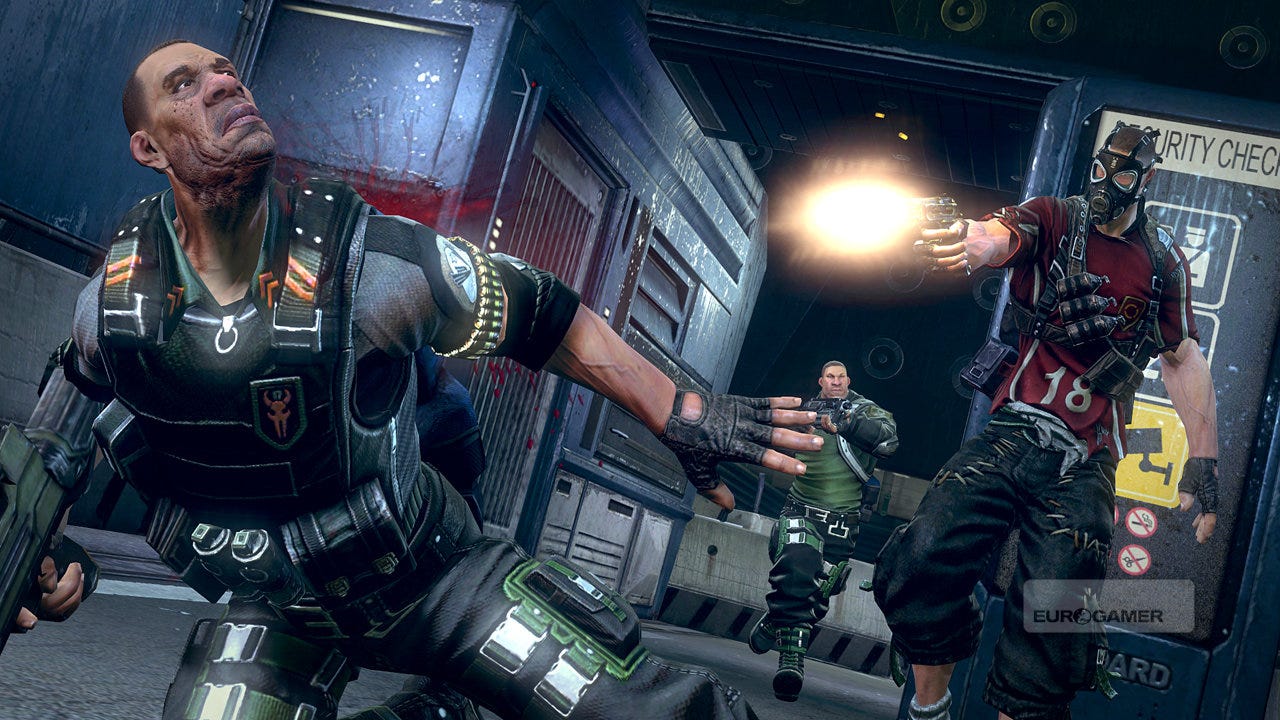
Wedgwood doesn't say much (by his standards) about competitive multiplayer: expect familiar gametypes mixed together via Brink's dynamic mission system.
A quick recap: it's the year 2045 and we're aboard a floating city called the Ark, once a green utopia, now a conflict-torn dystopia after an environmental disaster befalls mankind. Two factions, Resistance and Security, squabble for control, and there's a complete campaign to play through for each. We've already seen
the clean-cut Security soldiers invade the rusting container city that is home to the Resistance HQ. Now, Wedgwood and his colleagues don the cargo pants and bandanas of the Resistance's urban guerrillas to invade the bright, clean, hi-tech spaces of the Ark itself.
Splash Damage has pulled off the increasingly rare feat of creating an FPS with an unmistakeable and novel visual style. The cartoony, exaggerated features of the characters are the main feature of art director Olivier Leonardi's vision. The maps, though much more neutral, still have their distinct personality; brightly-coloured and well-lit under fresh sea skies, and with highly complex but well-defined geometry.
There are hints of Portal and Mirror's Edge about it, and in an echo of those two mould-breaking first-person games - particularly the latter - freedom to navigate the space is key to Brink. Splash Damage's one-button SMART (Smooth Movement Across Random Terrain, acronym fans) system allows you to sprint, vault, limbo and leap around the levels with ease, and without breaking the flow of the action.
"We've always believed that we shouldn't reward you for being good at an interface that sucks," says Wedgwood, and although some might argue that wasn't at all clear from Splash Damage's previous games, it certainly seems to be true now. It all looks wonderfully effortless.
Particularly so, because Wedgwood is playing using the "skinny" body type. Body types - the others are normal and heavy - are among the many customisation options that unlock for your character as you play the game. Heavy gives you access to Brink's most powerful weapons, while skinny increases agility and freedom of movement with SMART, giving access to escape routes, sniping and ambush points and stealth approaches to objectives (but restricting you to using pistols and sub-machine guns).
A skinny body type is therefore a natural companion for the tactical, sneaky Operative class, and that's the class Wedgwood spends most time demonstrating today. Like all Brink's classes and weapons loadouts, it can be switched at will during gameplay at any command point, as well as at the start of a mission.
Delving into the Operative's skills and abilities - those that go beyond simply being able to hack computers to complete objectives - we start to understand just how good Brink's class design and character development is. There are all sorts of clever ideas in the Operative's unlockable skills, from "sense of perspective" (a third-person camera which gives you more peripheral vision when sneaking) to "combat intuition" (alerts you when you're being targeted by another player) or "comms hack" (track enemy positions by scanning a downed opponent). You can even assume the appearance of a killed enemy, at the expense of being able to use your weapons.

Security on the march.
The Medic gains on-the-spot self-resurrection so you don't have to return to the respawn point, Soldiers can learn to shoot grenades, while buffs are key abilities for all classes: Engineers can improve the power of team-mates' weapons, and Soldiers can act as walking ammo dispensers. Brink's skill design is clearly a cut above that of many shooter/RPG hybrids, honed by Splash Damage's long experience in hardcore clan warfare. All of this is attained by a mixture of level-up unlocks and shopping for upgrades with credits.
The same goes for weapons too, and Wedgwood shows us how the game's already chunky and appealing gun designs can be turned into mad, comic-book devices with the addition of scopes, dot sights, muzzle-breaks to reduce recoil, even John Dillinger drum magazines. Each gun comes in a battered Resistance version and a slickly maintained Security model that look and sound different, even if they hit equally hard.
We see two missions, one an attempt to break out a fellow Resistance agent, a pilot, from Security captivity, the other an assault on the core of a fusion-fission reactor. Wedgwood shows how objectives, classes and ammo can be switched quickly through a wheel interface, and how the arrow that points you to your mission objectives reacts dynamically to your movement through the map, changing to suggest a stealthier route if you head off the beaten path.

The slightly cartooned art style works perfectly with Brink's brilliant character customisation and striking virtual fashions.
How the objective system will work in practice, particularly in co-operative gameplay, still isn't entirely clear. Wedgwood makes all the right noises - "We reward you most when you do things that lead to other people having fun," he says, explaining how the game will "bribe" players with XP boosts - but similar systems tend to meet with mixed success if the players using them aren't already organised, as MAG, among others, has proved.
But with its relatively small group sizes - eight-on-eight, or eight versus AI in the campaign - Brink is a much tighter, more focused game than MAG can ever hope to be. And maybe the XP bribes will work when the class and skill design is this good, the weapon unlocks this mouth-watering, the hunger to upgrade this strong.
It won't be possible to max out a character in one run through the campaign in single-player, and Wedgwood hopes that the desire to keep that character in use and take it as far as it can go is what will lead players deeper into co-op and, eventually, multiplayer - and Brink's brave vision for the future of the FPS will come true. He could very well be right.
Brink will be released for PC, PS3 and Xbox 360 in the autumn of 2010.
You may also like...
-
Why Devs Owe You Nothing
-
Digital Foundry: PS3 Skyrim Lag Fixed?
-
Face-Off: The Darkness 2
-
EA evaluating FIFA Street features for FIFA 13
-
Who Killed Rare?
-
App of the Day: Sir Benfro's Brilliant Balloon
-
Gotham City Impostors Review
-
Kingdoms of Amalur: Reckoning Review
-
Sony admits "dropping the ball" with Demon's Souls
-
Ultimate Marvel vs. Capcom 3 Vita Review
-
The Darkness 2 Review
-
Grand Slam Tennis 2 Review
-
CD Projekt: Witcher 2 intro cinematic "the most expensive asset we ever created"
-
Skyrim patch 1.4 now live for Xbox 360
-
One Piece: Unlimited Cruise SP Review
-
Skyrim patch 1.4 performance tip: make a new manual save
-
King Arthur 2 Review
-
Metal Gear Solid: The "Lost" HD Remasters
-
Epic's Sweeney on graphics tech: "the limit really is in sight"
-
Samsung Galaxy Note Review
-
Mass Effect 3 FemShep trailer debuts
-
Next Xbox has tablet-like touch-screen controller - rumour
-
App of the Day: Superman
-
Double Fine Adventure passes Day of the Tentacle budget
-
Valve admits hackers accessed Steam transaction log


Comments (21) Latest comment 2 years ago
Comments threads automatically close after 30 days, but please feel free to continue chatting on the forum!
Comment below viewing threshold Show
Hope it's good!
Comment below viewing threshold Show
please be good & lets hope the frame rate is not terrible!
Comment below viewing threshold Show
It just seems so... generic.
Comment below viewing threshold Show
compared to all the huge deluge of us-army-in-deserty/urban-style-gungho shooter fest?
Comment below viewing threshold Show
The competition between players is what Borderlands missed at it's end game and although the journey from level 1-61 was good, it wasn't good enough to want to start the game over
Comment below viewing threshold Show