A backlash was inevitable.
BioShock is amongst the most critically acclaimed games of the year. In terms of Metacritic average, its only peers are Super Mario Galaxy and Halo 3. You'll note, bar minor sniping, their status hasn't been questioned anywhere near as much as the adventures of a man with a wrench in Rapture's. This, also, is inevitable. They're known qualities. Everyone, to a lesser or greater degree, has made up their minds already. If you can't choke down the saccharine standard Mario world or aren't convinced that Halo's combat mechanics are anywhere near as elegant as its devotees make them out, you're highly unlikely to play them. There's much to hate in both games, but their fans simply don't care and those who aren't fans will never throw away forty quid for something that isn't to their taste.
In other words, a BioShock backlash was inevitable as it's new. People bought it on the strength of the reviews (and the hype - always, the hype) and then, when this random selection of gamers played it and compared their response to the ejaculate-smeared reviews, a larger proportion went "I don't think so" and pointed at the flaws.
But a game having flaws doesn't mean the emperor has no clothes, and the prevalent forum attitude to BioShock has wandered so far away from its merits to require a stern riposte. That I haven't done so yet saddens me a little.
You see, I was surprised to find BioShock's not my favourite game of the year. I'm also aware that perhaps the intensity of discourse around the game had something to do with it. When I think of BioShock, I have to wipe away pages of forum nit-picking and genuinely bitter pub-based rows before I can even start thinking about, at its best, how clever and elegant it is and how on its own grounds it makes everything else released in this incredible year for videogames distinctly second-rate. For most of this year, I've been too tired to actually do this.
But when the response to a patch with free new content is just a shrug and a bunch of whining over free stuff, I can't help but think we - as a community - need a good slapping and a reminder that we should be a little bit grateful. I'll start with more mechanistic stuff and head increasingly into the art, so if you want the fanciest ponce-words, get skipping. And, clearly, HEAVY SPOILERS FOLLOW.
A BioShock backlash was inevitable. As was a backlash to the backlash. So it goes.
"DUMBED DOWN SYSTEM SHOCK."
Yeah.
Okay.
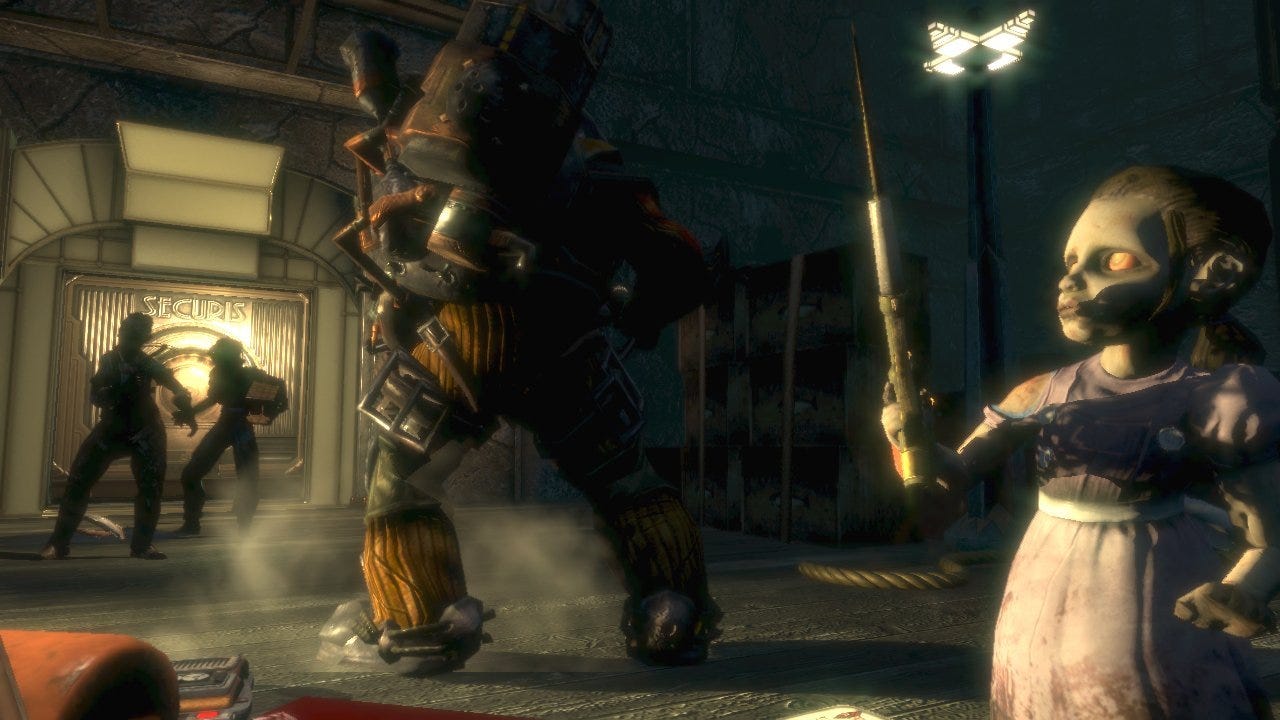
This is a difficult one, because I'm pretty much incapable of reading a paragraph with it in without immediately, out of hand, rejecting the person saying as having anything worthwhile to say. It's a buzzphrase that's just shorthand for "I haven't actually thought about this at all". But actually trying to engage with it... people who throw the "dumbing down" complaints seem to have two genuine issues.
1) It's easier to play.
2) A load of interesting options have been removed so it's a much simpler game.
The first one's true. BioShock is both a more accessible and easier game than System Shock 2. But "easier" doesn't have anything to with it being "dumber", and hating "more accessible" is just petty elitism from people who'd actually like videogames to be a ghetto consisting of them - especially when some of the things to make the game more accessible can be turned off. As long as point two's not true, then the former really doesn't matter.
And the second's not true. Mechanistically, you can do just about everything you can in System Shock. What was removed was either irrelevant, actual flaws or replaced with alternative methods to allow similar expression. For example, pre-patch PC fans were angry there was no option to walk on the PC. But - y'know - walking is about allowing you to move quietly. You can move quietly through the crouch, signifying creeping. In terms of the tactics allowed by your player, you can do the same. It's annoying when the Xbox has it, but it doesn't remove options. There's no leaning around corners but - really - if you're looking around a corner you're visible, and functionally a tiny strafe and back does the same thing.
(I'll concede losing the cover of a corner is regrettable, however.)
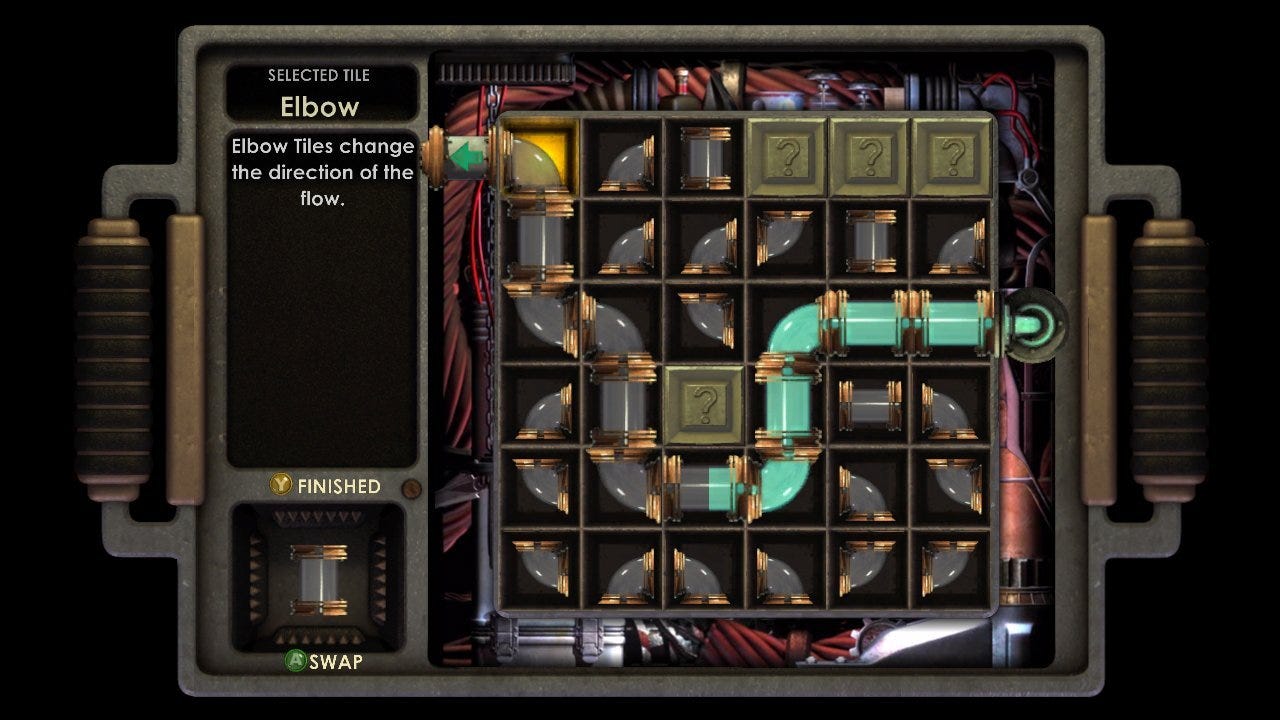
But that said, some of the elements which have been critiqued by the purists are actually more complicated than Shock 2. The hacking isn't BioShock's strongest point... but in Shock 2 it was literally pressing buttons with no relation to player skill whatsoever. The photo-based research is, mechanistically, more interesting than Shock 2's system of just finding the right chemical and dragging it to the right bit of the User Interface. Hell - stuff like the invention and the weapon upgrade system has no parallel in System Shock 2. The formalised role-playing statistics are removed, but a system where you can create a build for your character allows you to vary the character in meaningful ways. There's also the added bonus of increased verisimilitude due to things like weapons degradation and the requirement for a player to have a certain level of a skill before they can use certain weapons being cut. These are elements of Shock 2 which, frankly, most people thought were a bit rubbish.
It's a different, quicker paced, easier game, sure... but in terms of allowable player expression, it's not in any way a dumber shock.
"IT'S JUST SYSTEM SHOCK 2.5."
This, funnily enough, is a much better argument. The plot is similar. The structure is similar. What you actually do is virtually identical - you move around, you look at logs, you explore, you try and collect bits and pieces, you follow orders of some mysterious voice in you head.
It even shares the primary fault of System Shock 2 - despite some merits I'll argue later, the final third is less compelling than it should be. Once you leave the Von Braun in Shock 2, the game loses a lot of its sense of place, and leaving you in levels far more linear than anything BioShock throws at you that late in the game. Except the escort mission, obv.
So, yeah, it's a lot like System Shock 2.
Fair enough. Shock 2 was one of the greatest games of its period. If only all games were crippled with that problem.
"YOU CAN WRENCH, DIE, RESPAWN, REPEAT THROUGH THE GAME."
In other words, it's too easy. They've got a point.
That said, the actual quoted argument doesn't really. On the surface, sure, but on closer examination it falls apart. Sure, if you abuse the Vita Chambers in such a way, eventually you'll complete the game. But why the hell would anyone want to do that? It's like noting you can hit Level 60 in World of Warcraft by just farming the lowest-level creature that gives you XP at any point. No risk to yourself, and you'll get there. Of course, it'll take bloody forever, in the same way our wrench/die/respawner does. The alternate in a relatively freely structured level game like BioShock - quicksaves - still means that any challenge in pretty much every game will be eventually overcome through growing player knowledge of the situation. In fact, in a normal play-through, the Vita Chambers mostly work fine. I'd have preferred them a little less common to make them more of a encouragement to stay alive, but...
The actual punishment is you losing the resources you spent in the engagement before dying. And it's here the game actually gets too easy. Or rather, can get too easy. I was going to start this piece with a line that this is this year's Oblivion - i.e. a relatively thoughtful game that was hailed by critics (and gamers, frankly) on release but a backlash grew... especially when they realised how its balancing was so easy to knock out of whack.
That's the problem with BioShock, to a lesser degree. It only sunk in when I was chatting to Dave McCarthy about it. He didn't really like BioShock and claimed he played through with just the pistol. Which made me blink - because I was constantly scavenging for ammo, working out what I should be using, being forced into unusual tactics due to a temporary shortage and planning routes to go and manufacture the right rounds, right to the final levels. And, frankly, Dave isn't that much better a gamer than I. I thrashed him at Naked War, though he's better at SingStar and has a very impressive Brain Training 20-sums time.
Talking further revealed the difference in play-through. It was the research. He'd researched everything as much as he could, pretty much as soon as he'd got the camera. I'd barely touched the thing, only doing a little when I first met a new monster and a little more if one of the baddies was proving too resilient (the Leadheads, primarily). Since most research gives a damage boost, he needed less ammo to kill people, which fed back into him using less ammo, so filled his ammo reservoirs and he could stick with his handy pistol. Meanwhile, I was enjoying myself scavenging and thinking because I had to. Dave's surfeit of resources presumably only made the Vita Chamber deaths - and the loss of resources before going back - even more negligible.
Of course, this is a fault in BioShock. But it's not a fault which you will necessarily hit, and it's a fault that's far more easy to avoid than the equivalent unbalancing in Oblivion. Just don't go crazy with the camera.
(And while we're at it, remember if you do research cameras to max you don't need to hack them anymore, if you want to sidestep the whole hacking game.)
"IT'S TOO REPETITIVE."
This is a handful of associated points. It's partially a side effect of the research issue, partially the result of a psychological quirk of many gamers and partially a fact there's not that many distinctive bad people.
The first part's simple: When you find a tactic that works, many people stick with it. If they've got too many resources, there's not necessarily a need to experiment so they stick with it. And the game, logically enough, becomes really bloody repetitive.
The second part's a little more complicated: I think some designers believe that players like to do interesting things in-game. BioShock is based around that - in that you're given a wide toolset, with lots of weapons and approaches and ways to improve your character and an environment to beat the baddies up with. Go have fun, says BioShock. But players aren't all - in fact, I suspect most aren't - wired to have fun in a world just because the tools are neat. They need to be pushed into doing neat things. Even if you haven't an excess of ammunition, there's simpler methods to taking people out rather than the more amusing ones. So they do them, and the game's repetitive.
This reminds me of Invisible War's air vents. Invisible War actually had a really rich set of possibilities of things you could do to get around problems. Problem was, there was mostly also a handy air vent. Rather than playing with the other things they could do, most players would just go down the vents, then complain they were spending all their time in vents. Because most players would rather be efficient than have fun. This is just the way many of us are wired, it seems.
The third part is entirely fair. Which BioShock's baddies have a lot of personality, and Splicers - even when they act the same - tend to be individualised considerably. But in terms of what they get up to, there's not that many sorts to deal with. Shame. My personal wish for the patch would have be the two other in progress-big daddy's put in.
"THE FINAL THIRD GOES DOWNHILL."
While critics can't seem to agree where BioShock is at its best - they seem divided between the opening section and the middle third, depending on their inclinations - pretty much everyone seems to think it never recovers from the perfect f***-you moment. You've had the limitations of your existence exposed - and then, with this knowledge, you continue much the same as before, in less inspired levels. There's some truth to this. While it doesn't quite regain the intensity it previously managed, it does include some of the game's best-conceived sections (The Little Sister's indoctrination centre in the last level proper is on par with Fort Frolic, in terms of note-perfect conceptualisation). And - fundamentally - what it shows is absolutely essential to the narrative arc of BioShock.
The game's basically divided into three, broad sections. The first third is the introduction to the world of Rapture. Here, you're lobbed into this world gone mad at the bottom of the sea, progressing through an example of how the three pillars of the society have decayed. You'll have noticed Science, Industry and Art being the three inscriptions as you enter the bathosphere for the first time - which neatly ties into the medical lab, the fisheries and the debased stage-show of Fort Frolic. This is the world. This is how it is. The middle third, broadly speaking, is about your character. Who you are, what you're doing and - eventually - how you're being controlled. You're a slave, a meat-puppet murderer guided by a nihilistic force. Clearly, this grates. You want to get out of that.
The final third, primarily, is about how this is as true for everyone else in Rapture as you, one way or another. You move from the personal nature of control to how a society has been manipulated. The training of the Little Sisters - best personified by the Pavlovian electric shock machine that rewards you for rejecting the silhouette of a woman in favour of the hulking Big Daddy shape - is obvious enough, but how Fontaine manipulated society into revolt in his favour is key. Your first sight in Fisheries is a man strung up and torn apart, with the grim sign "Smuggler" to warn off anyone trying something similar. Looking at the discarded suitcase reveals what the contraband was - Crucifixes and bibles. People killed for trying to express faith? What manner of monster is Ryan? Except that's reversed in the final third. Fontaine's charities were everything that Ryan feared and loathed, using the cover of altruism to gain a power base and willing servants. After the final third, the nature of Rapture is made perfectly clear - Ken Levine's point of unquestioningly following any pre-set belief system being not the smartest thing in the world is made precisely.
It also picks up on the Meta level. You being programmed to kill on order is a critique of every linear shooter the world has ever seen. The final third widens it to everyone else - if you're stuck in a videogame, so is everyone else and... well, that's a really horrible thing. Even the (inevitable, in retrospect, but I was laughing at myself when I didn't see it coming) Protect The Little Sisters Escort sequence, if you've been following the fiction, has a resonance. Of course the girls are going to stop by each corpse. They can't help themselves, and your awareness of how they're trapped makes you falling into the role of protector make a lot of sense - you're fighting, on both levels, to end this videogame. Hell, you could expand that to the final uninspired boss sequence - this is what we're trying to get away from.
Even that has merits which are being glossed over in the "it's just crap" response. There's the incredible visual reference - Atlas becoming Atlas from the cover of the most famous edition of Ayn Rand's novel - and the final image of the nihilist disappearing beneath a wave of syringe-wielding little girls is incredibly right. Even at its lowest ebb, BioShock has something worth talking about.
The truest critique of BioShock is that while it openly ridicules FPS conventions, it never finds a way from it. I'd say, so what? The argument needed to be posed, and BioShock is the first-person gamer working through its awkward adolescence. Hell, that it capitulates to the genre while seething at it probably might even make it some kind of gaming equivalent to Adaptation...
"THE CHOICE DOESN'T REALLY MATTER."
The game was built up as posing challenging moral decisions and showing the consequences. Now, Levine's backed off on some stuff - he's said that the multiple endings wasn't his idea, and they weren't too pleased with how they turned out... but that's irrelevant to what the game actually does. What does the resultant game say?
Some have noted the game's incredibly judgmental - that the ends are you being the Best Dad In The World or some guy who's going to go nuke-crazy.
Hmm. Let's put it in a sentence:
Is it acceptable to kill defenceless girls to stay alive, just because someone tells you do?
BioShock says no. The answer's just "No". It's not something with grey areas - if you do so, you're someone who prioritises your own existence over someone else's or an easily lead dupe. There's no moral excuse. You're an ethical monster, and are made of the same stuff of Fontaine. Or, alternatively, you're someone who treats it just as a videogame. You're not thinking about it at all, just the lovely Adam. In which case, yes, BioShock - a game that's furious that it's a videogame - doesn't think much of you either.
This isn't a problem with BioShock. This is the absolute message. Perversely, for all its claims of edginess, it's the most old-fashioned decent videogame of the year. Where others have teased the idea of good and evil options, pandering to your tastes, BioShock just glares at you. You killed some kids? What Kind Of Person Are You?
"PLOT HOLE X."
For this, file anything that's similar to "Why don't the baddies use the Vita Chambers?" In other words, things which are explained in the game which you didn't play - or think about - deeply enough to discover. Which is fine - it's a game that works on a visceral level - but in doing the equivalent of speed-reading a decent novel, assuming they've missed something isn't a terribly fair thing to do. And BioShock - in a more elegant way than Assassin's Creed - does nest most of its mechanics in its fiction.
(And, no, I'm not saying that everything in the game ties off neatly. Just that more does than it's being credited with.)
Now, this kind of segues into the whole "BioShock isn't as smart as it thinks it is" argument. Having followed the threads, my position is pretty much the reverse. BioShock is a damn sight smarter than most of the people who don't think it's smart.
A completely unfair example: Games industry bible Edge were one of the few organs to not quite join in the review celebrations. One of their points was regarding the clunkiness of parts of the fiction. For example, if Ryan hated America so much, why did he make the currency "Dollars"? Which, as far as criticisms go, is a bit like wondering why Zelda doesn't include any obvious influences of the Indian subcontinent when its currency is the Rupee. Of course, Ryan's problem isn't with America per se - but New Deal democrats with their horrible back-door socialism. He's all for the laissez faire capitalism which characterised a slightly earlier era of the US - which the dollar embodies too. Generally speaking The Dollar is the absolute icon of modern capitalism - of course Ryan was going to use it. This requires a knowledge of politics and social movements in the first half of the twentieth century which the reviewer - and this is a reviewer for the most highly thought of games mag in the world - simply didn't either have or apply. It just thought it was smarter than the game.
I was recently reading an interview with Harlan Ellison in a recent issue of splendid sci-fi magazine Death Ray. He was relating an anecdote about speaking in front of a room of intelligent, educated students. One of them asks a question - it's about a word she doesn't know he used in a metaphor. Eventually, after some back and forth, they manage to work out what it is.
It's "Dachau". When pressed, it seems that about half the students in the room don't know either.
BioShock is a game that knows what "Dachau" is. This is not a thing to damn a game for.
"IT'S JUST MEDIOCRE WITH NOTHING TO REDEEM ITSELF."
I suspect I've managed to alienate everyone, even the people who clicked the link thinking that BioShock was the game of the year. But - y'know - I had to (And Tom offered me cold hard cash). I'm not convinced that hitting criticisms straight on is the way to defend BioShock. At best, you sound just as anal as the people you're arguing against. At the worst, you end up, as I did above, just calling some people ignorant. But sometimes people's positions are ignorant, and when you are, you've got no recourse but to say so.
I suspect the smarter way would be to just ignore the nitpicking and hit the big thrilling chords.
Because BioShock gives back for everything you're willing to put back into it. On every level. It only was really hammered home when I watched a friend playing - I talked them into having a crack on the demo, despite primarily being into Nintendo stuff. And they cheerily arrive in Rapture and walk along, not glancing left or right or down at those banners or... anything. It felt a little like I'd just tossed someone The Wire on DVD, and they were watching it with in x32 fast-forward or something.
With BioShock, the more you look, the more you see. The more you see, the more you have to think about. The more you think about, the more you understand the bloody thing. It's created, by far, the most novel setting for a mainstream videogame this year. Most importantly, while its narrative is of enormous importance to it, it never once betrays the medium. It doesn't - say - present Rapture in cut-scenes. It puts you in a room and puts things in a room and, by induction, you come to understand the place. This is what's most novel about games in relation to narrative - i.e. setting as narrative - and BioShock does it as well as anything ever has.
People who are - say - against BioShock and in favour of Super Mario Galaxy (For the record, I love both), argue Mario is a purer game. It's not true. Mario, by dumping you in cut-scene after cut-scene you have to click tediously through, features an element which is a complete sidestepping of what games can and perhaps should be. I'd accept someone making an argument that Mario's a better game - but a "purer" one stinks of some kind of misplaced fascism. BioShock is nothing but game.
BioShock believes in videogames and what videogames can be, and - if you go along with it - it'll take you to places we've never really been before.
Also: it's the only game which had a soundtrack and ambiance so splendid we started planning a BioShock party where we could all dress up fancy and dance to Under The Sea until midnight, at which point it morphs into a ZOMBIE PARTY.
That's enough. I'm going now. Bye.
"WHAT TENNENBAUM IS UP TO NEVER REALLY BECOMES CLEAR, DOES IT?"
Okay. Got me on this one.
