Version tested: PC
Genre mash-ups are nothing new, of course. Many games attempt to drum up interest by splicing the popular elements from different gaming styles, and the result can either be refreshing or desperate, depending on how compatible the transplanted parts are. However, few mash-ups are as ambitious, or as acronym-unfriendly, as Battleforge. Borrowing bits and pieces from World of Warcraft, Warcraft III and Magic: The Gathering, it's the first ever massively-multiplayer online real-time strategy collectible card game. Call it an MMORTSCCG, if you must. Just don't blame me if you cough up a hairball trying to pronounce it.
The meat of the game is real-time strategy, although it eschews the usual resource-harvesting and base-building micromanagement. New troops can be spawned wherever there are active units, and the only restrictions come from your power reserves. Find a dormant power crystal, activate it and it starts feeding points into your reservoir automatically until it runs dry or is smashed by the enemy. Each new unit spawned, structure created or spell cast depletes your power pool. Defeated or destroyed units pour their cost back into use after a short time.
Also dictating your abilities are elemental orbs, and it's here that the collectible card element comes into play. Rather than selecting a race or faction and making use of whatever comes with the territory, you're able to build and customise your own army culled from packs of virtual cards.
Cards come in four varieties - fire, frost, nature and shadow - and each suit includes ground troops, archer units, defence towers and spells. Each card has its own power cost, but also requires a certain number of magical orbs. These are also found dotted strategically around the maps, and when activated you can choose which form they will take. Some cards require up to four orbs of the same colour, while others only need one of its own colour with additional orbs of any colour before they become available. Each card can be used a set number of times to spawn the relevant unit or effect, after which it only recharges after a lengthy cooldown period, rendering it significantly less useful.
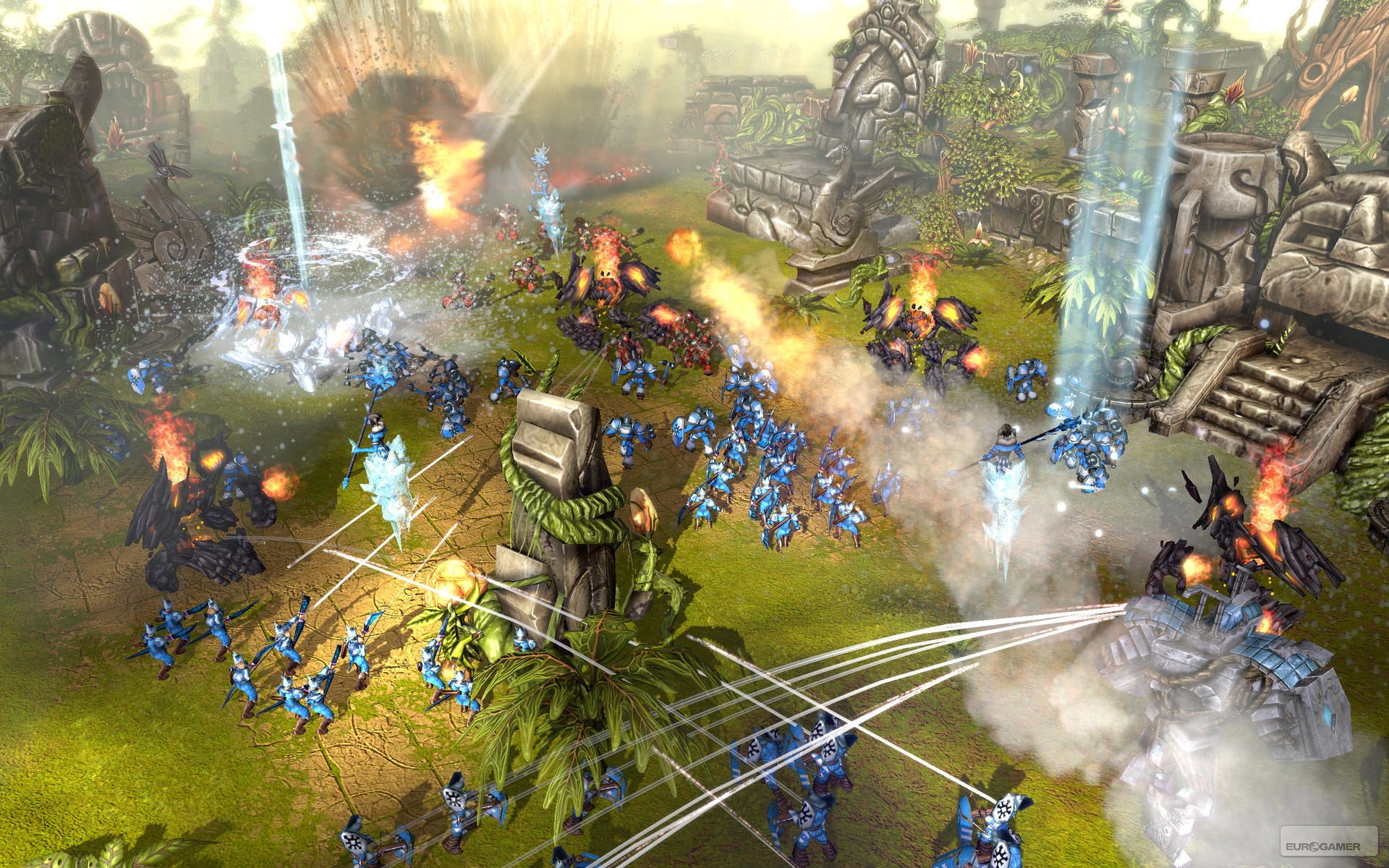
Like many high-speed RTS games, the frantic pace also means that there's little room for actual strategy on the battlefield.
As your collection grows, you can create a variety of different decks of up to twenty cards, and experiment with new combinations in the Forge, a practice arena that doubles as your gameplay hub. Clearly, there's a fair amount of tactical thought required to build a good deck, balancing out affordable troops that can carry a battle in the early stages against the heavy-hitters that can only come into play once you've amassed enough orbs. There are also the elemental properties to consider, with fire cards being better for offensive play, while frost tends to offer more defensive options, for example
Cards can also be upgraded through successful play, and traded online using the rudimentary Battleforge auction system - eBay it is not, but it's a way of getting rid of duplicates or nabbing an ultra-rare - and it's here that alarm bells may start to ring for a lot of potential players. The auctions use the in-game currency, and booster packs can also be purchased. The in-game currency, however, must be purchased using real money. So yes, this is a game built around micropayments. The cost of new packs is hardly steep, running to a couple of Her Majesty's pounds for six random new cards, but some will still balk at the very concept.
There are good reasons to be dubious, even if you don't have a natural aversion to micropayments. Balance is arguably the most vital element of any RTS game, and by offering a world in which players can create a vast array of possible combinations, any hope of maintaining that balance is gone.
The game has a strong focus on multiplayer matches, with a WOW chat window connecting you to other players, and specific arenas for sparring and competitive play, and the campaign mode offers missions designed for two, three, four and even twelve player co-op. Unfortunately, given the vast number of combinations available, there's simply no way to predict what you'll be up against. And since the game relies on a fairly obvious rock-paper-scissors framework, it's all too easy to see your army decimated by some previously unseen behemoth unit, unleashed by someone who just happens to have better cards. In those circumstances, victory is literally impossible to achieve and frustration seeps in.
Many of these problems also emerge in the solo campaign, albeit in different ways. The very first mission contains many of the pitfalls of sloppy RTS design, culminating in a battle against masses of different enemy types - from hulking goliaths to exploding suicide bombers, plus the usual foot-soldiers, archers and fireball-lobbing magicians. As these foes swarm towards you, the frantic pace of the real-time all but overpowers the strategy, leaving you spamming units at the enemy as fast as the recharge system will allow. And there's a vital NPC who must survive the battle. Needless to say, you have no control over him or his troops, and the weak pathfinding and AI means that he's likely to get trapped in a corner and beaten to death while you're still shuffling your cards. Later missions also pull timed defence objectives and escort duties from the real-time strategy Hall of Shame.
The story, meanwhile, is an embarrassing mush of sub-Tolkien nonsense, and does little to form the enormous array of monsters and magic into a coherent and self-sustaining world. Told through chunks of dry text and occasional voiceovers on interminable loading screens, you'll soon be tuning out the droning guff about Skylords and evil Twilight forces.
It all contributes to the sense that while Battleforge is a game bursting with potential, it's held back in lots of little ways. It feels solid and inviting, and it looks lovely, with impressive details considering the sheer number of characters and animations the game needs to offer, but as easy as it is to get into, there are constant niggles. The client software, for instance, is a touch clunky, with no option to save your password, so you have to retype it every time you play. There also doesn't seem to be any way of changing your randomly assigned alphanumeric jumble, or at least I couldn't find it when the game booted me back to my web browser to update my account details.
This sort of giant unit can easily wipe out all your forces in moments. Awesome if he's on your side, teeth-grinding if not.
Other basic options, like the ability to immediately restart a campaign mission, are also absent, so you're forced to slog back through menus and loading screens just to try again. The client also has no voice chat, and expecting players to type to each other in a game this relentless feels hopelessly old-fashioned. These are the sort of rough edges you might forgive in an obscure independent title, but coming from the EA publishing powerhouse a little more attention to detail is expected.
More significantly, the card system is a clever idea, but ultimately undermines the RTS framework more than it supports it. The strategy elements are rudimentary at best, and once you get down to the guts of the thing you're left with a fun but fairly shallow click-dragger. The multiplayer elements deserve praise, especially the broad support for all kinds of co-op fun, but the inherently uneven unit-balancing in a game with this much scope means that joy can turn to irritation very quickly.
Any card game brings with it a certain investment requirement; investment in the time to master the intricacies of the perfect deck, and an ongoing financial investment in the cards to build it. Battleforge is a commendable attempt to find common ground between that mindset and the twin lures of RTS and MMO play, but it can't quite pull them together strongly enough to justify that same level of dedication. A naturally divisive game, a few will succumb to its slightly wonky charms. Most, however, will find that the gimmicks have only limited appeal.
6 / 10
