Version tested: Xbox 360
Everyone loves a fat, juicy rivalry. Pepsi or Coke? Beatles or Stones? SEGA or Nintendo? These simple, binary pop-culture choices prompt endless arguments about which is best, but also help us define who we are and who we stand with. Now here comes EA's Swedish studio, DICE, making no secret of the fact that it wants to add another choice to that list: Bad Company 2 or Modern Warfare 2?
The first Battlefield: Bad Company game was an entertaining blast, with its crudely destructible environments and snot-nosed cast of irascible characters blagging dodgy gold in the middle of a war-zone. Boisterous and exciting, like an affectionate pit-bull, it still felt tentative, timid even at times. This was DICE feeling its way back into a console shooter market that had changed beyond all recognition since they last ventured into the land of the joypad with 2005's Battlefield: Modern Combat.
Bad Company 2, however, is an open challenge to the market leader, Activision's blockbuster behemoth. So let me pin my flag to the mast right from the start. This is the superior game.
It's not just the occasional overt jibe at the competition's expense - though one cut-scene pokes fun at elite special forces who use "pussy-ass heartbeat detectors", while another vocal aside insists "snowmobiles are for sissies" as quad bikes roar along a narrow jungle path. The overall structure of the game echoes that of Infinity Ward's cash-cow while being smarter and deeper in almost every aspect. This is a game that nicks Call of Duty's party dress, and looks better in it.
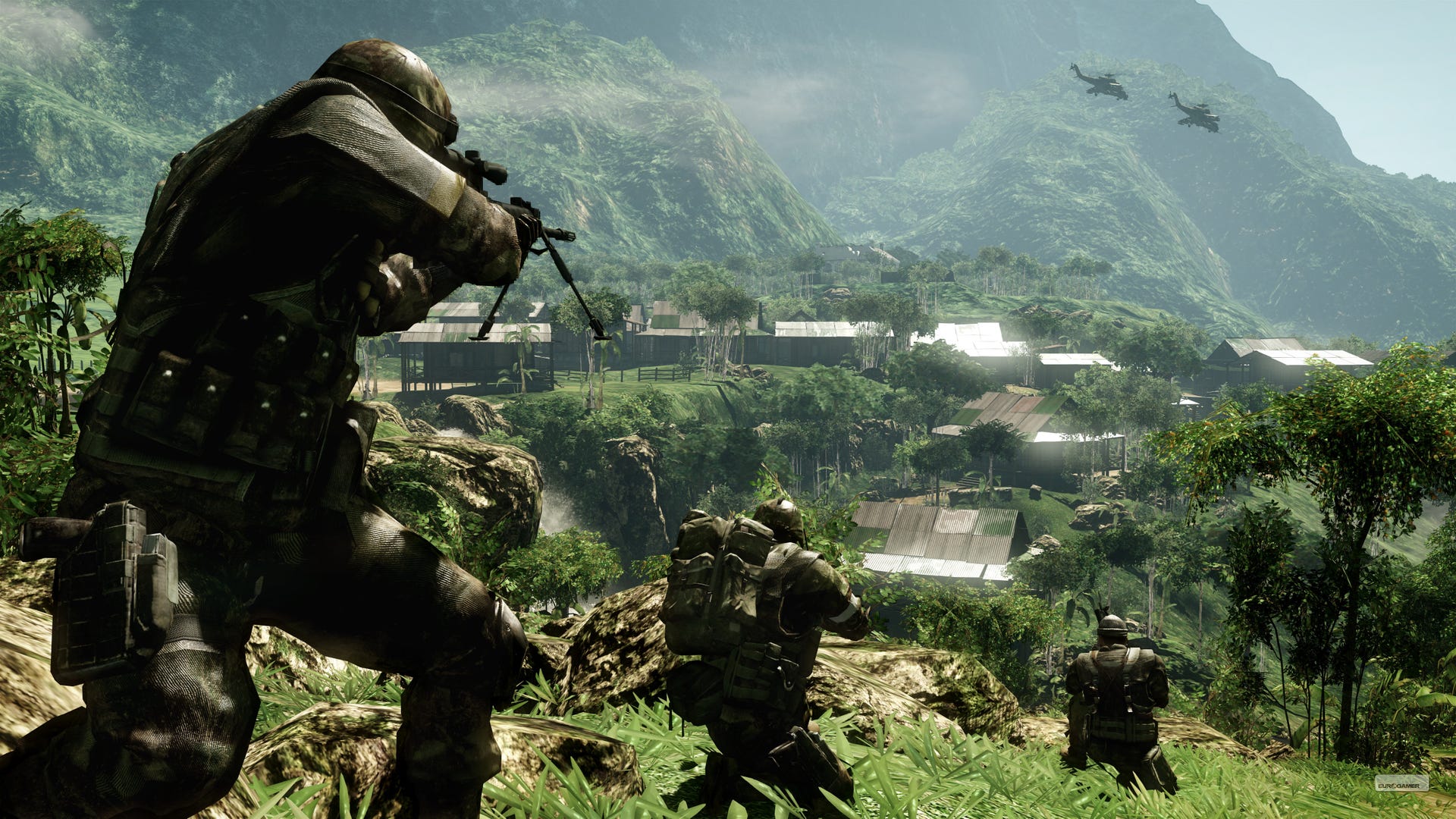
One of the most stunning locations in the game. The reveal of this valley in the story mode is a jaw-dropper.
This is evident from the start of the single-player campaign, which opens proceedings with a tense and lengthy prologue mission set in 1944. This establishes the over-arching threat of the game - a secret and devastating Japanese weapon - and also acts as a nice bridge between the original Battlefield games and this brasher, hi-tech version. The pace is immediate and intense, packing in short bursts of exposition and in-game cut-scene material with frantic running gun battles. It ends ominously, and establishes the saurian foghorn sound of the scalar weapon as something to make your blood run cold. As an opening salvo, it's memorable and effective.
We then cut to Bravo Company in the present day, and the game hits the ground running. While on a routine mission, our quartet of salty, cynical soldiers stumble across something connected to the doomsday device. Clearly, it's about to fall into the wrong hands and Bad Company is swiftly drafted into the world of black ops to track down and retrieve the device before it can be used to aid Russia in invading US soil.
The improvements over the previous game are immediately evident. For one, the story and dialogue are nigh-on perfect. Not only does writer David Goldfarb manage to spin a yarn that hops all over the planet while remaining coherent, he also peppers every dialogue scene with the sort of quotable banter that will thrill any fan of vintage action movies. Unlike Modern Warfare 2's disjointed compilation of set-pieces, Bad Company 2 plays like a whip-smart Shane Black script from the late eighties. The razor-sharp quips are delivered with some superb voice acting and subtle deadpan animation, and the result is a game that will have you laughing out loud even as you're gripping the joypad for dear life.
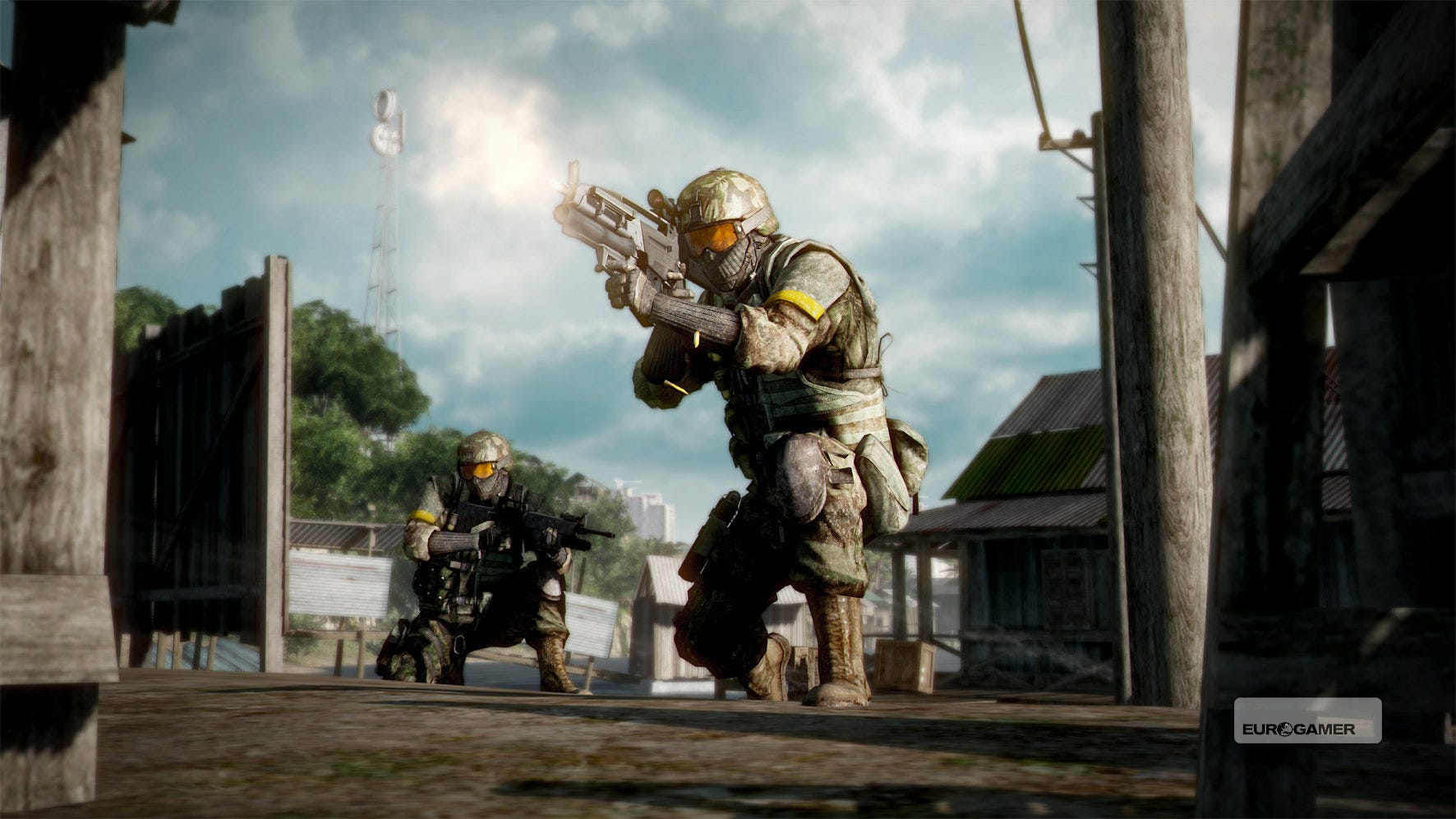
The lack of a prone posture is the only enduring control complaint, making life a little frustrating for both snipers and their hapless victims.
The 13 levels (if you include the prologue) are nicely varied, dropping you into situations that tweak the expected shooter framework in refreshing ways. One particularly memorable section finds you in the Andes, forced to make your way down a mountain in a blizzard. As well as contending with enemy guards, you have to keep finding cover or creating fires with explosives to keep from freezing to death, ice crystals encroaching on your view, your gun rattling in frost-bitten fingers.
There's also an epic mission that sends you to a South American desert on a multi-pronged quest to triangulate the position of a beached freighter containing vital info. The game goes a little bit open-world for this section, offering up three objectives that can be reached by Jeep or quad-bike. You'll battle through canyons in a sandstorm, storm a castle and pick your way through a derelict town populated by snipers before engaging in a tastefully small amount of Gordon Freeman-style first-person platforming to navigate the rusted hulk of the freighter. There are numerous vehicle sections, some of which feel superfluous and little more than excuse for some turret-based catharsis, but they do break up the on-foot action.
It's the firefights that form the meat of the game, however, and they play to the strengths of the enhanced demolition engine without ever making the mayhem feel gimmicky or forced. It's just what happens when you let rip with bullets and grenades in built-up areas.
The vast array of weaponry available to you means that there's always a different way of approaching any given encounter. As in the previous game, collectable weapons can be picked up from dead enemies, or taken from weapon crates, and these can then be swapped out at supply points in each level. This immediately frees the game from the restrictions of a genre that likes to dictate what firepower you can use to tackle each level, allowing the player to find their own style of combat and finesse it throughout the game.
Bad Company 2 is, arguably, still a game on rails, but the track is long and broad rather than a narrow corridor. Between the size of the stages, the weapon flexibility and the scope offered by the collapsing scenery, no two fights play out the same - even though they're every bit as reliant on invisible triggers as anything in Call of Duty.
The enemies don't quite match up to the breadth of gameplay approaches on offer, however. They're not the dimmest bunch in shooter history, but they're unlikely to trouble anyone expecting a tactical shooter. Even on the hardest difficulty setting, their tactics generally boil down to darting in and out of safety, firing wildly. The same isn't true of your AI companions, who walk a fine line between admirable efficiency and deliberately not killing everyone so you've still got something to do. They're also invincible, which looks a little strange as they stroll unharmed through a mortar strike while you cling to life by a thread.
The destruction compensates for these minor wobbles. Even at the end of my second playthrough, I was still being caught off guard by the temporary nature of cover in Bad Company 2. The instinct to crouch by some wall which magically repels all rocket attacks is so ingrained that having that wall showered all over me after one hit takes some getting used to.
Ground vehicles are immediately gratifying, with the more sophisticated controls for helicopters justifying the practice they take to master.
The physics is noticeably more sophisticated than the previous game; it's no Red Faction Guerrilla in the demolition stakes, but it's enough to wriggle another limb free from the straitjacket of traditional FPS design. The ability to shoot through wooden barriers, topple brick walls and eventually demolish entire buildings utterly changes the way you play. Both defense and attack become far more complex problems in a constantly changing battleground.
Control is crisp, with the heavy stiffness evident in the beta test replaced with a responsive scheme that adds heft to your movements while retaining the agility required to keep pace with the blistering action. It's a lovely-looking game as well, despite some obvious pop-in and repetitive character models. DICE has eschewed the glossy, bloom-heavy look of most of its rivals, preferring instead to craft a world rich in detail and texture, with impressive vistas that wallow in their generous draw distance. Explosions are predictably impressive, but it's their aftermath that brings the world to life. Smoke, dust, sand and water spray all linger in the air.
Bad Company 2's single-player campaign would be a genre standout in any year, but it's online that the game comes into its own. It's no wonder that the box bears the tagline "Defining Online Warfare", since the multiplayer component here is a confident, muscular distillation of everything DICE has been building up to over the past decade. This is the online shooter at its most streamlined, most thoughtful, most exhilarating.
Quite simply, DICE understands that you don't necessarily need martyrdom perks, killer dogs or even hundreds of simultaneous players to make an excellent multiplayer game. You just need two very simple, yet often overlooked, factors: maps and balance.
The eight maps available (10, if you use your VIP code to get the two bonus DLC maps for free) are a masterclass in how to gently guide and funnel the player experience without intrusion. In other shooters you can tell which maps have been designed for which modes or with certain class abilities in mind, but Bad Company 2's skirmishes take place in large, roomy environments that feel effortlessly organic.
Drawn from the same broad locations as the single-player without lifting the layouts wholesale, there are no choke points because there are dozens of ways up and down, to and fro, across the map. They feel like real places where war has made its home, rather than artificial arenas designed for videogaming. And if it can all be brought down with the right barrage of explosives or a cunning flanking route, no single player can have an unfair upper hand, no matter how skilled.
For example, I was dropped into one Conquest game already in progress, on the losing side. At this late stage, all our base were belong to them and a particularly skilled enemy had taken to the skies in an Apache helicopter, performing an elaborate aerial ballet and bombarding our last refuge with rockets whenever anybody tried to make a break for safety. By taking advantage of the open environment, however, I was able to lurk out of sight in the scrub, make my way down the coastline to a shipwreck with an AA gun mounted on the deck and bring him down with no small amount of vengeful vindication. Almost immediately, the tide turned; my squad mates were able to commandeer tanks and APCs and start taking back the bases that had been complacently left unguarded, so sure were our foes of air superiority. Back and forth, the glorious flow of Battlefield is still a joy to behold.
You can never be too careful. That tree might be a communist.
The game is full of fantastic little stories like that, and the maps do a great job of letting such things happen, providing the playground but leaving the game up to the players. Scamper up to an attic, use C4 to blow out one of the walls, and create a sniper spot that nobody will think to look for. Lose yourself in the rusty snarl of a beached freighter and wait, shotgun ready, for someone to dash past on their way to an objective. It's endlessly, brilliantly immersive stuff, fully deserving of the Battlefield legacy.
There are just four game modes, but sometimes less is more. Between Conquest (the de facto Battlefield base capture mode) and the objective-driven Rush, the game finds room for every style of online play other than the mania of a free-for-all deathmatch. Squad Deathmatch tickles that itch, setting four teams of four against each other, while Squad Rush caters for the gamer in a hurry, trimming the ebb and flow of the long-form Rush mode down to a deliciously simple "two objectives and you're out" morsel.
This is one of those games where you're perpetually convinced someone is right behind you. Sometimes, they are.
Career progression is similarly well handled. Experience is earned for the usual things - kills, objectives attempted and completed - and there are several ways to tweak your score higher, either by getting headshots or designating targets for your squad to attack or defend. There are over 90 pins and insignia to earn, ranging from simple killing sprees to long-term awards for supplying hundreds of allies with ammo. Each offers yet more XP which accumulates and unlocks a range of benefits, some specific to class, others applicable across the board. It's a balanced system, as befits a developer that has honed PC multiplayer to a fine art; it ensures that there's momentum to your progress up the ranks while preventing any single player from becoming a super-charged killing machine.
Battlefield: Bad Company 2 is quite simply a superb package, with neither single-player nor online feeling like it's been given short shrift. They come together in the most robust, nuanced and carefully crafted game of its type this hardware generation. Modern Warfare is the obvious benchmark, and Bad Company 2 meets and even passes it with ease. But it's the high bar it sets for a genre mired in complacency that makes it so invigorating.
9 / 10
