Initially, I blamed the weather. The hottest week of the year, with the blazing sun promising lazy afternoons in London parks with cold beers to hand, is a pretty uncharitable time to start plugging hours into a massively multiplayer game. I was clock-watching, glancing at the time after every couple of missions, wondering if I'd played enough for today and could justify switching off the PC and marching out into daylight.
Within the first ten hours, however, I knew that something was wrong that had nothing to do with the weather. I didn't really want to go out into the dazzling sunshine - I'm Irish, for God's sake, our reaction to the sun makes vampires wince sympathetically - I just wanted a reason to stop playing APB.
In itself, that's not unusual. Game reviewers end up playing all manner of dreadful stuff, and are honour-bound to play for several hours longer than any sane human would ever wish to. Yet APB doesn't tick the boxes that usually point to a bad game. For a start, it's from a studio - Realtime Worlds - whose last game, Crackdown, remains one of my personal highlights of the Xbox 360's catalogue, and whose creative bosses cut their teeth on little projects like, oh, inventing Grand Theft Auto.
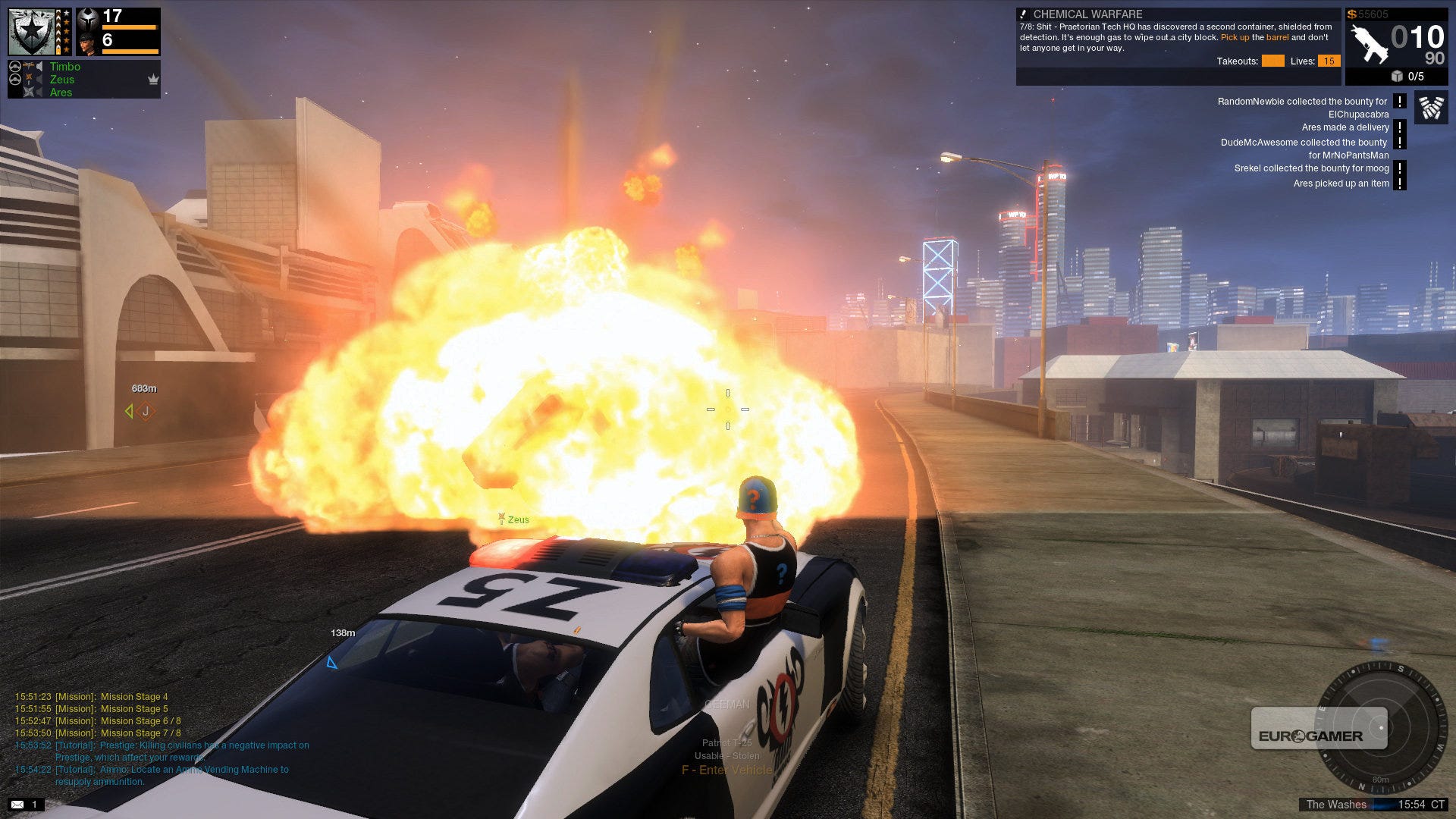
San Paro's approach to law enforcement is unique. He won't be doing that again, that's for sure.
For another thing, APB is a remarkably polished and accomplished game in many ways. I've played many MMOs at launch, and if they share a single trait, it's bumpy starts - server issues, unstable, buggy clients, half-finished content and unimplemented features are the order of the day. Not in APB; the game isn't technically perfect by any means, but it's closer than any launch MMO I've ever played.
If my lack of enthusiasm for APB could be blamed on easily patched technical issues, it would offer a glimmer of hope. It's a lot harder to patch fun into a game which has seemingly forgotten to add any.
That's a sweeping statement, so let me clarify. APB is a game about driving and shooting. It takes the basic template of Grand Theft Auto and attempts to place it into a massively multiplayer environment.
A lot of thought has gone into how that is accomplished, and some very clever solutions have been created, but the core idea is simple - you pick a faction for your character, either a Criminal or an Enforcer, and whenever you start a mission, the game notifies opposing players in the region and offers them the task of stopping you.
Enforcers can subdue criminals with non-lethal weapons and earn bounties for cuffing them.
It's an entirely player-versus-player game, then, where the opposition you'll encounter during quests is made up of other players, not AI-controlled enemies. Each engagement generally ends up with a handful of players on each side, either playing in a team together or shoved together temporarily by the game's matchmaking system, all battling for a variety of objectives scattered around the city district.
Since you can only attack opposing players who are directly involved in your mission, the result is that each sprawling district ends up with multiple gun battles and high-speed chases going on at once, ensuring that there's always plenty of action to watch even if you're just cruising around the city.
If you ignore the conceit of having several of them going on in the same district at once, however, these battles are just third-person multiplayer shooters, pitching a handful of players against each other in a variety of objective-based scenarios. This is the initial surprise for many new players of APB - it has vastly more of its DNA in common with online action games than it does with MMOs. There are few stats, no concept of levelling up in the traditional sense, and no numbers floating around above people's heads in combat. It's a game about shooting and driving.
Unfortunate, then, that so little attention has been paid to the crucial task of making the shooting and driving entertaining. Instead, this is a game whose combat bears all the finesse and refinement of the early 3D GTA titles, and whose driving, although greatly improved since earlier betas, remains a reasonable facsimile of attempting to sail a bathtub down a canal.
The mission structure compounds these problems. Each mission is generally made up of a number of stages, in which you either have to complete objectives or defend objectives from opposing players. In general the final stage will be a lengthy one where you need to capture and hold a location, or grab an item and keep it away from your enemies until the timer runs out.
The weakness of the game's combat is brutally exposed by these missions. Like many games with poor shooter mechanics, camping is heavily favoured, so the second team to arrive at the objective will generally find themselves running in, being shot, waiting to respawn 200 yards away, running the whole way back, and then being shot again. I make no claims to be any great shakes as a gamer, but in general, if I arrived at the objective first, I won the mission; if I turned up second, I died over and over again.
To add insult to injury, on some occasions a team is wiped out with only a few seconds left on the mission clock, only for their foes to capture the location and hold it for a grand total of about five seconds before winning the mission - Realtime Worlds having determined, bizarrely, that victory should be based on who holds the location when the timer runs out, not who has held it for the majority of time over the course of the mission.
The game adopts Modern Warfare's health system - strawberry jam on the screen means you're dying.
Things get even more tedious in the "hold an item"-style missions. In general, the first player to grab the item will make his way to a vehicle as quickly as possible, and drive around the city at high speed until the timer runs out. There's not much you can do about this, especially if the player has a bit of a head start. Unless he makes a mistake and crashes his car (which, admittedly, is fairly plausible given how badly the vehicles handle), the timer is going to run out and he's going to win.
These huge weaknesses are all the more annoying because they undermine the vast amount of intelligent thought and clever design that has gone into the structure of the game. There's something intensely satisfying about APB's meta-game, which gives you the ability to carry out a variety of free-form activities (stealing cars, mugging pedestrians or ram-raiding shops as a Criminal; witnessing crimes and taking out their perpetrators as an Enforcer) and then feeds a steady stream of optional missions to your in-game PDA. These might be new missions for you to undertake, or invitations to join other players who have called for backup to tackle a tough objective.
Criminals can ram-raid shops and steal stuff. Enforcers can raid criminal dens and, er, steal stuff.
The backup system, in particular, is a great concept. In essence, it means that if you're playing solo in the game, you can drift from group to group, playing one mission with one group of people before moving on to another group when the next backup call comes through. The game is heavily focused on team play, but the backup system makes soloing possible - and although you'll often be matched up with idiots, as is the case in any online game, at least it'll only be for a few minutes before the mission ends and you can find a new team to play with.
Unfortunately, it's not just the weak shooting and driving which undermine this system. The matchmaking engine which underlies the whole APB experience is also crippled. At first, I assumed that it was simply an ill-conceived piece of code, but I soon realised that the more fundamental problem is how few players it actually has to match up against one another.
In general, there are only a few dozen players in each instance of the zone at once - the maximum number is around 100, meaning that there aren't actually very many players to match up against one another. (One could argue that this also means APB isn't really an MMO, but as it offers persistent character progression and a large shared social area, I'm going to stick with the MMO terminology.)
The result is that many of your match-ups will be incredibly unbalanced, and it's easy to be put off, early on, by running up against players who have spent vastly more time in the game than you have, and whose equipment is miles ahead of your own. APB doesn't level up your stats like a conventional MMO, but players still gain access to better weapons and equipment as they progress, and of course, those who have spent longer in the game will generally be more skilled. With only 100 players to choose from, the matchmaking system is stymied, forced to throw raw newbies into utterly unbalanced match-ups against seasoned hardcore players - a rather off-putting experience for both parties.
Although it's possible to pay a monthly "unlimited" subscription for APB as you would any MMO, Realtime Worlds expects to cover most of its costs by selling pay-as-you-go game time (20 hours for £5.59). This only applies to the Action Districts, with time spent in the Social District being off the clock. It's a fair enough proposition, but it might not work out for the studio; currently, it's hard to imagine many players exceeding the 50 hours supplied free with the game.
Although it's a good-looking game, with only two districts to see, there's no real sense of exploration.
Did I find anything at all to love on the mean streets of San Paro, then? Well, yes. One aspect of APB which has received almost unqualified praise is its player customisation, and that's certainly the high point of the game. There's an enormous range of customisation possible for your character's physical appearance, and that's only the tip of the iceberg - as you progress you unlock options for clothing, vehicles, decals and even the ability to compose theme tunes that play when you defeat an enemy.
The range of built-in creative tools is truly amazing, and players are already turning out custom clothing, music tracks and vehicles which they can exchange with one another through the in-game auction system. Customisation even offers an alternative advancement system - spending time in the game's Social District, a non-combat region, working on your clothing or customising your vehicles will unlock higher ranks of achievements such as "Fashionista" or "Tuner", each delivering new items to play with and a cash injection for your account.
The character customisation is the best part of the game by far. It's like Barbie dress-up for violent lunatics.
This is perhaps one of the most confusing things about the experience Realtime Worlds has created. The player customisation options are extraordinary, the game client solid and polished - yet the most basic aspects which APB needed to get right, the driving, the shooting and the mission structure, seem anaemic and neglected. There are only two Action Districts in the game, which while large, offer very little variety of scenery, and the missions you're asked to undertake will start repeating themselves within a matter of hours. It feels, for all the world, like the developers were so busy fussing over the interior design and soft furnishings that they forgot to build the house itself properly.
Coming from a team of Realtime Worlds' calibre, it should be no surprise that APB isn't dreadful - as I've pointed out, it's polished and accomplished, and certain aspects of it, such as the meta-game structure and the player customisation, are fantastic. Even so, there's no escaping the fact that the game is hugely disappointing. The flashes of brilliance only serve to throw the mediocrity of the game into even sharper relief.
6 / 10
