Version tested: Xbox 360
So where do you go after "bigger, better and more badass"? The guiding principle for Gears of War 2 produced a masterclass in sequel design, taking a monstrously successful concept, ironing out the kinks and delivering one of the most thrillingly memorable blockbusters of this generation.
Back still further, as Halo had with the original Xbox, Gears of War's debut defined not just a platform, but also expectations for a new era of high-definition console gaming with a stunning demonstration of technical prowess.
In triple-A action, Cliff Bleszinksi and his team could not unreasonably argue that they were always one step ahead of their rivals in terms of raw spectacle with the first two Gears titles. But, of course, someone would always come along to match and then surpass that step.
Bleszinksi, ever-cocksure and combative, clearly thrives on the pressure and the limelight that comes with the territory he has forcibly occupied. But where next?
As the final part of a trilogy, Gears of War 3 not only has its willy-waving technical point to prove and rivals to outgun, but a story arc to conclude. In doing so it offers the most complete (in multiplayer) and human (in the Campaign) instalment, but one whose wings are clipped ultimately not by a lack of ambition, but by the limits both of the blueprint Epic created and the technology it has mastered.
Say what you like about the game, but the trailers are always brilliant.
After the discovery of the Lambent, leading to the fall of Jacinto in the climactic scene of the previous game, Gears 3's narrative deals with the legacy of events and decisions, detailing the consequences of these actions in a torrid tale of harsh realities, sacrifice, and redemption.
One direct impact this has on the game is in its pacing. Key characters are each given time and space to have their 'moment' before the end, with mixed results in dramatic effectiveness and gameplay.
As control switches from Fenix early on, for instance, we're treated to a lengthy and indulgent section focusing on another character's backstory that dulls the pace at too early a stage.
Bleszinksi has stated publicly that the team became "drunk on set-pieces" during the creation of Gears of War 2. Which may be true, but the trade-off here for dialling down the intensity is that the previous game's near-pitch-perfect, breathless consistency is replaced by occasional moments that sag in addition to the many that soar.
And boy, does it soar. When Epic plays to its strengths Gears 3 shines, with set-pieces that blend Naughty Dog-scale widescreen awe with a violent ferocity that would make Nathan Drake faint from the shock.
An underground boss fight in Act II is the first genuinely breathtaking moment of the game. This is followed immediately by another stunning sequence above ground - but somehow Epic still manages to crank it up another notch as the Act concludes with a pulsating siege that evokes the climax of Lord Of The Rings: The Two Towers.
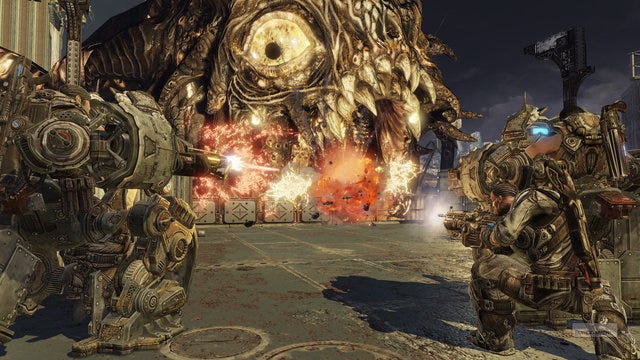
Epic pushes 360 even harder and the results are - mostly, but not always - glorious.
And yet, and yet… Throughout this coruscating rollercoaster of action I could never quite shake the nagging sense that much of it was also a distraction from the game's limitations.
The boss battle I mentioned, beneath its gorgeous terror, is incredibly old-fashioned in the way it plays out; the scene above ground requires you effectively to be strapped in for the ride; and the siege came unstuck when I realised my distressed heroics were actually only delaying the next scripted sequence in the battle.
Later on in this game, I spy an area I want to explore and stamp over with Fenix, only for him to mutter grumpily to himself something along the lines of: "I'm not ready to do this yet." In other words, I have to go back and do things in the order the game expects me to before it will let me cut through a few fragile planks with my massive chainsaw. Oh.
It's at the (still rare, I should stress) moments like this that the bubble bursts. Fall in line with the game's rigid rules and you'll be gleefully whisked along by the majesty of it all; step out of line and the edges begin to fray.
To be clear, for every one of these annoyances, there are a number of superbly judged action sequences that present the series at its very best - sequences which should make repeated play-throughs in four-player co-op an enduring blast.
Furthermore, Epic is no fool and at times there's a playful self-awareness of the fact that, for the most part, Gears sticks stubbornly and unashamedly to its terrifically successful formula. Approaching yet another area whose structure has, by remarkable coincidence, collapsed into perfect lines of cover, Fenix sighs: "Aaaaand cue the reinforcements."
Visually, of all the general improvements to the engine, it's the lighting that works the real magic, at times creating a sense of something I've never previously experienced in a Gears game: beauty. And I struggle to think of a more gloriously convincing riposte to the persistent jibes about Gears of War's colour palette than the setting for Act V.
Elsewhere, however, there's evidence that we are reaching the limits of the hardware, such as those moments when Fenix is arbitrarily required to chainsaw through wood - which result in some horrible clipping as his tree-trunk arms clumsily disappear through it. At times pre-rendered cut-scenes kick in, and slightly dodgy compression sees to it that they lack the razor sharpness of their real-time counterparts.
The game also supports stereoscopic 3D. As with others in the currently shallow pool of compatible 360 titles, this uses side-by-side mode, so the resolution of the resultant image is effectively halved. Nevertheless, for a game so reliant on cover-based shooting, the sense of depth the 3D provides can be an impressively pleasing, immersive bonus.
The multiplayer side is feature-packed and extremely comprehensive, with four-player co-op and Beast Mode the headline additions to an already substantial suite of co-op and competitive entertainment.
The original Gears - a successful formula Gears 3 is happy to recreate.
The delicious novelty of Beast Mode makes it an instant attraction. Offering the opposite perspective to Horde Mode, players control Locust enemy types from the scurrying Ticker all the way to the rampaging Berserker, with teams of up to five players tasked with clearing waves of humans against the clock. It's great fun.
Horde Mode has also been tweaked, with teams now selecting a 'Command Post' around which they can purchase defences in the lull before a wave begins to bolster their position against the onslaught.
In regular Versus mode, after several days of thoroughly enjoyable scrapping with the lucky few already online, whilst forecasting is a dangerous business, it's hard to see anyone getting bored in a hurry with the content that's included.
Of the ten maps on offer here, personal favourites are Drydock, its caged central section a blood-and-guts magnet; the absorbing interior/exterior cat-and-mouse of Hotel; and, for plain out-and-out chaos, Thrashball, set in the ruins of Cole Train's home football stadium.
The overhauled rewards system deserves a special mention. It's a real boon whatever your skill level, often giving you all kinds of ego-salving props even after a total mauling. Whatever and however well you're doing (including Campaign co-op), there's a constant and satisfying sense of progress.
The general sense, then, is evolution rather than revolution, with the team set on delivering the most complete Gears multiplayer experience in the final instalment of the trilogy. While there's nothing game-changing here, it's hard to find real fault with what there is. Certainly, no aspect of the game better represents that clichéd but well-meant "love letter to the fans" mentality.

If not quite bearing his soul, we get closer to Fenix the man in Gears 3.
In its pursuit of the ultimate "wow!" moment, Gears of War 3 can occasionally forget that the player's experience should always have primacy - as one beautiful but bizarrely disconnecting level around three-quarters of the way through underscores.
The script is chock-full of the kind of cheesy one-liners it would by now be churlish to complain about in view of the series. Writer Karen Traviss, faced with the daunting prospect of supplying a solid conclusion, does so while providing enough twists and turns along the way to sate the die-hards.
While the performances are a far cry from Uncharted's standards, we get to see a side to Marcus Fenix in particular that does at last breathe convincing humanity into this elephant-skinned hard man. As thickly as some scenes layer it on for emotional impact, the moment I found most affecting is over before its impact has fully registered. There's probably a lesson in there.
Gears of War 3, then. In its multiplayer, all you could have reasonably asked for; in its visuals, new heights reached, while cracks of old age are papered over; in its story, a fitting conclusion; and in its campaign, though short of the consistent brilliance of its predecessor, a mostly rousing and memorable spectacle.
So where do you go after "bigger, better and more badass?" You go to your fans and give them that which they crave. But now Epic has surely exhausted the formula in its current form - and, probably, on current-gen - the really exciting question is: where next?
8 / 10
