Retrospective: Animal Crossing

DO NOT ESCAP.

Several Christmases ago, I went to Guildford to interview Peter Molyneux. Towards the end of our conversation, I asked him what I thought was a pretty sneaky question in order to get him to spill the beans on his next, as yet unannounced project. "I know you can't tell me what you're working on at the moment," I said, laying a trap so elegant that even a canny panther might find himself caught within its snare, "but can you tell me about the problems with games that you're currently interested in solving?" I sat back and complimented myself on my underhand brilliance. Maybe after this interview, I should apply to the CIA.

Molyneux thought for a minute. His phone went off - a weird Jools Holland-style dum-der-dum-der-dum piano ringtone, I'm sad to report - and he ignored it. Then, he looked at me. "Games," he said, allowing for a portentous pause, "games have lost their sense of wonder."

I smiled and nodded, and pretended to turn that thought over in my head a little. Really, though, I was thinking, "Well, that didn't work." Then I went home and spent most of Christmas stuck on a train just outside of Tonbridge.

I haven't thought about what Molyneux said since - until a few weeks ago, anyway. A few weeks ago, I was having a curry with a friend and chatting about my first encounter with Animal Crossing, Nintendo's weird village sim that I played quite a bit back in the days of the GameCube.

My friend Stu and I - we worked, at the time, two cubicles away from each other - had seen pictures of the game in Edge, but didn't know much about it. When the US version turned up at our local import shop, we picked it up, paying half each for one copy so we could split the shame if it turned out to be a stinker. We didn't bother to read the manual: we just started to play.

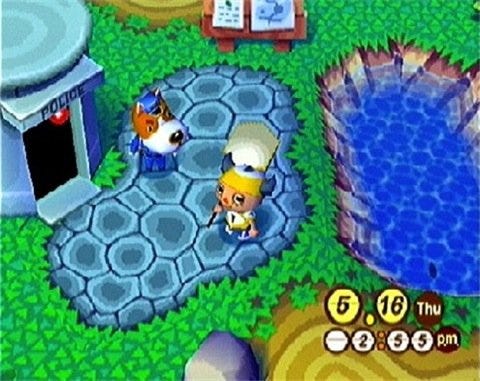
It was a morning in early Spring. We pootled around our village a little, met Tom Nook who is, as I'm sure you're aware, an utter bastard, poked around our new houses, and messed about with a shovel. Animal Crossing seemed strange, but fun: a weird kind of expanded Tamagotchi.
1

If you know Chris Schilling, ask him about the Able Sisters' backstory. IT WILL MAKE YOU CRY.

We checked back in that evening - and that was when Animal Crossing started to come into focus. It was evening in the game now, too, the little windows of the houses sending out warm yellow light, and snow had started to fall. That was enough for us - a game that moved through time exactly as you did, which kept pace with you, evening for evening, month for month! - but there were more surprises in store. We dug a hole, and stuck a pear in the ground, and then buried it.

A shoot emerged! We went for a wander, and saw a gift box floating through the air on a balloon. We chased it, but couldn't catch it, and it didn't snag on any trees. The next morning, Stu phoned me up and said, "That shoot is growing!" (Then he said, "Oh, it's Stu, by the way.") It was all a bit much for us.

I hadn't thought about Animal Crossing in years, but it all came back. In the gloom of that curry house, I heard, as country singers often put it, that lonesome train whistle blow, and I suddenly realised something. Something big. Something original. Something important. "Games," I said, allowing for a portentous pause, "games have lost their sense of wonder."

And so last weekend I tore my house apart looking for a village. The village was called Tristero - I was going through one of my tedious literary stages at the time I named it - and it lived on a friendly chunk of light grey plastic: a GameCube memory card with a sticker on the front that said, "DO NOT ESCAP". (The reason for this, incidentally, makes a strange kind of sense. I had meant to write "DO NOT ERASE" and had been doing a pretty good job of that. Early into writing the word "ERASE", though, my mind started to wander, and I ended up trying to write "ESCAPE" instead. I don't know why exactly. Then I ran out of room for the last "E".)

Tristero was my one, my only, my only ever Animal Crossing village. I shared it with Stu - we passed it back and forth, along with the disk and a scratched copy of Freeloader - and we both lived there. I was called McFly - after the film, okay? - and he was called StueyP: a name, I think, that came from his computer logon at work. We were asynchronous neighbours, living across from each other in a tiny cobbled square. He had much nicer wallpaper than I did.

We also shared Tristero with Spike, a punk rock rhino (I cried when he left), Aziz, a laid-back Lion who liked to play football outside my house at nights, and a seemingly unending supply of grumpy frog folk who would move in, bitch about things, score some sweet matching chairs, and then pack up and head off again. Jerks.

Other local eccentricities included a bizarre bias to having Gulliver, the useless sailor, washing up on the shore. On the flipside, I was lucky to meet Sahara, the travelling carpet salesmen once every six months. No rugs for me. Just Drunken shipmates. (It's part of a wider trend.)

Ours was a world of endless letter writing, chats about favourite slang, and fishing. The seasons changed, festivals I barely understood came and went, I stayed up 'til four every few weeks to meet Whisp, the wandering ghost, if I'd got behind on the weeding (he would do it for you if you netted five spirits for him.)

When Stu came over we'd connect to strange devices like the e-Reader, which allowed us to scan in weird little imported cards for goods, and the GBA, that let us explore a not-very-exciting tropical island. It was exciting to us, though, because we couldn't be bothered to cobble the necessary wires together very often, so it had rarity value. Besides, its coconuts played havoc with the local pear economy, particularly after we planted trees back home.

All of this weird connectivity reminds me how lucky we were that Animal Crossing didn't actually run on the internet. If it had been born in the current climate, it would have to be some horrible kind of service, a mess of micro-transactions and Facebook spam about super pumpkins.

Instead, marching to the ticking of the GameCube's internal clock, which remembered when to start the snow falling, when to send the yearly Groundhog Day letter from mum, and when to tootle Tortimer off on his holidays so that one of us got to actually go inside the lighthouse for him, Animal Crossing became a universe in a bottle.

2

It's a leafy paradise.

It became a place that was convincing and persistent: always changing, but always comfortably cut off from the real world around it, free from updates, new content, and balancing patches, surrounded by high cliffs, water and a ribbon of train track.

It was my universe, and yet it wasn't perfect - and that was all part of the plan. The little nuances and irritations were why, as that guy says in The Matrix, we accepted the place so readily, and went back to it on a daily basis.

In actuality, as countless cleverer writers have pointed out, beneath the papercraft sweetness, Animal Crossing isn't a very nice place a lot of the time. Animals complain, take against you, test your truthfulness with little quizzes, find you lacking, and move on.

Little bugs infest your house, and turn into little bug ghosts when you step on them. Bees sting you if you shake too many trees, axes break if you hit too many rocks and if you're cursed by the travelling fortune-teller, you may find you spend the next couple of minutes falling over all the time.

And, of course, at the heart of all the unpleasantness is that bastard Nook, a shop-keeper and local entrepreneur who stiffs you for your house and turns you into his serf. You plant flowers for him, compose his ad slogans, pay into his exorbitant mortgage schemes, and take endless crap from him every time you go into his shop to buy the things you need in order to perform the tasks he's just assigned you.

When my children ask why monopolies are bad, I won't tell them about the robber barons or Murdoch and his ilk. I'll tell them about a snotty little raccoon who charged me crazy amounts for paint, and wouldn't even let me carouse in his shop after I'd paid up. Carousing, in fact, was expressly discouraged. My kids will learn a lot from me.

Nook has lead a lot of people to suggest that Animal Crossing is little more than a capitalism simulator: a toy-box treadmill away from your normal every day treadmill, a place where you spend your free time working to acquire tables and chairs and funny little doodads to fill out your pretend house.

From this perspective, it's a bleak game; a Diablo for soft furnishings, in which you divide your life between toiling for wages and frittering those wages away, and a game that serves only to remind you how stupid you are, selecting a form of play that looks so very much like work.

There's something to that, certainly, but it's possible that there's something beyond it, too. I've started to think that Animal Crossing has a deeper motive. I've started to think that it builds a rat race in order to give you the option to step away from it.

That was certainly my own experience with the game. I had a few heady weeks of enlarging my house, stuffing the basement with NES titles (Nintendo won't be doing anything like that again), collecting matching furniture, and trying to beat Stu in our flower-arranging arms race.

And then, as with real life, it all started to seem a bit hollow, and a bit embarrassing. After that, I still returned to Tristero every day, but now I did the things I wanted to do. I wandered around chatting to my grumpy frog neighbours, I meddled unmusically with the town anthem until I had achieved optimal terribleness, I wrote letters to Spike, pleading with him not to go, I requested tracks from KK Slider, and I planted pears and watched the shoots grow into trees.

3

Look what I found at the dump.

I loved it all the more now, too, because I had made the time to do exactly this - and I was doing all this instead of getting annoyed about Stu's wallpaper, which really was quite something.

Eventually, the rest of the world caught up to Animal Crossing. On the DS, it became an enormo-hit, and so now even my little sister knows what an enormous dick Tom Nook is. Back then, though, it was a cherished GameCube secret (at times, it felt like the GameCube was a cherished GameCube secret, actually), and I'd no more buy a sequel to Tristero than I would buy a sequel to my own legs - even if my new legs came with a coffee shop run by a friendly pigeon who price-gouged me for imaginary Americanos.

Speaking of Tristero, I'm going to have to end this on a faintly melancholy note. Last weekend, I couldn't find that grey memory card anywhere, so I asked Stu if he had it. He did, he admitted, but he'd gone back to the village recently and found it filled with weeds, so he erased the whole thing.

4

Time travelling by changing the GameCube's internal clock? Cheating.

The whole thing. I'm ashamed to say I felt worryingly bereft at the news. It's lucky I don't have a real job, like doctors or social workers. I'd expected to be able to visit Tristero for years to come.

I'd figured I'd show Tristero to my kids, to my grandkids. I'd even fantasized that - warning: I'm weird - millennia from now, my frail and frozen Earthling body would be found floating in space by extra-terrestrials, Frank Poole-style, and that I'd be thawed, patched up, and would get to jump-start Tristero on some super-advanced mainframe, so I could even show aliens what a dick Tom Nook is. After all that time, Mr Resetti would be reaaaaally pissed, too, I reckon.

That's not going to happen. Tristero's gone, Stu's now a web editor, and I now write about videogames. We aren't in our early 20s, sitting a few cubicles from one another, and we're too old to stay up until four to get Whisp to tidy our village for us. And yet, we still love Tristero. We love it so much, actually, that Stu would rather nuke it from orbit than see it buried in weeds.

Comments (86)

Comments for this article are now closed, but please feel free to continue chatting on the forum!

  • Loading...hold tight!