"Choice and consequence" may be the action-adventure clichι du jour, but being able to define your own combat style through a suite of overlapping toys is definitely up there too. Pretty much ever since BioShock invited us to paralyse splicers with electricity and then whack 'em with a wrench, everyone's been at it.
Typically though, with great power comes great limitation, and in order to keep worlds like Rapture from descending into anarchy mechanically as well as narratively, designers have become jailors, building environments around you like gilded cages that lock you away from too much imagination.
So it's pretty interesting to sit down and watch Arkane Studios' Harvey Smith and Raf Colantonio play around with the tools you get in Dishonored, their first-person stealth game about an assassin with magical powers, because they insist they've taken the opposite approach.
Whenever they introduce a new power or tool during development, within hours someone on the team invents an exploit that kind of breaks the game, like coupling the high-jumping ability with a partial-teleport to travel vast distances and meddle around in the rafters of the world. Rather than shut that option down again, they then think about how they can design levels that benefit from it.
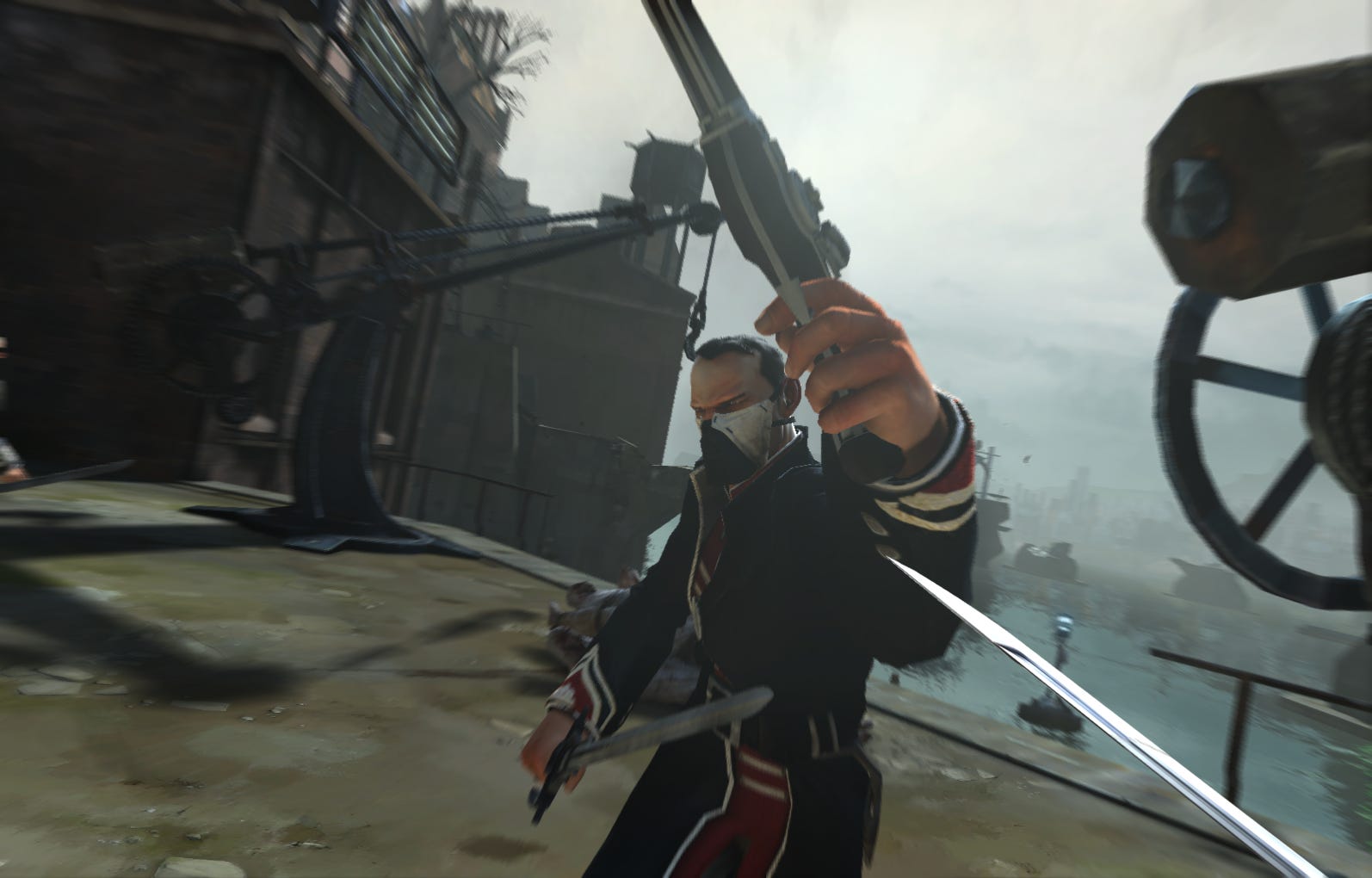
Dunwall isn't an open world it's a series of missions but there's a lot of paths through each of them.
Dishonored is set in a retro-future industrial world where human civilisation is crowded onto four islands in a large and turbulent ocean, and this adventure takes place in the whaling city of Dunwall, ruled over by an oppressive regime against whom your character, a voiceless blank slate called Corvo, has a grudge to bear.
Corvo's been wrongly accused of murdering his employer, the Empress, and the game is about his quest to visit revenge on the people who framed him. In the demo we're seeing at QuakeCon, Corvo is on the tail of a dodgy lawyer who is rinsing the local population for their homes and possessions, but it's up to you how you prosecute your agenda.
Armed with various powers in your left hand and a short, cutlass-like blade in your right, you can hack and slash your way through melee combat, but you can also do things like bending time pausing enemies and queuing up bullets a couple of inches from their faces, then unpausing or blasting them out of windows on bursts of concentrated air.
You can also possess people and animals like rats and use them to travel around, scurrying through ducts into servants' quarters and then resuming Corvo's original shape once you're inside. Again, it's pregnant with game-breaking potential, but Arkane doesn't seem to mind.
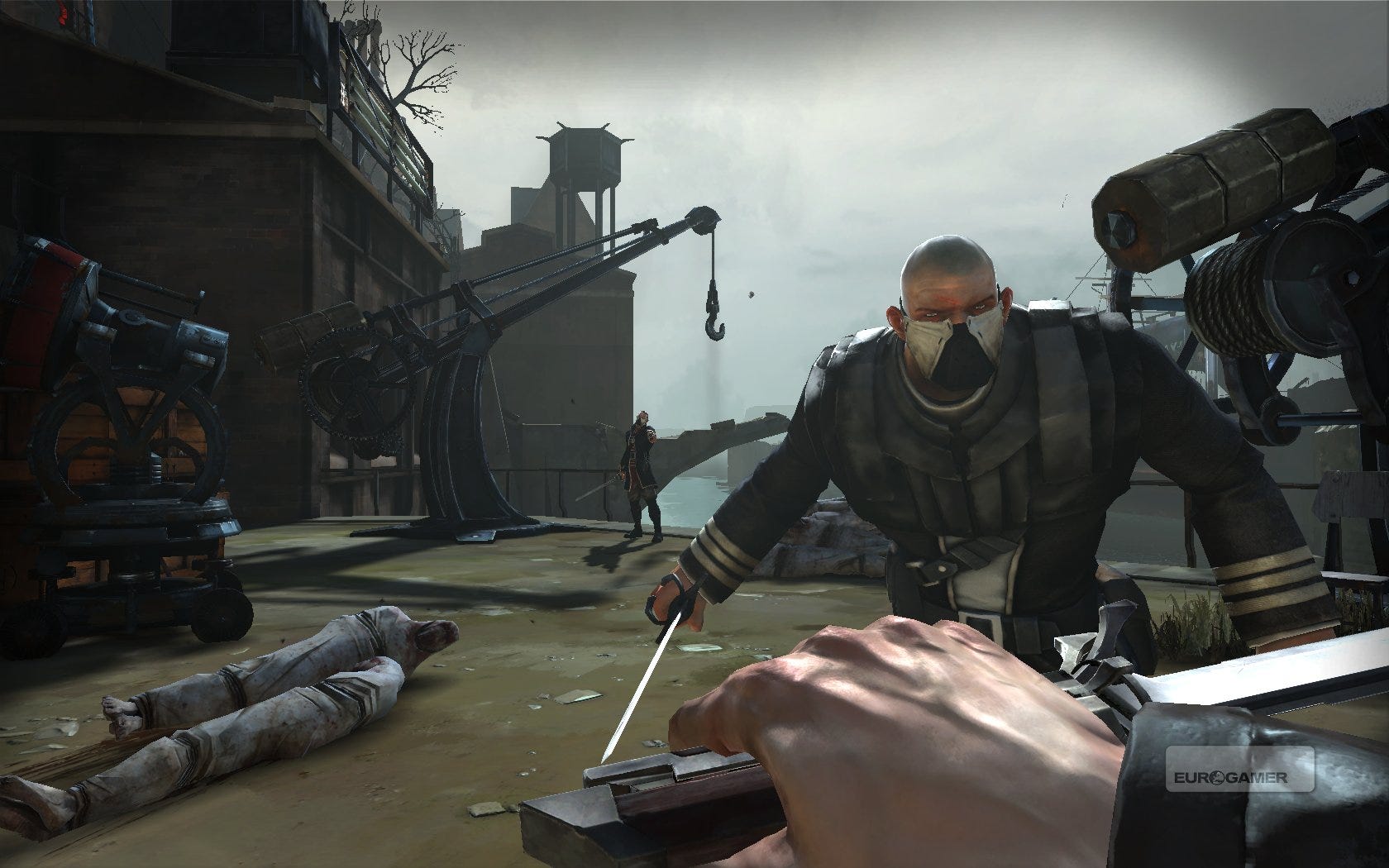
You can hide the bodies, but the idea is that someone in the world would miss them, which sows chaos.
Smith and Colantonio answer most questions with examples of combinations people have come up with. For example, strapping a mine to a rat, possessing the rat and walking it into a crowd of enemies, then possessing something else and getting out of there before the mine explodes.
Another one they rather like is pausing time just after an enemy has fired his gun, possessing him and walking him in front of his own bullet, then getting out of there and letting him suicide himself.
Dunwall is an interesting place to do all these things. Arkane's art director is Viktor Antonov, the guy who imagined Half-Life 2's City 17, and his touch is evident right from the first frame of our demo, staring at the reflection of a bleak, overcast sky in a glassy ocean that stretches as far as the horizon.
There's a whaling ship coming in its blubbery mass suspended above the deck by a huge H-frame crane. There's no electricity in Dunwall although this is not Earth, the architecture and period dress is decidedly Victorian but the volatile whale oil has recently been harnessed into various echoes of Nikola Tesla, like Wall of Light barricades that zap anything that passes through them into mists of blood.
Dunwall is also in the grip of a plague, spread by the swarms of rats that clog the streets. They approach the player or dead bodies and feast on them in daylight, munching loudly amidst the scarlet haze of disintegrating flesh. The local government is using the plague as a good excuse to harvest and purge whatever takes their fancy. Everything's in some way corrupt.
As well as the central objective, you can also explore the world around you to try to find hard evidence of the lawyer's corruption, or other tools that you can benefit from like blueprints that allow you to hack the Walls of Light so they let you through but aren't so kind to pursuing guards.
Every significant action you perform has a potential ripple effect on events later on especially negative actions like killing civilians or guards, which feed into the game's Chaos system.
The more of this chaos you set in motion over time, the more your options change. A character who discourages your violence may choose not to support you or even betray you further down the line if you ignore his advice, for instance. Or areas of the world may be more hostile to your presence.
You can always choose not to kill. Dishonored as perhaps befits a game designed by the men who made Deus Ex and Arx Fatalis is an assassin game where you don't have to assassinate anyone. Silence, shadow, occlusion and distance protect you from discovery as you stalk side streets and rooftops, and by exploring all your options you can even find ways to eliminate your target without actually killing them.
Arkane has spent a lot of time working with 3D sound, muffling it through walls and so on, so you can plot your stealth effectively.
The developers estimate only one per cent of players will want to take this path, but they evidently care about that one per cent, allowing them to save anywhere even on console so they can try to preserve that invisibility by recalling earlier states.
Arkane clearly wants you to experiment, too, allowing for partial failure all over the place. In our demo, Corvo sneaks into the lawyer's home and makes it to his office lurking in shadows, peering through keyholes and waiting for guards to pause in front of paintings or warm their hands by fireplaces to sneak past on the way and eventually confronts and kills him in a blaze of magical abilities. But if you do alert the lawyer, you can continue he'll cower somewhere, or run away, and that will change the way the mission unfolds but won't stop you from succeeding in it.
Games like Dishonored often have a sort of purity problem here, where being discovered feels like a shoddier outcome, and it remains to be seen how that will pan out, but there seems to be enough interesting content around every corner to distract you from that notion, like a final battle with Tall Boys tough, shielded enemies on stilts who fire rockets at you.
Arkane says we can expect multiple game endings depending on your actions, although there's no New Game Plus option - you just start over.
Dishonored looks rough around the edges at the moment. Some scenes, like the arrival of the whaling ship, closely followed by a quick eavesdrop on a pair of guards dumping plague corpses in the sea, are polished and compelling. Others, like the ascent through the lawyer's house with repeated guard chatter and slightly clunky NPC routes, are still getting there.
We also still have much to see like the progression system through which you accumulate your abilities, based around collecting runes and much to understand, like Corvo's link to the supernatural world and its role within Dunwall and the surrounding Pandyssian Continent.
But as first impressions go, this is a beguiling one, sumptuously potent. After so often being invited to use our imaginations but only up to a point, it's exciting to see a game that perhaps watched that Would You Kindly moment in Rapture once upon a time and thought: well then, we better let them do what they want from now on.
It's also quite amusing that the level we saw was called Eminent Domain, because part of me did sit there thinking "compulsory purchase".
