Dead or Alive: Dimensions Review

3 double D.

Version tested: 3DS

Portable fighting games: to some they're an enjoyable time-sink with endless replay value; to others, they're a mechanically sound premise that's let down by frustrating controls. But while it's easy to whinge about d-pads and analogue sticks when you're dropping simple combos, when you consider the pocket fighter's progression in recent years, it's clear we've come a long way.

The PSP has near-flawless ports of Street Fighter Alpha 3, SoulCalibur IV and both Tekken 5 and 6, and with the advent of the 3DS, we can add a fully-fledged Super Street Fighter IV and BlazBlue: Continuum Shift II to the ever-growing list. But despite offering some of the richest fighting systems in portable form, few handheld fighters can match their console counterparts. Dead or Alive: Dimensions, however, is one that can.

Those unfamiliar with Dead or Alive may have heard about leather-bound ninjas, jiggly breast physics and extreme button mashing - and to be fair, most of these assumptions are entirely correct. But while DOA is considered to be less technical than Virtua Fighter or Tekken, it offers a precise fighting system that lets you punish predictable combos with ease. A DOA master will always trounce a DOA dabbler.

Dimensions is no exception, featuring a system that's based on Dead or Alive 4. But to make the flow of combat slightly less demanding, the counter system is borrowed from Dead or Alive 3. As such, there's no difference between countering punches and kicks as you simply counter by height - be it a low sweep to the shins, a sucker punch to the midriff or a high flying kick to the head.
1

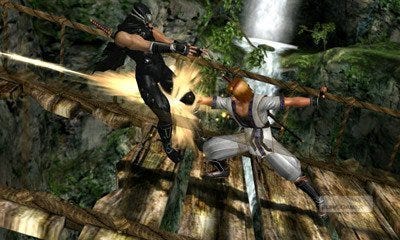
Dimensions doesn't feature any Aerosmith, which depending of your music tastes, is either a good thing or a bad thing.

A rock-paper-scissors dynamic also gives the fundamental techniques a clear strength and weakness. Strikes beat throw attempts, throws stuff up counters and well-timed counters turn the tables on striking momentum. It's classic Dead or Alive, and there's nothing like baiting your opponent into a predictable strike, only to answer with a galling counter that sends them ricocheting off an electrified wall.

However, this only covers the basics, as Dimension's flashiest combos are built around the Critical Stun and Launcher systems. These work by having certain moves that put your opponent into Critical Stun, and for every hit you land before they break free, the height of a follow-up launcher will be slightly increased.

This leads to freeform combos that require you to mix up your strikes so your opponent doesn't guess correctly and counter. And while that may sound baffling on paper, one of Dimensions' many triumphs is how it progressively teaches the full combat system through the Chronicle story mode.

The story is split between five Chapters that recount the canon plotlines of the main DOA games, and while you'll likely finish it in one sitting, it offers a ridiculous (but nonetheless entertaining) narrative that features hidden villages, multinational corporations and nefarious experiments. It's a retelling that focuses on the four main ninjas with everyone getting their moment in the spotlight - although for drunken master Brad Wong, this means showing up unexpectedly, trying to grope Ayane, getting beaten up by Hayate and then wandering off.
2

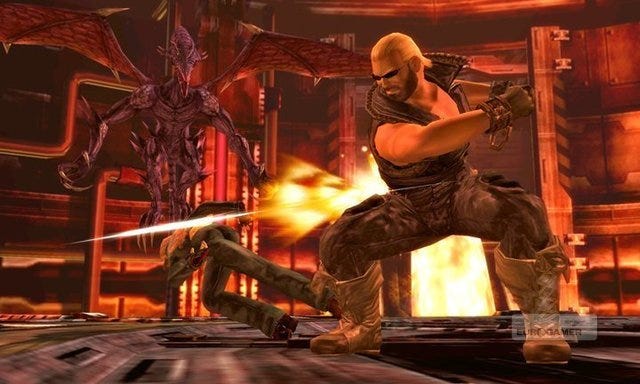
There are around 15 playable stages, including a Metroid arena that features Samus and Ridley in the background.

Chronicle mode also acts as a showcase for Dimensions' smooth graphics and seamless animations, and although it recycles a few FMV sequences from the series' history - including Hayabusa's ending from Dead or Alive 4 - the other cut-scenes are rendered with the in-game engine and use 3D for maximum effect. It's a convincing field of depth that puts most other 3DS games to shame. But once Chronicle mode is done and dusted, you'll likely turn the 3D off, as fights are best viewed at the standard 60 frames per second.

Another tricky decision comes courtesy of a select screen that offers every character from the series' 15 year history. This includes Jeet Kune Do doorman Jann Lee, wrestling actress Tina Armstrong, Sambo commando Bayman, karate high school student Hitomi and ninja siblings Kasumi, Ayane and Hayate.

Five unlockable bosses brings the character tally up to a fairly impressive 25, and although the game lacks original characters, a selection of new moves means series diehards will have plenty to discover. The main roster is also split between 11 men and nine women, making Dimensions one of the most sexually balanced fighting games ever.

But if you can't decide between the dainty damsels, muscular men and Eliot, then the Tag Challenge mode lets you pick your two favourites. This is different to the tag system from previous DOAs, as you only take charge of one character. Your partner, meanwhile, is either controlled by the AI or a friend via local wi-fi. And while this may sound like a cop-out in lieu of a full-featured tag mode, Tag Challenge is surprisingly fun to play.

The "challenge" aspect comes in the form of solo fighters and tag teams with brutal AI difficulty that can withstand lots of punishment and deal heavy damage. But to balance things out, you and your partner can tag out to recharge health while performing tag combos and throws. A limited lives system also lets you revive a downed team-mate if you can stay alive for five seconds. But if you're down to your last slither of health, this is harder than it sounds.

The other features on offer include an Arcade mode with six difficulty courses that range from Easy to Hard, a Survival mode that challenges you to win anything from ten to 100 consecutive fights and a Free Play mode that lets you get straight into the action. There's also the obligatory Training mode that comes with everything you'd expect - except a record function. But as an aid to improving your game, Dimensions also offers two lower-screen functions.

The default function is a handy Move Details box that automatically highlights whichever move you're performing, along with its nearest contemporaries. This is perfect for those who're just starting out as it's a constant reminder of each character's depth. But the pièce de resistance is the alternative Move Details box that displays everything from damage scaling and critical damage to the start-up, advantage and disadvantage frames of each move in your repertoire.

3

The 3DS' gyro sensor is used to tilt the camera angle on the main menu. Gimmicky but fun.

This is an excellent tool for advanced players as it lets you gauge the safety of your own moves as well as looking for possible exploits in the various match-ups. It's the only game I can think of that actually contains frame data; Team Ninja should be commended for going the extra mile. But while these technical features are aimed towards fighting game enthusiasts, Dimensions also offers its fair share of casual content.

By winning fights you'll gradually unlock 999 different figurines that can be viewed in Showcase mode, and if you feel the need to "create epic diorama scenes" as the game suggests, then you can put your figure collection into compromising poses with the 3D Photo Album. While it's a throwaway addition at best, anyone familiar with the Trophy system from Super Smash Bros should know what to expect.

The final piece of the puzzle is the online functionality offered by Internet Play mode. This works by tapping into your wireless router and offers a choice between two- or three-round matches against local or global opponents. A dual ranking and matchmaking system also charts your progress while pitting you against similarly skilled opponents, and while the netcode isn't anything to write home about, the stability of local matches is still impressively smooth – especially for a handheld fighter.

4

All the DOA bosses make an appearance including Raidou, Tengu, Kasumi Alpha, Omega and Alpha-152.

However, to describe Dimensions as simply "good for a handheld fighter" would be a huge injustice. By offering a finely tuned fighting system, a full cast of characters, a seductive graphics engine, a robust online system and a multitude of excellent modes and features, it's easily the best Dead or Alive to date.

And although you're within your rights to moan about the d-pad and thumb stick if you choose, in this reviewer's opinion, Dead or Alive: Dimensions is the best game currently on the 3DS and the best portable fighting game ever made. It's no less than the pocket fighter of choice.

8 / 10

Read the Eurogamer.net scoring policy

Comments (65)

Comments for this article are now closed, but please feel free to continue chatting on the forum!

  • Loading...hold tight!