The Witcher 2: Assassins of Kings Review

Son of a witch.

Version tested: PC

Do you know that strange bit of gaming folklore that an RPG can be judged by its first town? It's true more often that not. Baldur's Gate 2 was a planet-sized experience that thrilled in first setting you loose in the intimidatingly vast city of Amn. The first Fallout's settlement of Shady Sands was a bleak scrap of nowhere where the primitive inhabitants could be saved, perhaps, but they could also be exploited.

The Witcher 2's first quest hub, the damp and drunken swamp town of Flotsam, is as true a statement of intent as I've ever seen in an RPG. If you didn't play the first Witcher and aren't aware of the setting and mythology behind these games, a description of Flotsam should bring you up to speed.

Flotsam is a gory place. On one side, the stinking, moss-coloured Pontar river dutifully carries a huge number of trade vessels, but also a legendary monster. On the other, a larger-than-life fairytale forest hides everything from colonies of burrowing, bloodthirsty imps ("Nekkers") to the Scoia'tael, a guerrilla army of elves.

In the universe of The Witcher, elves and dwarves are the subject of heavy racism from humans, and the Scoia'tael represent a furious, deeply political elf faction who Just Won't Take It Anymore. If they had their way, Flotsam would be reduced to ash. They can't have their way, however, thanks to Flotsam's similarly resolute commander and his disproportionately large, hateful, womanising militia.

Flotasm sounds like hell, right? Wrong. Flotsam's beautiful. Everything from the architecture, to the conversations you overhear, to the tasks given to you by the nervous inhabitants - it's all breathtakingly believable. Flotsam being a disgusting and dangerous place, both materially and morally, isn't the point. The point is that - as you watch a butcher hack a cow apart under a pale sun and listen in on a conversation about who shagged who last night - the setting is real enough that you'll actually be disgusted, and feel in danger.
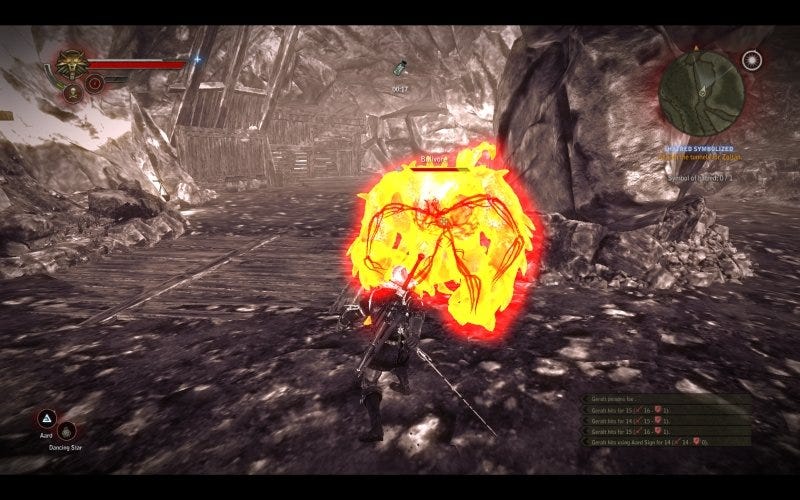
1

Kate Middleton is so last month. 'The Geralt' is going to become the new most-asked-for haircut. Watch this space.

This is the most obvious of The Witcher 2's many achievements. It provides a world that's so well thought out and so lovingly crafted that the player is transported. Flotsam is a shitty place, yes, but The Witcher's is a shitty world. What CD Projekt has achieved here, more so than any RPG I can think of from the last five years, is bringing its (shitty) world to life.

This plausibility extends to the game's merciless plot. It's a tale of love, war, unlikely allegiances, unexpected rape and even more unexpected pregnancies, assassinations and accidents, with so many bent moral codes and political groups that any gamer who wants more than a vague sense of what's going on will often find themselves referring to the brilliantly written in-game codex of information.

For now, it's probably best to sum the plot up by saying that your character, Geralt of Rivia, is trying to prove that he is not, in fact, the titular assassin of kings, and move onto exactly who and what Geralt is.

Geralt is a Witcher, a rare breed of mutant notable for two things. One, they're legendarily strong and have a knack for magic, and make their living as monster slayers. Two, they're sterile, and therefore a hit with ye olde ladies.
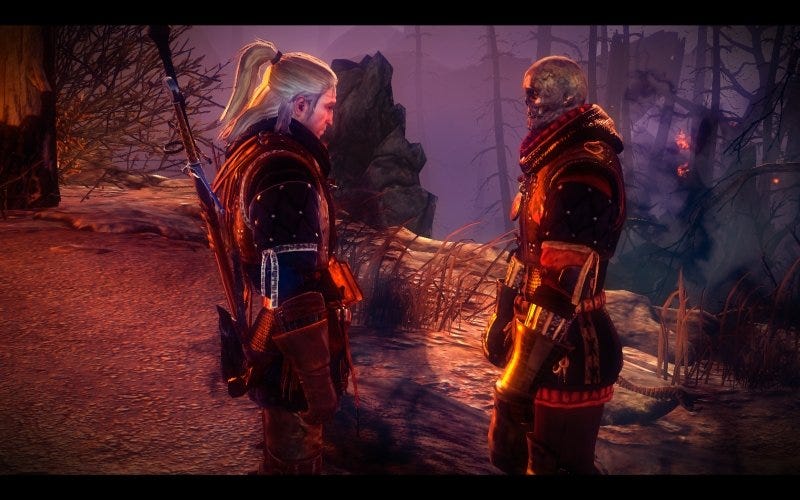
2

Scraps of defeated monsters can be hung on Geralt's back. Which is nice, as the ladies love a desiccated troll penis.

The Witcher games have, a little sadly, come to be defined by all the sex Geralt has, with the "sex cards" you collected in the first game being a pretty memorable feature. The sex cards are actually gone this time around. While Geralt can still seduce his way around the world if you so desire, there's less sex in general (with one wonderfully venomous quest even using the promise of it to trick you). In part that's because this is a shorter game (clocking in at some 25 hours), but also because it's keener to press you into the fighting that defines Geralt.

Combat is also the key area where The Witcher 2 falls from greatness. When it works, which it does for most of the time, it's a joy. Simultaneously slow and panicked, you control Geralt from a third-person perspective, delivering heavy blows from one of his two-handed swords (silver for monsters, steel for everything else) with clicks from the mouse. A few key shortcuts handle magic, evasive rolls, throwing knives and traps.

Combat itself is a matter of crowd control. You get hits in where you can, cast spells when you can't, and live in terror of being flanked. Being totally surrounded results in you getting bounced around like a football with such incredible brutality that it might be funny if it weren't happening to you.

When it works, it's fantastic. The game routinely pits you against a half-dozen or more enemies, and surviving these encounters by the skin of your teeth through quick thinking and preparation feels massively satisfying. There's a sense that Geralt wins fights not because he's the hero, but because of talent, training and intelligence. Which, of course, makes him even more of a hero. He's a great protagonist.

The problem is one of balancing. The Witcher 2 has an inverted difficulty curve. Rather than starting you off gently and getting tougher as you learn, The Witcher 2 starts off ungodly tough after an inadequate tutorial, then eventually plateaus into being hugely tricky, before you finally end up progressing far enough into the game's skill trees that everything becomes too easy.

Where most games expect you to climb a mountain, The Witcher 2 is more like being thrown out of a plane after a parachute and then expected to walk the last 20 miles. This imbalance extends to the gear Geralt finds, which is all over the place. You might painstakingly craft a jacket from the carapaces of forest spiders only to find something better with relatively little effort not 20 minutes later.

Thankfully, the game lets you lower or increase the difficulty at any time, although I'm not sure if starting off on Easy is all that wise. Instead, I'd recommend you learn early on that the shield glyph and charm glyph - the two lowest magic attacks on the list revealed by pressing Ctrl - are your best friends in all those wildly unfair fights.

Besides, it's only when you're struggling with fights that you'll get involved in the many excellent ways Geralt has of preparing for them. By sitting Geralt down to meditate (a pose in which he looks so absurdly badass that I can't help but wonder how many gamers will take up meditation as a result) you get access to the alchemy and potion-drinking menus, where you can mix any number of poisonous tonics that will buff him slightly. There are also traps, which can be assembled and set in advance.

3

Bulletstorm had a four-barreled shotgun, right? I will give 10/10 to the first game to feature a four-handed sword.

The sum of all of this is a combat system with all the potential in the world, but that coughs up everything from perfect duels and nightmarish battles against ridiculous odds to dull cakewalks and fights so infuriating that you need to turn the game off for a bit to make a cup of tea and do some catatonic staring out of the window.

It's a little disappointing, but it's completely fixable should CD Projekt choose to put out an Enhanced Edition, as it did with the first game. And it's something of an achievement that 'combat that's all over the place' is by far the biggest complaint anybody could level at the game.

The rest of The Witcher 2's errors - which consist of small glitches, bits of exposition getting jumbled up because you did some quests in the wrong order, a couple of crappy scripted events and some of the worst doors I've ever encountered in a game - are all inconsequential things that leave you free to enjoy one of the most impressive RPGs ever made.

Combat might have its low and high points, but the talking and exploring is one long high point filled with upward spikes into brilliance. Without wanting to give away a single moment, I found myself routinely cheering at my monitor, laughing more times than that, and had even more occasions where I stared hopelessly at my conversation options, too captivated by the situation to make a choice.

4

You end up fighting with doors so much throughout the game that I was half expecting the end boss to be a giant enemy door.

Speaking of choices, one decision you make in the game's first half alters the rest of it more radically than I ever would have believed if I hadn't talked to a friend who followed the other path afterwards. Between this, correcting all your other mistakes and following a different path down the skill tree, there's so much meat to be found in a second play-through that it's barely even a decision. If you've a completist bone in your body, you will be playing this game again.

Fans of RPGs should consider The Witcher 2 a must-buy. There's simply no competitor that can touch it in terms of poise, characterisation and storytelling, or the way in which it treats you not as a player - someone to be pandered to and pleased - but as an adult, free to make your own mistakes and suffer a plot in which not everyone gets what they deserve.

Everybody else should approach excitedly, but with a little caution. The Witcher 2's opening ten hours are as impressive as they are clumsy, and a little patience is needed until the game hits its stride. What a stride, though. What bravery and gravity. With a little time investment, this game offers everything the fantasy genre can be.

9 / 10

Read the Eurogamer.net scoring policy

Comments (114)

Comments for this article are now closed, but please feel free to continue chatting on the forum!

  • Loading...hold tight!