No More Heroes: Heroes' Paradise Review

Touchdown!

Version tested: PlayStation 3

At the halfway point of No More Heroes, a boss pontificates to Travis Touchdown on the nature of being an assassin. "Seeking meaning in everything is a bad habit," Travis deadpans, before suplexing the peg-legged mentalist into submission and dumping her body in a sandhole.

Holly Summers is one of many bosses in No More Heroes, which is more or less a game about boss fights. A gaggle of semi-psychotic originals and archetypes - each introduced painstakingly, dispatched quickly, and dying slowly - they're the constant in a bizarre world as puerile as it is profound, as mundane as it is thrilling.

It's also an old Wii game, and here things get a little confusing. No More Heroes: Heroes' Paradise is an HD port originally released for 360 and PS3 over a year ago in Japan. However, this version of Heroes' Paradise also includes Move support and a bevvy of extras that range from welcome to queasily sexual. It's also the first European release of the game with all of the gore intact - the Wii release replaced blood with black pixels, an effect that worked pretty well, if you ask us.

The jump to PS3 is not a small one, but Heroes' Paradise has great material to work with. The setup: Travis is the 11th-ranked assassin in the world, and under direction from the irresistibly saucy Sylvia Christel (a petite French blonde perfectly sculpted to give any nerd the ooh-la-las), has to kill the ten assassins above him to climb up the ranks.

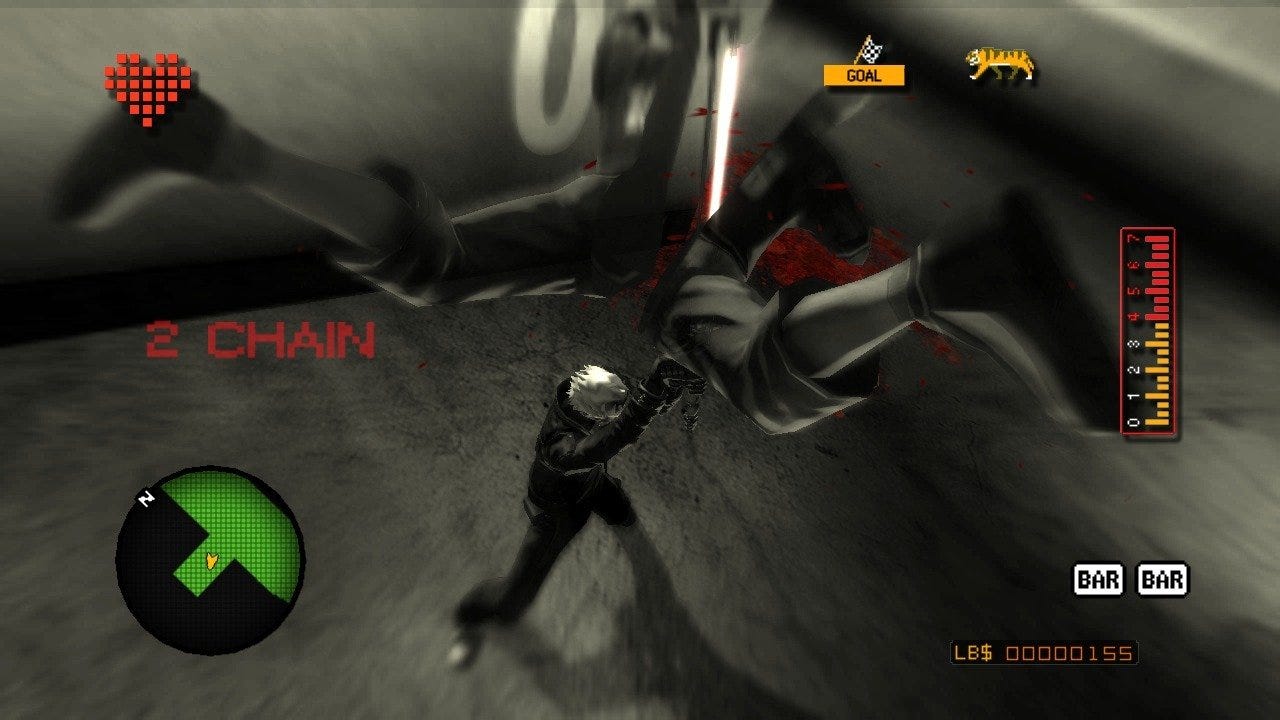
The combat system looks beautiful and feels great. Travis' 'beam katana' is No More Heroes' greatest visual flourish, its luminescent twirling and crackling lighting up every encounter and finishing it off with a great big bang of a swing.

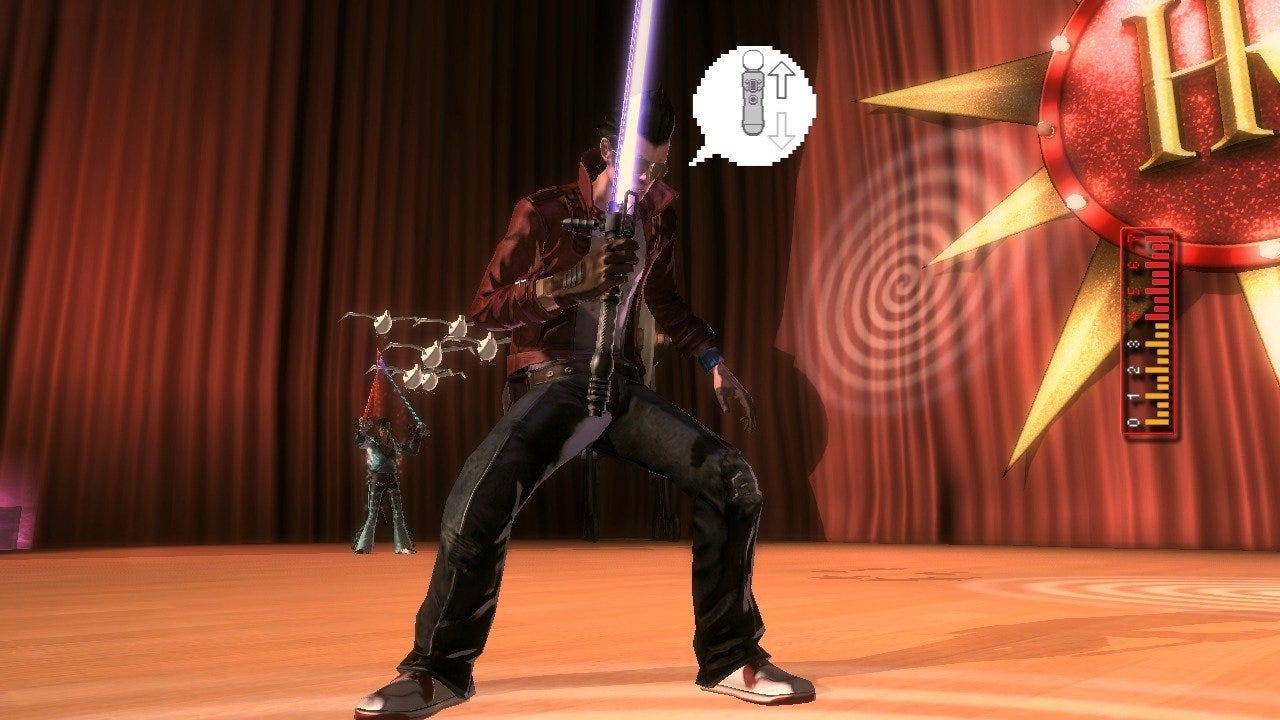
The Move controls are a headline feature, but No More Heroes isn't really a motion-control game so much as a game with motion-control elements. Finishing blows are delivered with a directional slice, the beam katana is recharged by vigorous shaking, there's plenty of mini-game waggling, and Move handles these simple actions perfectly well without ever feeling essential.
1

Travis' Dark Side abilities (read: super invincible death mode) can now be saved up until needed, a welcome tweak.

Fighting is a mixture of parry timing, frantic button mashing and spectacular QTE finishing moves, and it's a system where the depth is stylistic - fight cautiously and Travis guards bullets and blows like Obi-Wan, cracking out with his own flurries in the instant of an opening and ending with a clean blow. Parry everything and he begins breakdancing and executing near-invisible samurai sword swipes to lop up the packed thugs and coat the screen in blood.

Add a library of classic wrestling moves picked up throughout the adventure, which let you go all lucha libre on stunned enemies, and every fight's a little different. There are too few enemy types, unfortunately, but perhaps they only seem samey in the context of the bosses.

Each one is a trump card for No More Heroes, and developer Grasshopper Manufacture knows it, saving up all the best ideas for these regular high points. Dr Peace, second on the list and clearly based on Charles Bronson, serenades Travis in an empty baseball stadium with an Engrish ballad so good it was a single, before an awesome sword-versus-revolver showdown.

It doesn't let up: homicidal schoolgirls, dishonourable superheroes, white-trash witches, masked magicians and smoking hot amputees. Each of the assassins has their own style and set-pieces, and cutting through them - especially on Bitter, a difficulty unlocked after completion - is a rewarding challenge.
2

The beam katana runs out of juice periodically, and has to be recharged through a very particular motion...

Then there's Henry, or as Travis calls him, "Mr Sir Henry m***erf***er." It's worth mentioning Henry because, if you like lightsabers, fighting him is the best lightsaber action going in games. It's not quite up there with Devil Hand (what is?), but it's hellishly close.

There isn't a single duffer among the game's marquee fights. Good job, too, because No More Heroes tests your patience between them. The town of Santa Destroy is a small open world that plays host to menial jobs in the form of mini-games, assassination missions, a few stores, some collectables and not much else.

Santa Destroy, taken for what it is, has charm. Travis' ridiculous bike, the Schpeltiger, looks like a Sinclair C5 and handles like a truck, but its flaming exhaust, wheelies and plentiful boost make it a fun ride - especially in first-person.

Much of the criticism aimed at Santa Destroy is technically fair and holds for this version of No More Heroes: it is largely barren, with stretches of nondescript block housing and boxy vehicles alongside the most basic of NPCs. But this isn't meant to be the kind of sandbox environment we're so familiar with.

It's meant to be a boring small town. And it is. This aspect of Heroes' Paradise is ingenious, sometimes very funny and often frustrating: it has parts that are quite deliberately menial. Take the jobs Travis acquires to make some extra cash. They're all timed at two or three minutes and seem to finish up just as you're getting bored of that particular repetitive action. It's clever-clever, but frankly the jobs would be better if they were fun.

Repetition is a wider problem: the freelance Assassination missions, picked up in Santa Destroy for extra cash, are mostly uninspired re-hashes, with the occasional glimmer of an idea hammered home ad nauseam. No More Heroes' saving grace is the combat system, but that doesn't excuse such a paucity of content.

Quite apart from this, Heroes' Paradise isn't technically outstanding. There's screen-tearing and AQ Interactive, responsible for the port, also makes some dreadful decisions: the various posters dotted through Santa Destroy have been defiantly embalmed in their original pixellated form, and the on-screen font when you're doing jobs has been irretrievably ruined.

There's also one minor detail, unavoidably missing, that made the original perfect for its platform. The phone calls from Sylvia before each boss just aren't as special, because on the Wii she spoke to you through the remote's speaker.

That obviously isn't a big deal, but it points to a deeper truth about the original. No More Heroes was always defiantly lo-fi and gimmicky. Its characters and combat look spectacular, but the rest is basic, and its visual charm rests in touches like the arcade scoreboard after each boss fight, the icons composed of giant pixels and the blooping sound effects. No More Heroes should look great in HD, and it kind of does, but the increased resolution also makes some of what was passable into flaws.

3

The game name is from a Stranglers track with genuinely the worst rhyme ever: Shakespearos.

But No More Heroes was always an aesthetic triumph rather than a technical one, and there's more vivacity in any one of its characters and designs than entire other games. The HD treatment works best on the main character models and those wonderful beam katana effects.

Substantial additions for Heroes' Paradise include five bosses imported from the game's sequel, who crop up occasionally when Travis falls asleep on the toilet. The simple arena created for these excludes any of No More Heroes 2's more excessive pyrotechnics, sadly, making these fights feel a little vanilla - after all, half of it is the show. You do, however, get to perform a rotating backdrop on a schoolgirl while listening to what sounds like an OutRun tribute. That's got to go down as some kind of result.

There's also a score-attack mode, which gives the bosses a Street Fighter select screen and offers online leaderboards, and there are a few new jobs in Santa Destroy. There's nothing among the additions that changes the game per se, but the new bosses are a nice bonus.

It certainly has problems, both as game and port, but none are big enough to bring down the whole. In literal terms this is a game about killing, and plenty of it. But it plays out with a more human element: specifically, how life sometimes sucks, and the escape value of fantasy. Controlling deadbeat Travis as he rises through the ranks is a vicarious thrill, an experience that's still sweet because it's still rare.

4

The motel in No More Heroes, interestingly enough, is based on the one in Memento.

The frequent description of Travis as an anti-hero falls woefully short: outside of his ridiculous combat abilities, which are clearly a necessity, he's a geek and a bum. He watches too much porn, buys too many T-shirts, and after the hyperbolic fantasy of each match-up returns to his little motel room and starts another dead-end job to get some money together.

This is a man's game, in other words, but not in the "hoo-rah titties" sense. It's about the crap bits: going to work, receiving a surprisingly large bill, or that hottie you fancy who doesn't fancy you, and who turns out to have a husband. Its open world is a bare one because it only contains what's of interest to Travis: the job centre, a video store, a gym, a couple of esoteric buddies to visit. Santa Destroy has no place for a comedy club, because the whole thing's kind of a joke.

And Heroes' Paradise? It's a rip-roaring beam katana slashfest with the odd dull moment - a heady brew of gore, coins and mini-games, full of gamer culture and presented with unmatched flair. It's crass and it's delicate. It's a fantasy real-world fantasy with as much meaning as you care to take, as long as you don't take it seriously. It's a game about games, and stuffed with the kind of scenarios and salacious tidbits that presuppose a largely male, largely 20-something audience ready to get lost in them.

So let's put it this way. If you masturbate with any degree of regularity, you'll probably really enjoy No More Heroes: Heroes' Paradise. And you can quote me on that.

8 / 10

Read the Eurogamer.net scoring policy

Comments (60)

Comments for this article are now closed, but please feel free to continue chatting on the forum!

  • Loading...hold tight!