Version tested: Xbox 360
Last month marked the 20th anniversary of the most important fighting game ever made, and although I dare not speak its name in this opening paragraph, it shows how far the genre has progressed in two decades. It also highlights those series which started out as fresh ideas, and then thanks to a steady supply of subtle tweaks and major leaps, evolved into the current cream of the combative crop.
Virtua Fighter pioneered the polygon punch-up and now has a daunting degree of depth. Tekken introduced limb-based controls and today is rich with command lists and extreme juggling. And although Soul Blade was once described as Tekken with weapons, it paved the way for SoulCalibur and the 8-Way Run system. But in comparison to these mechanical innovators, Mortal Kombat has been riddled with creative decay for the last 15 years.
This Mortal Kombat is a revamp that returns to the series' roots while taking notes from the competition. We're back to a 2D fighting plane with a five-button layout that delivers punches and kicks in ambidextrous variations. The combo system retains the uppercuts and sweeps that old-school fans will instantly recognise and each character has a selection of one-hit strikes and multi-hit assaults that can be combined with their special attacks.
This means Scorpion can start with a two-punch combination, cancel into his "get over here!" special (still back, back, punch) and then propel his victim into the air with a launcher before finishing with a well-timed dash uppercut. That's a five-hit combo that uses a more freeform combat system, and while past Mortal Kombats had an illusion of freedom – but were ultimately scripted – this Mortal Kombat encourages players to find the limits for themselves. It's much the better for it.
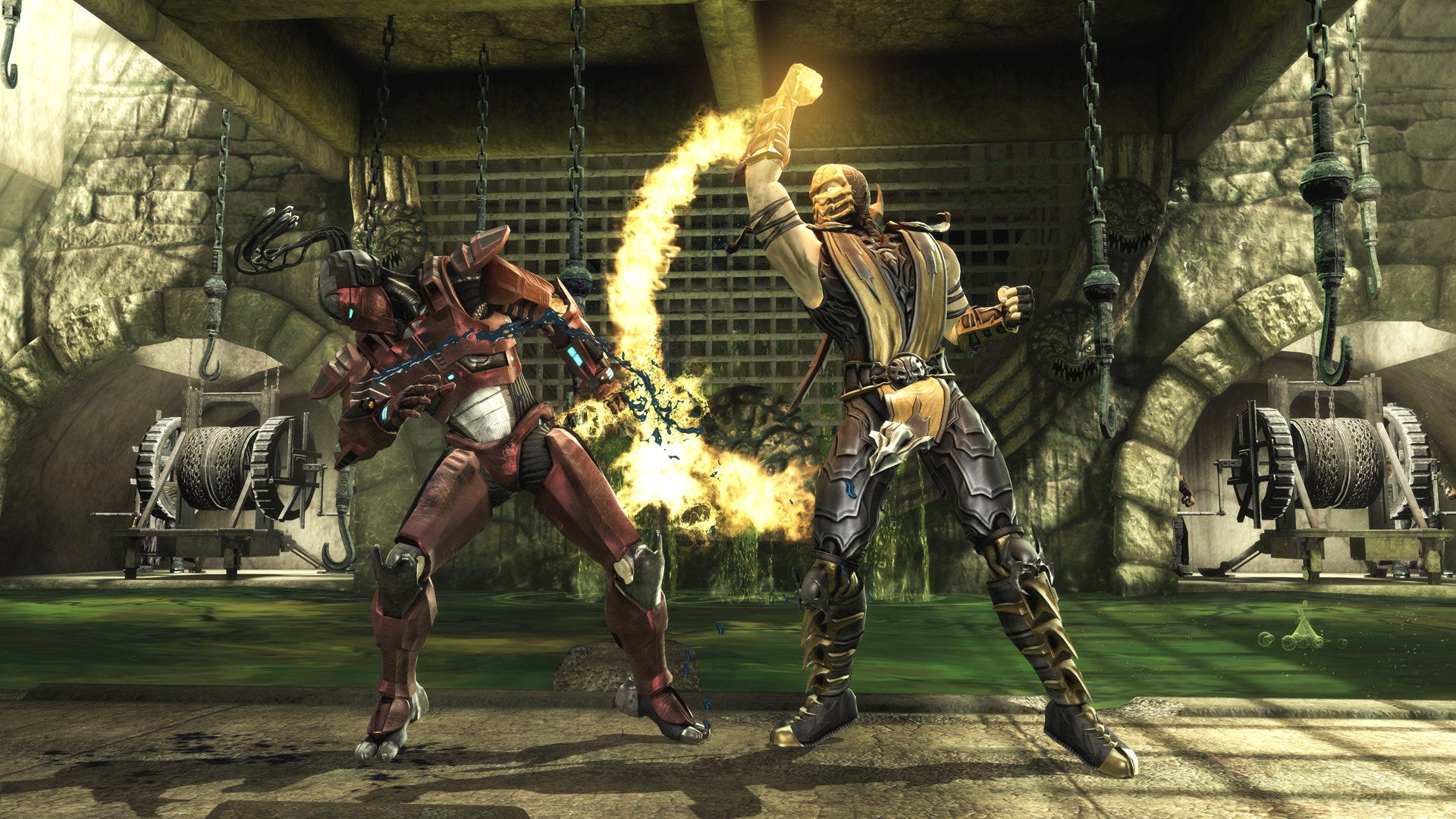
Fighting earns Kurrency which can be spent on concept art, secondary Fatalities and alternative costumes.
Further tech has been introduced with a three-tiered super gauge. One bar nets you an Enhanced special that works like the EX system from Street Fighter III, while two lets you break free of a combo. (Although, due to copyright issues, you have to shout "k-k-k-kombo breaker!" yourself.)
Save up for the full three bars and you'll gain access to the X-ray. These are Mortal Kombat's own-brand supers, except rather than a massive fireball or elongated combo, the effects are typically more brutal. Baraka impales his opponent on one claw before puncturing the neck and eye socket, Kano splinters both femurs with twin daggers before booting his opponent in the face and Johnny lands multiple shots to the crotch before breaking his opponent's back with a devastating elbow drop.
The X-ray lives up to its name, as you see skulls shatter, tendons tear and ribs rupture as the damage piles on, and by the end of a closely fought match, both fighters will look like they've spent ten minutes in a cement mixer made of knives. Then, when you get down to the Fatalities themselves, you're treated to a range of invasive surgery that includes decapitations, amputations and eviscerations.
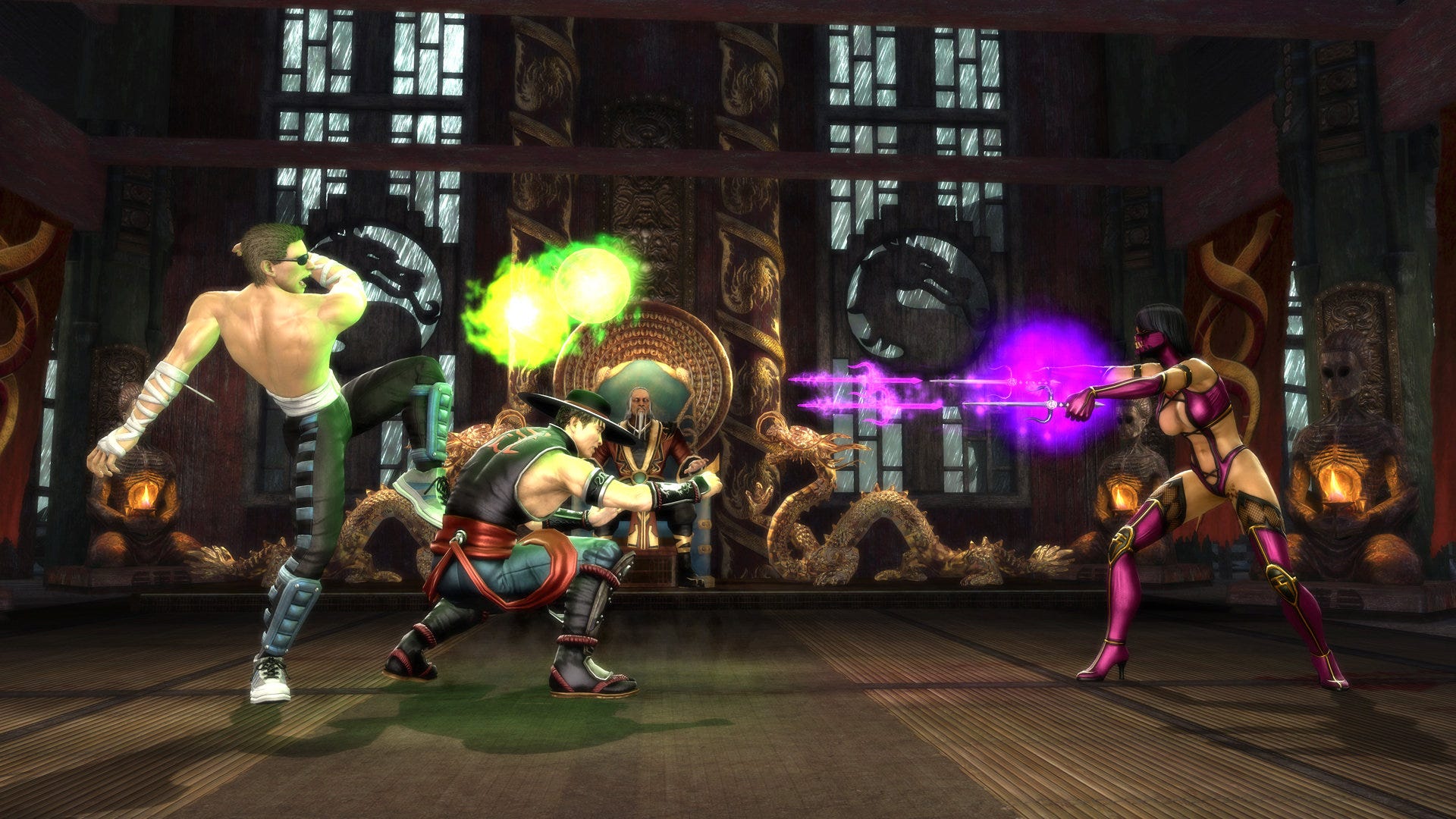
The three unplayable bosses are Shao Kahn, Goro and Kintaro.
Next to a series showreel, these executions are no more creative than what we've seen before. But when you compare the returning Dead Pool Stage Fatality with the Heroic Brutalities of Mortal Kombat vs. DC Universe, it's clear that an opponent drowning in acid is more goresome than watching Superman comically hammer Reptile into the ground like some giant nail. Not only has Mortal Kombat left much of its humour at home, but the 18 rating has been reinstated for a reason.
It’s a return to form that’s accentuated by a roster of 30 characters (27 of which are playable) that includes iconic favourites like Sub-Zero and Mileena. The select screen is devoid of new faces, but the familiar cast has never looked better. And while it’s not as stylistically stunning as Capcom’s leap to Street Fighter IV, this Mortal makeover is nonetheless impressive.
Equally impressive is the new Story Mode. The plot begins in a future where Shao Kahn has killed more or less everyone and is about to finish off his brother, but before the coup de grâce hits the mark, Raiden sends a message back through time. This is received by his past self at the start of the first Mortal Kombat, and as the timeline is gradually distorted by Raiden's intervention, the events of MK1 through to MK3 unfold in an alternate reality.
This means nothing is set in stone and everything – from the fate of the Lin Kuei, to who wins and who dies – is now entirely subject to change. It's a solid challenge that's worth seeing through to the end, yet despite taking around seven hours to finish, the bulk of the single-player can be found in the appropriately titled Challenge Tower.
This mountain of mayhem is made of 300 challenges that range from fighting an opponent who can only be damaged with throws to avoiding hellish hands that grab your character's feet. A number of challenges fall outside the normal fighting system and include one stage where you have to spam Stryker's Pistol special to slow down a horde of advancing zombies. There are even matches which make use of the new Tag-Team mode.
SPOILER ALERT! Playing through the Story Mode will unlock Cyber Sub-Zero.
The fact that Mortal Kombat has never featured tag gameplay before is a little surprising, but looking at how it's been implemented here, it's clear where the inspiration stems from. Any two characters can be teamed together and you need to dispatch both opponents to secure a victory. Advanced mechanics come in the form of Swap Attacks and Assists which burn meter and function much as you'd expect. It's not the most elegant tag system you'll play this year, but as an additional mode that can be taken online, it's a credible first attempt.
The online environment that Mortal Kombat creates for Xbox Live isn't short of features. Players can test their might in Ranked, Player and Private Matches using the single and Tag-Team systems, as well as a new King of the Hill mode that caters for up to eight players. This works similarly to the Endless Battle mode from Street Fighter IV as two players fight for the right to be king while the rest watch. And as a quirky feature, the spectators can boo, cheer and rate the winner's performance with their Xbox Avatars from the bottom of the screen.
This can be turned off if you find it distracting, but if you can see the funny side of seven zeros after a double Flawless Victory, then it's a welcome addition. The online is topped off with Rooms that field up to 100 players. But if Mortal Kombat online has one weakness, it's noticeable lag. It's not game-breaking (and at the time of writing, I was mostly fighting players in the US), but it does make certain moves hard to punish. It also throws the timing of flashier combos, and as a result, you may come to rely on less demanding methods.
Mortal Kombat offers over 20 stages with classics like Kahn's Coliseum and new arenas like Wastelands.
Evaluating the strengths and weaknesses of Mortal Kombat is a tricky business. On the one hand, if offers a single-player experience that's very comprehensive, but as a competitive fighting game, it falls short of the Japanese competition by a wide margin. The less restrictive combo system is a step in the right direction, but an overburdened super gauge doesn't pick this out as a future tournament favourite. And while it's also too early to be making calls on the character balancing, an abundance of easy-to-abuse specials is still cause for concern.
But to judge Mortal Kombat harshly simply because it isn’t the equal of BlazBlue or Street Fighter IV on a technical level would be unfair to what the game does right. The series has always ridden in the wake of its own spectacle, but after years of unfocused deviation, we finally have an evolution that demonstrates clear progress. It’s the best 3D game in the series by a long way, and that’s because it embraces the 2D heritage which always made Mortal Kombat its own kind of game. Long may it kontinue.
7 / 10
