Homefront Review

Seoul mates?

Version tested: Xbox 360

"Press X to jump in mass grave". I've been confronted with some bizarre button prompts in my time, but Homefront earns itself a special biscuit for this strangely calm exhortation to dive in amongst my slaughtered neighbours.

The moment also neatly encapsulates the ways in which Homefront takes aim at an obvious and broad target, yet somehow still manages to miss the bullseye.

The plot is as simple as it is implausible. North and South Korea are reunited and become a new superpower, just as America's economy collapses and bird flu ravages the population. Before you can say Senator McCarthy, the evil Communist menace has invaded American soil - and these Reds aren't hiding under any beds. No, they're murdering and oppressing like there's an expiration date for villainy, casually shooting a young mother and father in front of their child during the opening sequence, just in case having enemy soldiers occupying your country wasn't motivation enough to get you up and shooting.

It's here that the game hits the first of several snags. Not only does the situation make little sense, but our relationship to it is flimsy and vague. Maybe you need to be American to truly appreciate the chilling horror of this Tea Party nightmare, but when you're playing as a mute ex-Marine whose reason for fighting back is simply that someone gives him a gun and says, "Hey, shoot those Koreans, would you?", it's hard to care.

The same is true of your companions, a small and thinly sketched bunch of resistance fighters who make all the right action movie noises but never really become characters in their own right. The premise of the game all but demands rich back-stories, personal tales of loss and tragedy that have led each character to this point, but they remain empty cyphers to the end.
1

In case you were wondering, yes, there is a nod to Red Dawn in the game. Go Wolverines!

Not that sub-par characterisation will be at the front of your mind as you follow these cardboard cut-outs through a single-player campaign that is slim even by current first-person shooter standards. Most of the time you'll be wondering why these characters are even here, since you're always either being shoved aside while they move the plot forwards, or left to fend for yourself while they hide behind scenery. There's no middle ground.

So when the game tells you which button to press to jump into a mass grave and hide from a Korean patrol, it's especially pointless. You already know that's what you've got to do because the game has manoeuvred you into a place where it's the only logical response, while your NPC companions have voiced the thought for you and jumped in to illustrate the point - but you can't actually do anything until that prompt appears and gives you permission 10 seconds later.

That's how scripted this game is. Every ladder, every door, every obstacle forces you to step aside and wait while AI drones take the lead. Then you follow in their wake, always heading for the little white blob that says "follow", in case you were in any doubt.

Homefront's first 15 minutes.

The closest you get to breaking ranks is dawdling around while they wait at checkpoints, searching for the glowing golden newspapers that provide your recommended daily allowance of pointless collectible as your companions bellow looped instructions to regroup. Even then, stray too far from the preferred path while rooting around, and our old friend Invisible Walls makes an unwelcome return to shove you back in the right direction.

It's a shame, because when the game stops dragging you along by the hand and lets you make choices of your own, it's generally good stuff. Aiming and accuracy are both perfectly realised, while the best encounters take place in large, open locations with dozens of opportunities to forge your own path through the carnage. But then, all too soon, the game clamps shut again and you're back in the corridor, doing as you're told, watching those digital arses shuffle and sway in front of you.

Graphically, things are similarly flaky. Homefront sometimes musters an impressive view - such as when you first see a makeshift work camp with shacks sprawling into the distance against a sombre sunset - but it struggles in gameplay. Characters glitch into each other, scenery snags and the frame rate wheezes during larger set-piece battles. It's certainly not terrible, but as with high-end racing games, the FPS genre is no place for visual slouching.

It's all over so quickly that you probably won't have time to let such foibles bother you. The problem isn't so much that Homefront's seven stages are too short, but that they spend too much of their meagre time treading water with predictable, generic encounters. You could easily stretch it out to eight hours or so, but it's all so inconsequential; what Homefront needs most is direction rather than length.

Despite the potential of staging FPS battles in familiar suburban locations, the game quickly falls into a rut familiar from too many of its genre peers. There are stealthy sniper bits. There are turret sections. There's a scramble beneath the girders of the Golden Gate bridge which is a virtual redux of Half-Life 2.

But there's no personality and there are no moments: none of those perfect collisions between concept and execution which give you that fist-pump rush that a good shooter needs. You're always aware that this is a pale echo of a more successful formula.

Single-player campaigns are fast becoming a quaint anachronism though, and if this offering feels more vestigial than most, it's largely because the genre itself, particularly this brand of modern military shooter, is ever more interested in the long-term lure of multiplayer. Here, at least, Homefront proves more capable.

Maps are broad and varied, with no end of pathways to discover. Whether you prefer holing up in building interiors, crawling through scrub or charging down the middle, all guns blazing, the game accommodates everyone without ever playing favourites. Vehicles are simple to control, effective enough to be worthwhile, but fragile enough that an enemy tank won't bring the match to a dispiriting halt. There's a satisfying balance, and the fully customisable load-outs mean that it's easy to find a combat role that suits your style of play.

2

It's actually quite cute how we're now supposed to be horrified by all the usual FPS carnage, just because it's the American suburbs.

More noteworthy are two reasonably fresh ideas that KAOS Studio has stirred in. Battle Points are the in-match currency that you accrue for successful play. Separate to your XP, they must be cashed in if you want to use any of the game's more interesting gadgets. Want to spawn in a vehicle? Launch a drone? Whip out an RPG? They all require Battle Points.

The most obvious benefit is that this system tips the balance away from the Call of Duty model where the best and longest-serving players have a veritable arsenal of destruction at their command while new players go into battle armed with a toothpick and a scowl. Battle Points scale it back to focus on the match at hand, so any player capable of downing a few enemies or assisting in an objective will gain access to something cool.

The second worthwhile idea is Battle Commander. This game mode puts you under the command of an unseen taskmaster, who will highlight notable enemy targets. It's a way of taking the idea of "kill streaks" and inverting them; the better you play, the more attention you attract. There are alerts for individual soldiers, vehicles, even remote drones. Keep racking up kills and the enemy commander will direct more and more of the opposing team to your location - and they'll all want some of the XP bounty for taking you down.

3

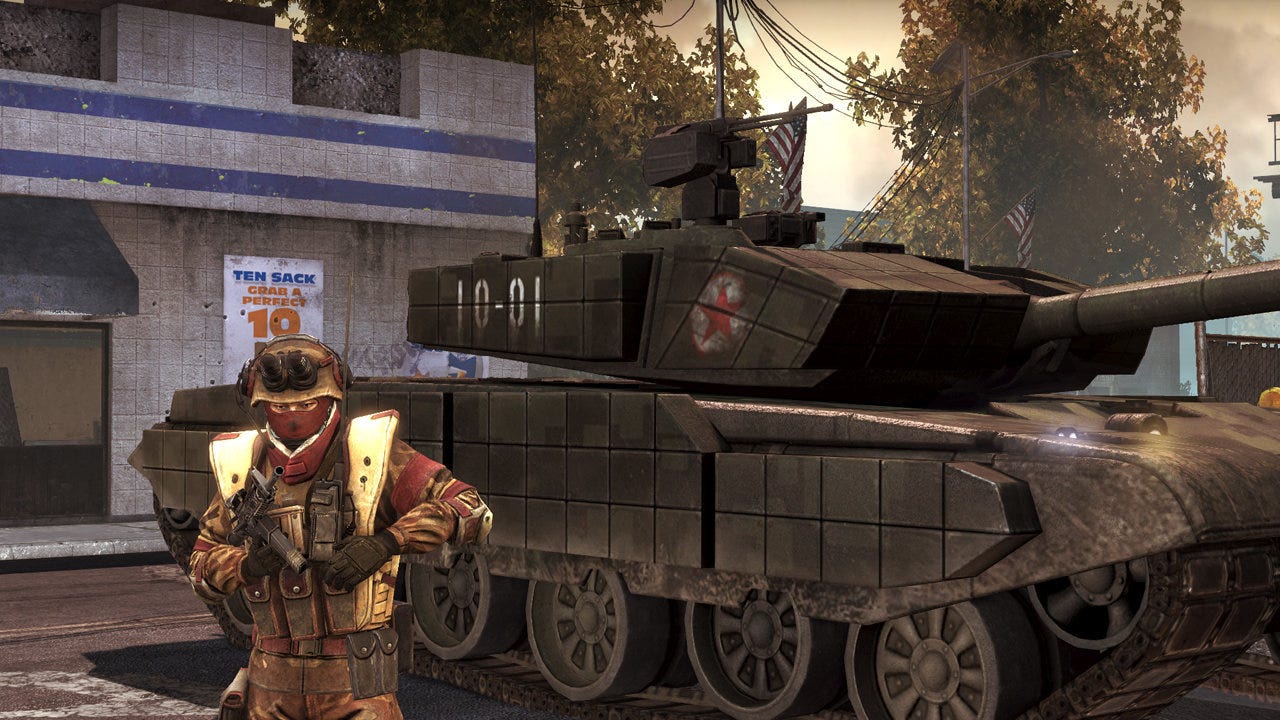
The US military barely features in the single-player story, but is inevitably a more active presence in multiplayer.

The impact of these two ideas is noticeable and beneficial, but still the sum of the experience isn't different enough to the pack leaders to stand out, nor is it polished enough to stand alongside them. It's a decent multiplayer offering, but is unlikely to lure dedicated players away from the dominant franchises and their enormous and enthusiastic communities for long.

Taken as a whole, the online action is just enough to balance out the mediocrity of the single-player campaign. But, ironically, Homefront's place in the FPS genre is an inversion of its own narrative fantasy. In the game's fiction, Korea is the underdog that takes on the American giant and wins; in reality, Homefront similarly hurls everything it has at the FPS behemoths in its path, but can barely scuff their armour.

Homefront floats in the limbo between "not bad" and "pretty good", and is hamstrung by a single-player element that feels like a half-hearted obligation. What's most disappointing is that Homefront wanted so much to join COD and Battlefield at the top of the genre, but has ended up as merely a weekend timewaster for players waiting for the next shooter fix.

6 / 10

Read the Eurogamer.net scoring policy

Comments (173)

Comments for this article are now closed, but please feel free to continue chatting on the forum!

  • Loading...hold tight!