The Last Guardian Preview

Fumito's secret.

The two PlayStation 2 classics made by the small Sony team led by Fumito Ueda, Ico and Shadow of the Colossus, have a powerful air of mystery about them. Their hazy, bleached visuals, sorrowful air and vague stories make them seem like half-remembered children's books – the kind that had some secret, solemn, adult meaning that was always just beyond your understanding, but that affected you powerfully anyway.

This enigmatic mantle was passed immediately and automatically to The Last Guardian, the team's third game and first for PlayStation 3. Although it's already five years into development, we've been granted only brief glimpses – basically one trailer at E3 2009 and another at last year's Tokyo Game Show – of a game that appears to be about a small boy and a giant animal, part cat, part dog, part bird. Fans have combed over these beautiful clips in a speculative frenzy, loading every frame with significance, multiplying their questions.

So when an invitation arrives to visit Team Ico's Tokyo studio, talk to Ueda and see a live demo of The Last Guardian, we snap it up. It's impossible not to come looking for answers about the true nature of the game and the elusive creative spark that drives this studio, and mystifies and enraptures its fans.

You're not going to find those answers in the studio itself. It's an unassuming floor of bland, brightly-lit office cubicles, high up in a Sony tower block, left half-empty by the small (50-odd) team of craftsmen under Ueda's leadership.

I don't find the works of Goya, Ted Hughes or Hayao Miyazaki lying around. I do see copies of Halo: Reach, StarCraft (the Brood War expansion) and a complete set of Kiefer Sutherland's TV potboiler 24 on DVD, but these seem disappointingly pedestrian, and more to the point, completely irrelevant.
Ueda has no secluded office that you can peer into to divine his soul. Turns out he just works there, like everybody else. There's a very nice view of the Imperial park. That's all.

I don't really expect to get the answers I'm looking for from Ueda himself, either. The game designer and director is a notoriously unwilling and evasive interviewee, although pleasant and polite. With his long hair, neat button-down shirt and boyish features, he looks an awful lot younger than his 40 years. Still, he seems in fairly relaxed and receptive mood, so I probe gently. What does The Last Guardian have in common with his previous games?

"In the very first game there was the interaction between the player's character and the AI character, the girl," he says. "In the second game, it was the action of climbing on these giant monsters. In the third game, there's a bit of each of those in there. You've got an AI character this time, but this time it's kind of a really giant AI character rather than the small helpless character of the first game."

And in this simple answer, The Last Guardian's secret is laid bare. It is, quite simply, Ico and Shadow of the Colossus rolled into one.

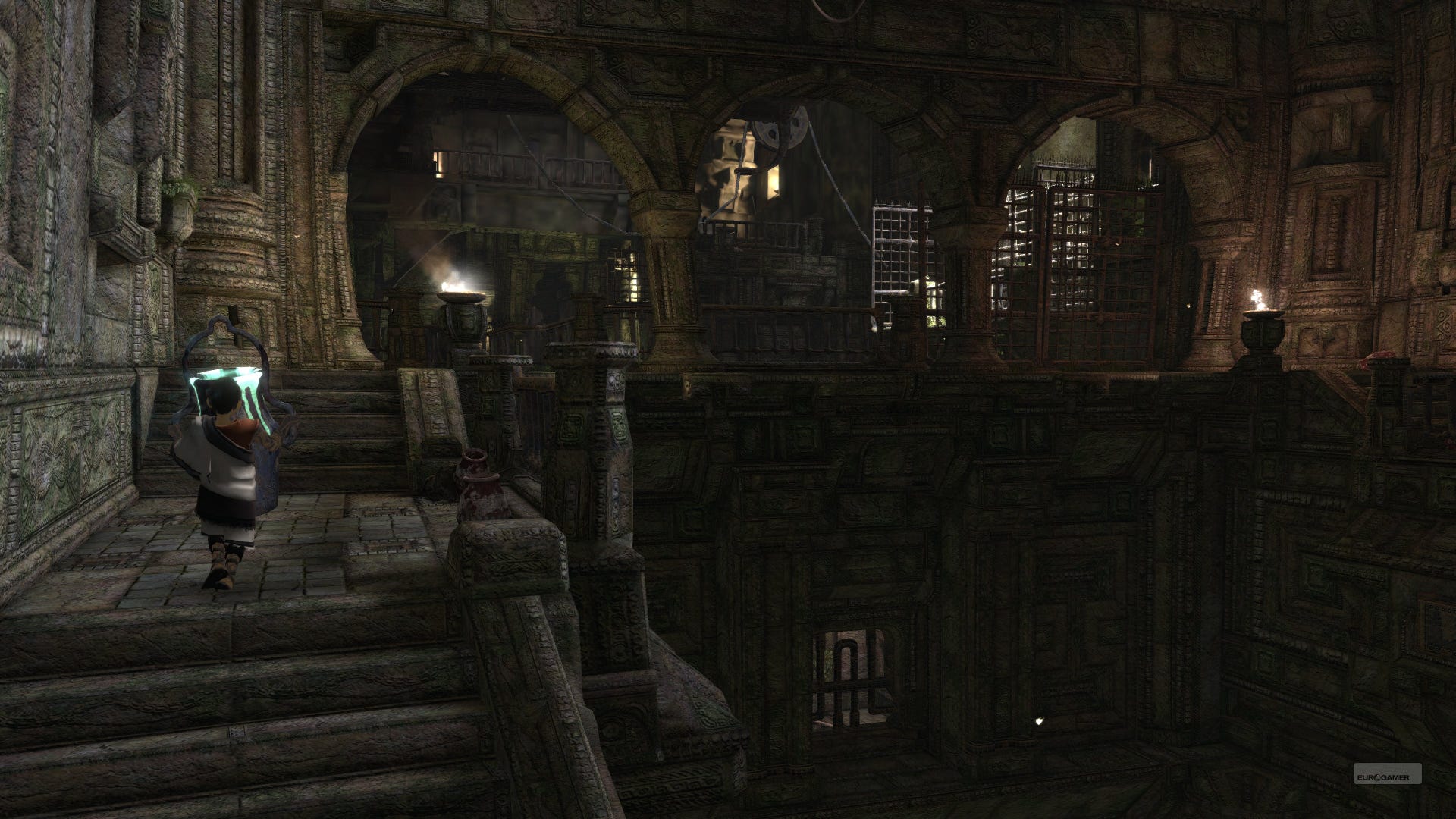
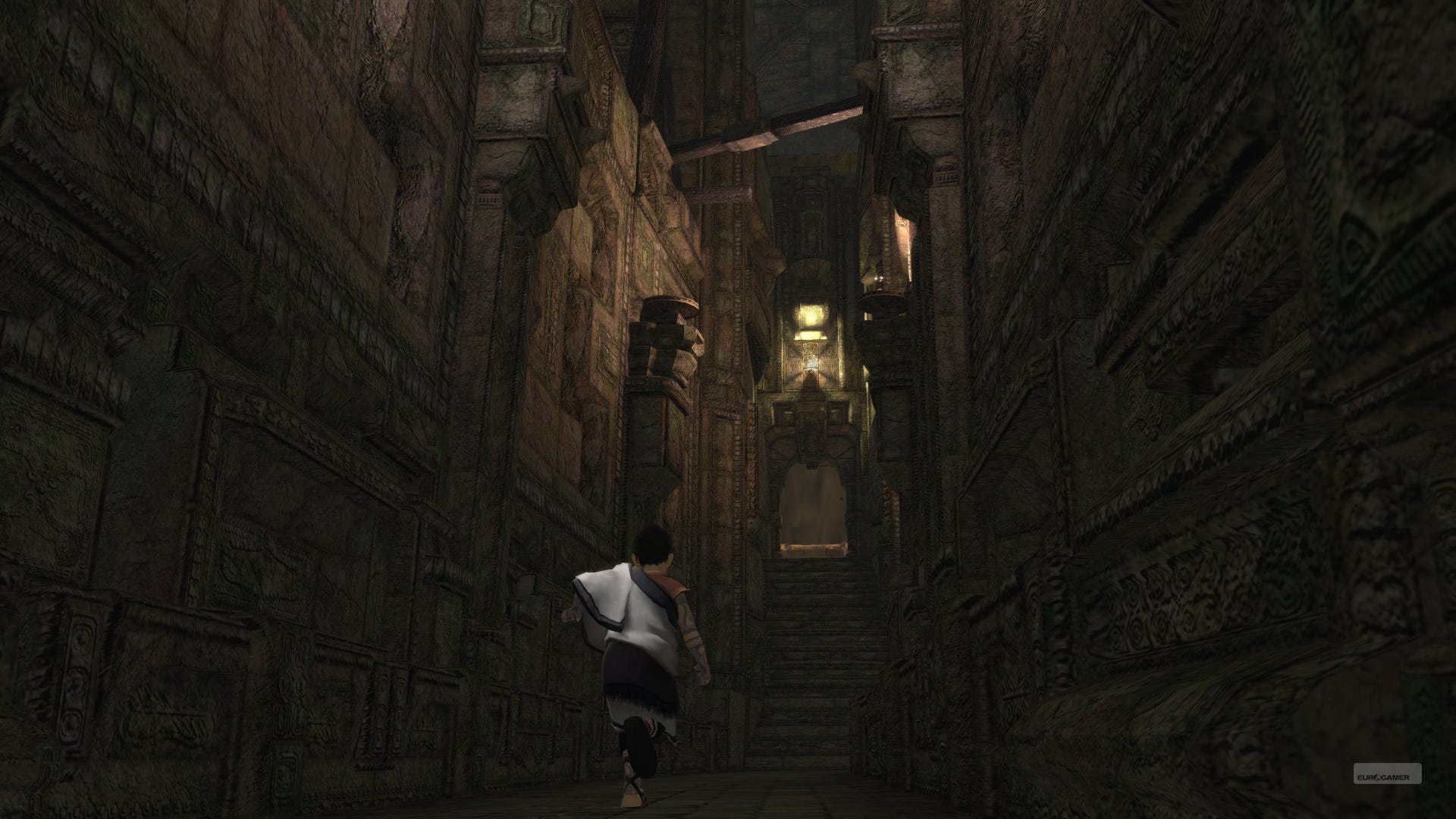
That much is also revealed by the 15-minute gameplay demonstration, a "vertical slice" of puzzle-solving, platforming, light stealth and creature-wrangling. As in Ico, the boy must use his vigorous, ungainly child's agility to scramble through rooms in a labyrinthine, Gormenghast-style ruin. He must also face sinister enemies and guide his companion to follow him.

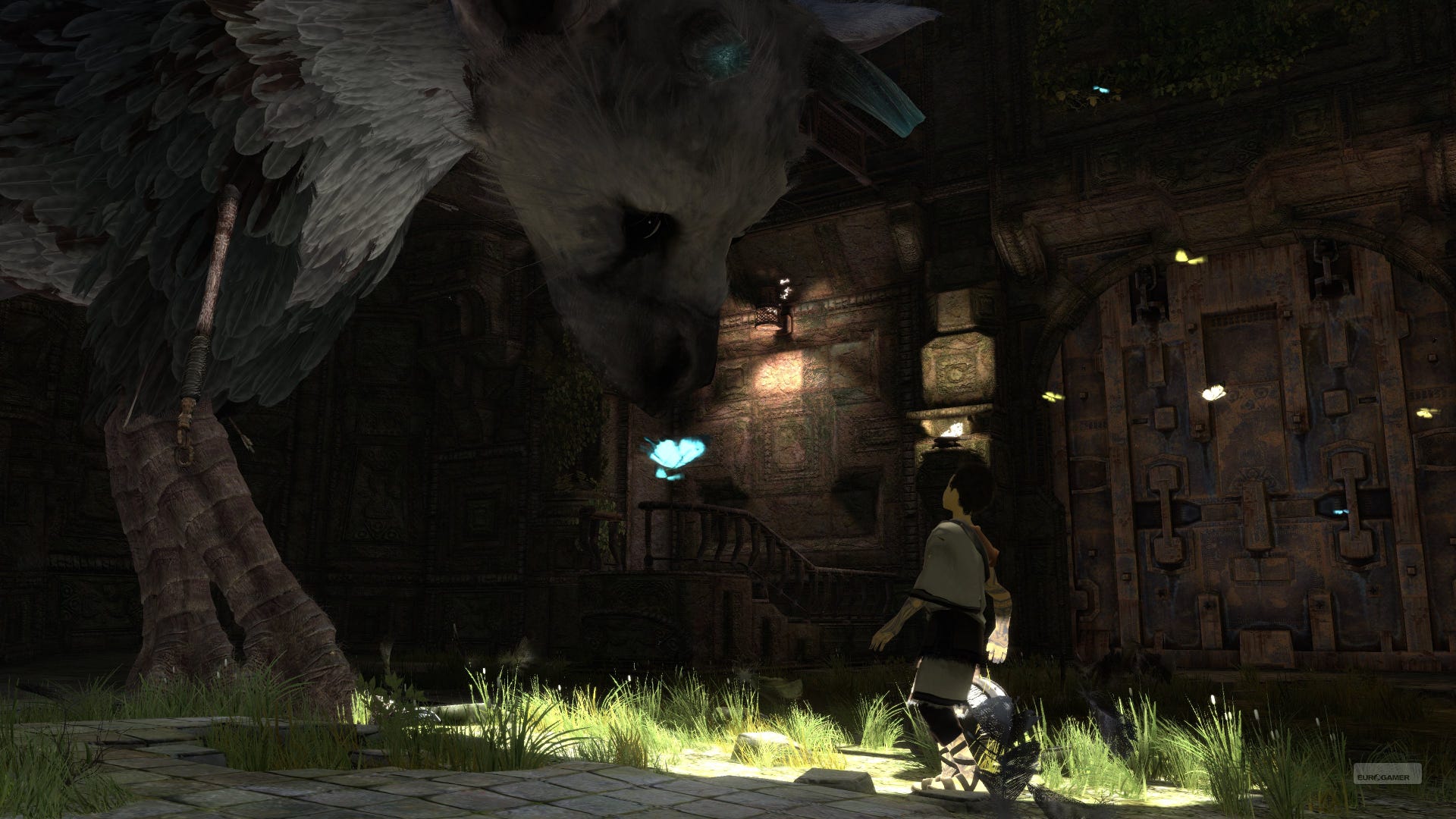
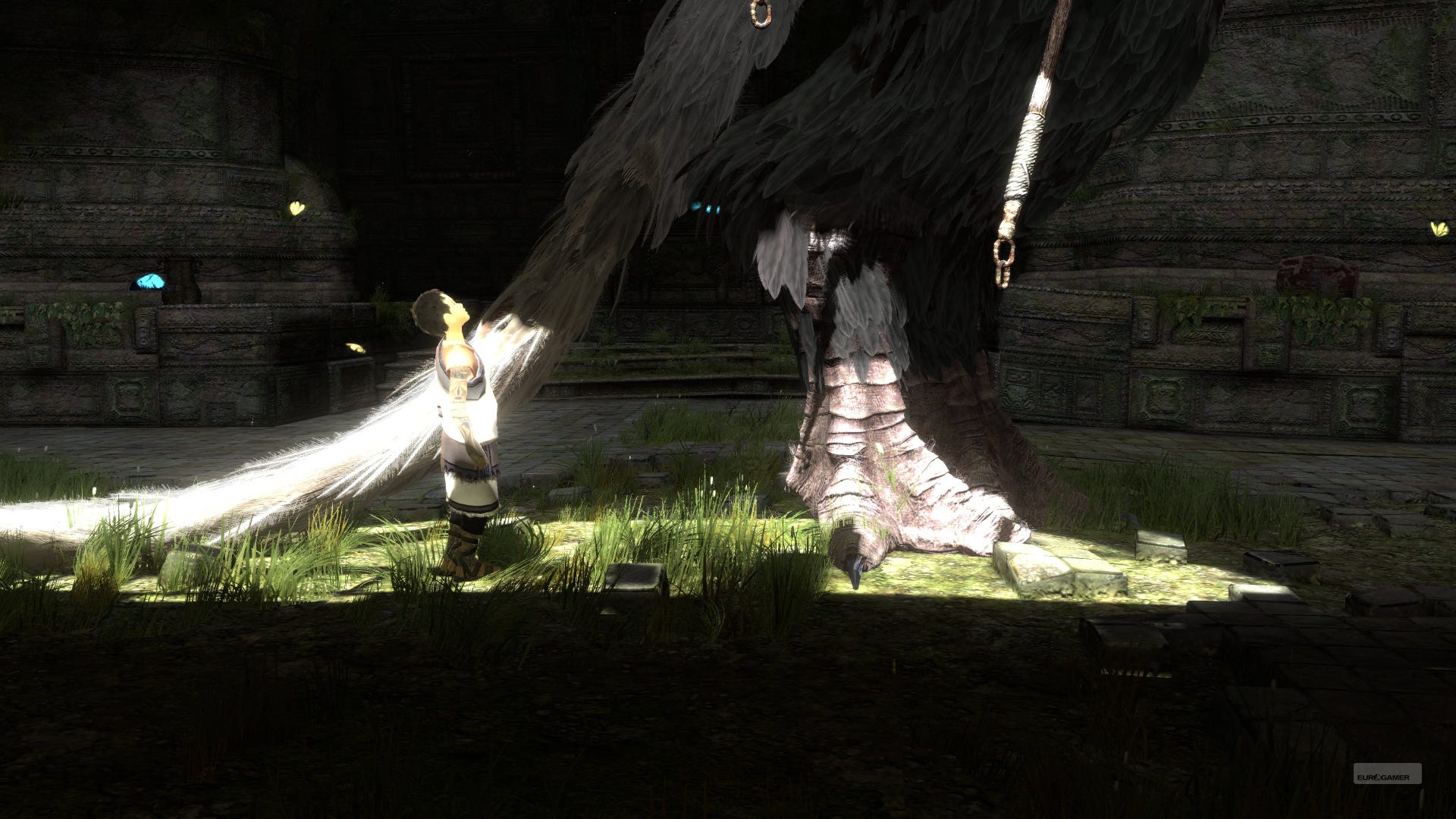
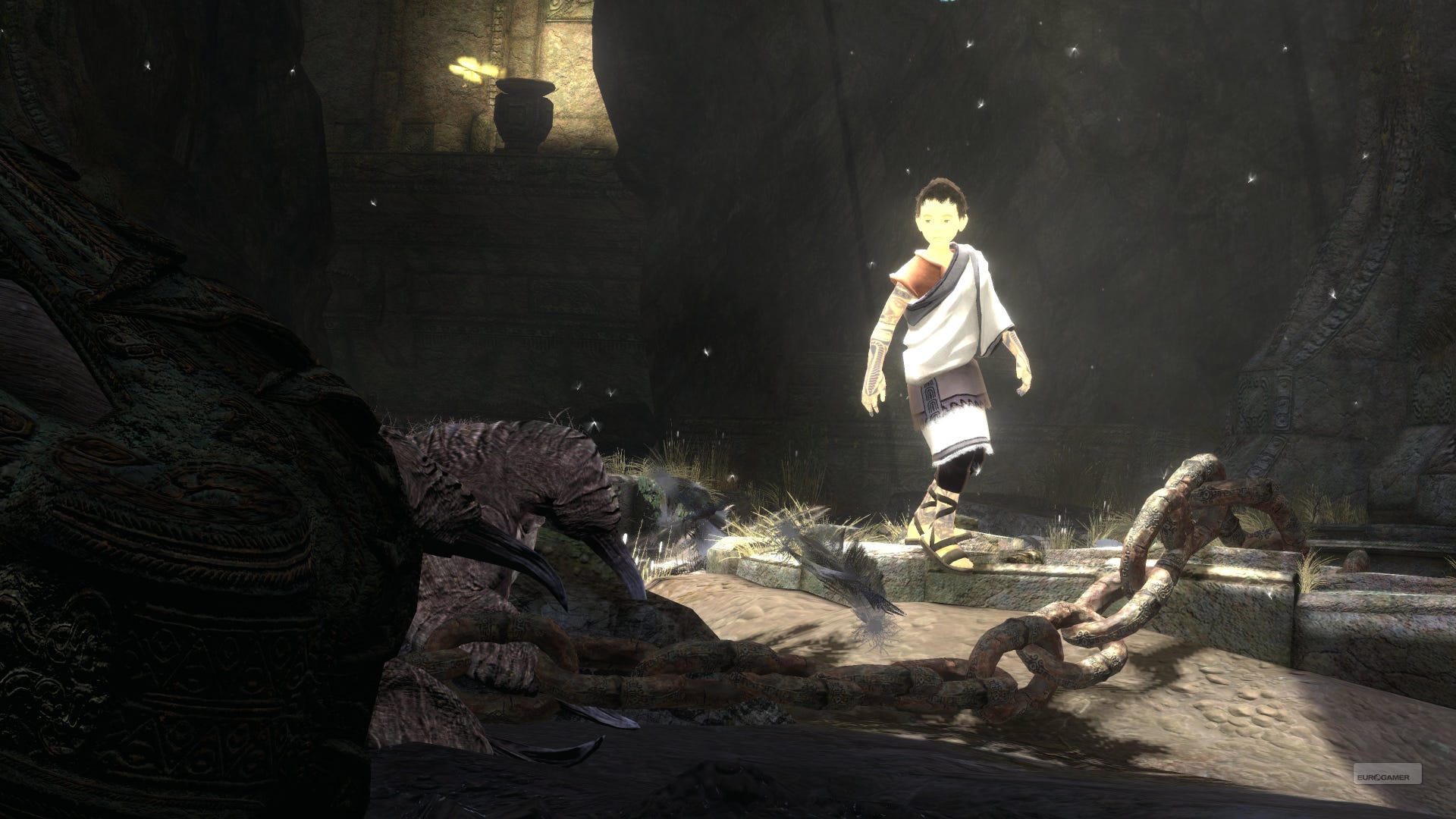
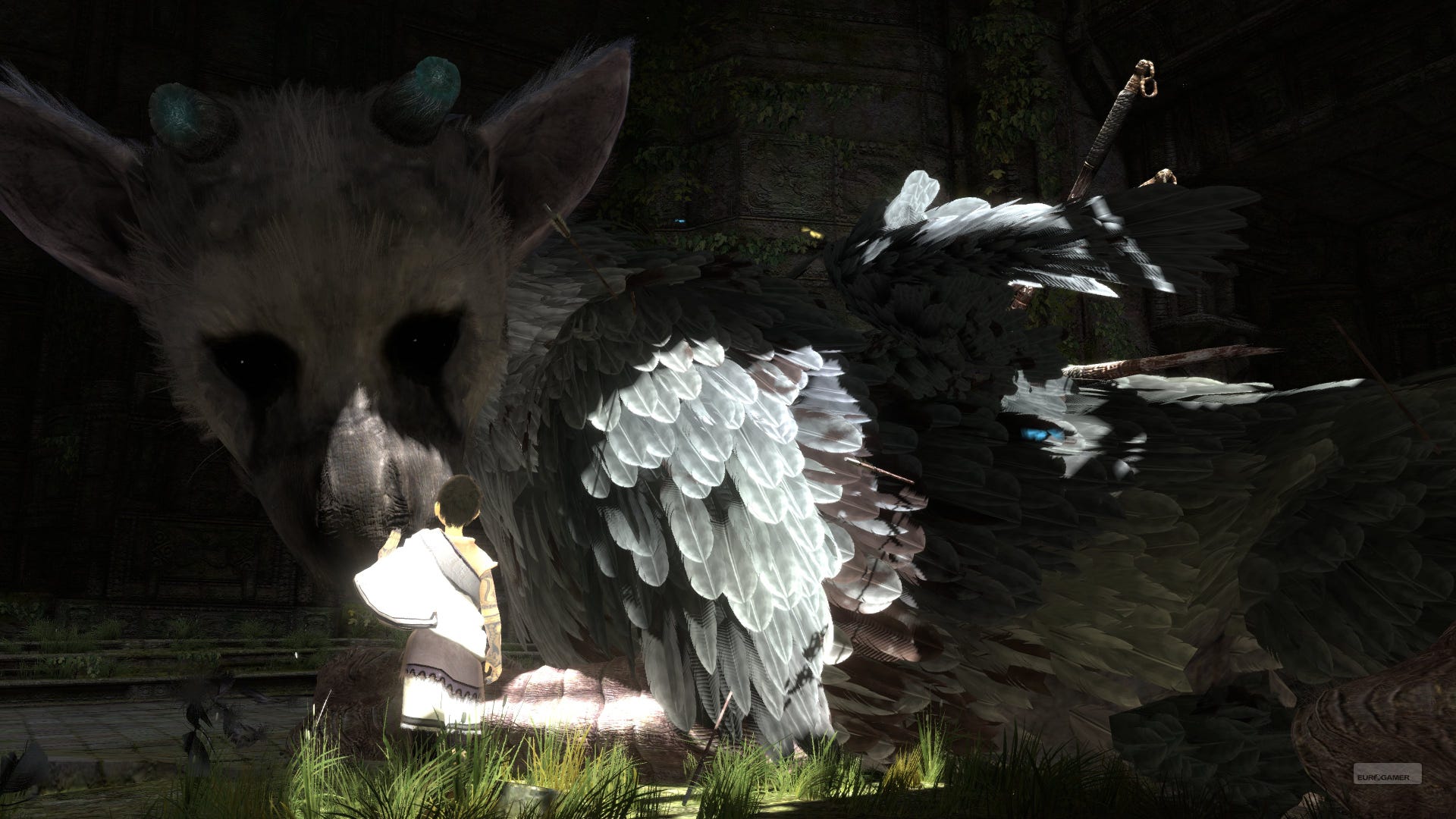
The difference, of course, is that his companion is a 30-foot mythical beast – Ueda's calling it Trico, which was the game's codename – that looks like a sort of cub chimaera. You'll need to use Trico's power and size to help you progress, employing it as a kind of sentient platform, clambering up its feathered hide to reach higher areas, just as you did with the vast granite golems of Shadow of the Colossus.

The demo starts with a deep-voiced, elderly narrator setting the scene in Japanese, and the boy standing next to the sleeping creature. The soundscape is familiar – the hollow drone of wind through man-made stone canyons – as is the artwork's combination of moody, monolithic ruin with fine, feathery detail.

But The Last Guardian doesn't have the opaque, almost monochrome visuals of its predecessors. It's given a much more vivid look by a scattering of brightly coloured butterflies amid swirling particle effects, and the extremely bright, high-contrast splashes of sunlight that streak across the creature's back in the gloom. The PS3's high resolution and ability to draw environments far into the distance sharpen things up, too.

The boy tugs on Trico's ear to wake it up (Ueda is careful not to give the creature a gender) and their mini-adventure begins. Trico stretches, yawning and shaking off its slumber, clumsy and kitten-like, but with every movement accompanied by deafening thuds to bring home its tremendous weight and size.

Its animation is astonishingly lifelike. So is the flappy-limbed, unselfconscious energy of the boy, Ueda's youngest and most human protagonist to date. Sailing against the wind, Team Ico refuses to use any form of motion-capture, using hand-crafted step-by-step keyframe animation instead. The studio's gifted animators marry the tiny, exquisite observations you might see in a hand-drawn Miyazaki film to complex 3D models and sophisticated AI. It's a mind-blowing achievement.

It's a gorgeous game soaked in dreamlike effects, but the breathtaking animation is the centrepiece.

"Recently, mocap's becoming more and more popular, but the benefit of keyframe is that you can really control the movements you are displaying," says Ueda. "That's what I feel is the benefit. And especially in the case of this game, because we've got Trico which is a combination of various different animals, and it has the traits of a cat in some instances, and some traits of a dog – there's no animal that you could motion capture in this case!"

Ueda explains that, unlike the obedient Yorda in Ico and Agro (the horse) in Shadow of the Colossus, Trico very much has a mind of its own. To begin with, the boy will have to find ways to cajole the beast into following; later, their relationship will develop so Trico will listen to him more readily, and he may even develop some tools for commanding it. "This is very early in the game... the relationship between the boy and Trico is very shallow. So Trico will have a tendency to not interact with you," he says.

Watching the huge creature twist and snuffle and root around in a large room as if trapped in a cage, I begin to understand why this game is taking so very long to make. Selling this being to the player as a living creature, giving its behaviour enough detail that you can read its moods and intentions, and programming its AI path-finding with a minimal reliance on scripting has been a monumental challenge, Ueda admits. "The most difficult thing is to get such a large AI character moving properly in such small, confined spaces."

Calling to Trico but getting no response, the boy explores an adjacent chamber and finds a large vase giving off fragrant fumes. As soon as he picks it up, Trico shows immediate interest in the smell, shoving its snout through a doorway. The boy carries it up to a ledge, and Trico cranes up towards it on its hind legs, allowing the boy to climb up his back, access a new platform and move on. "In a nutshell, the gaming experience that you'll have in The Last Guardian is luring Trico with a variety of objects," says Ueda.

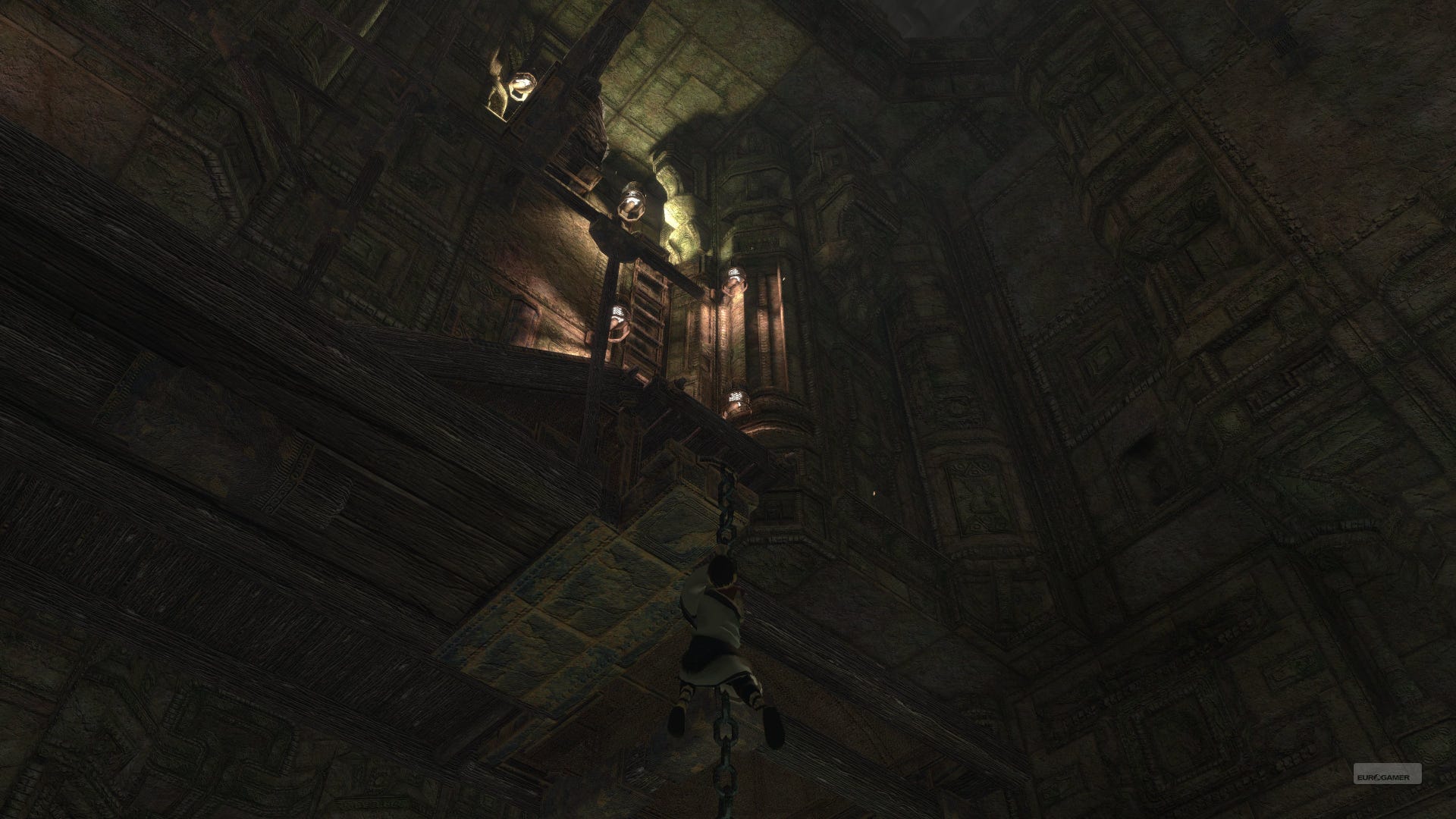
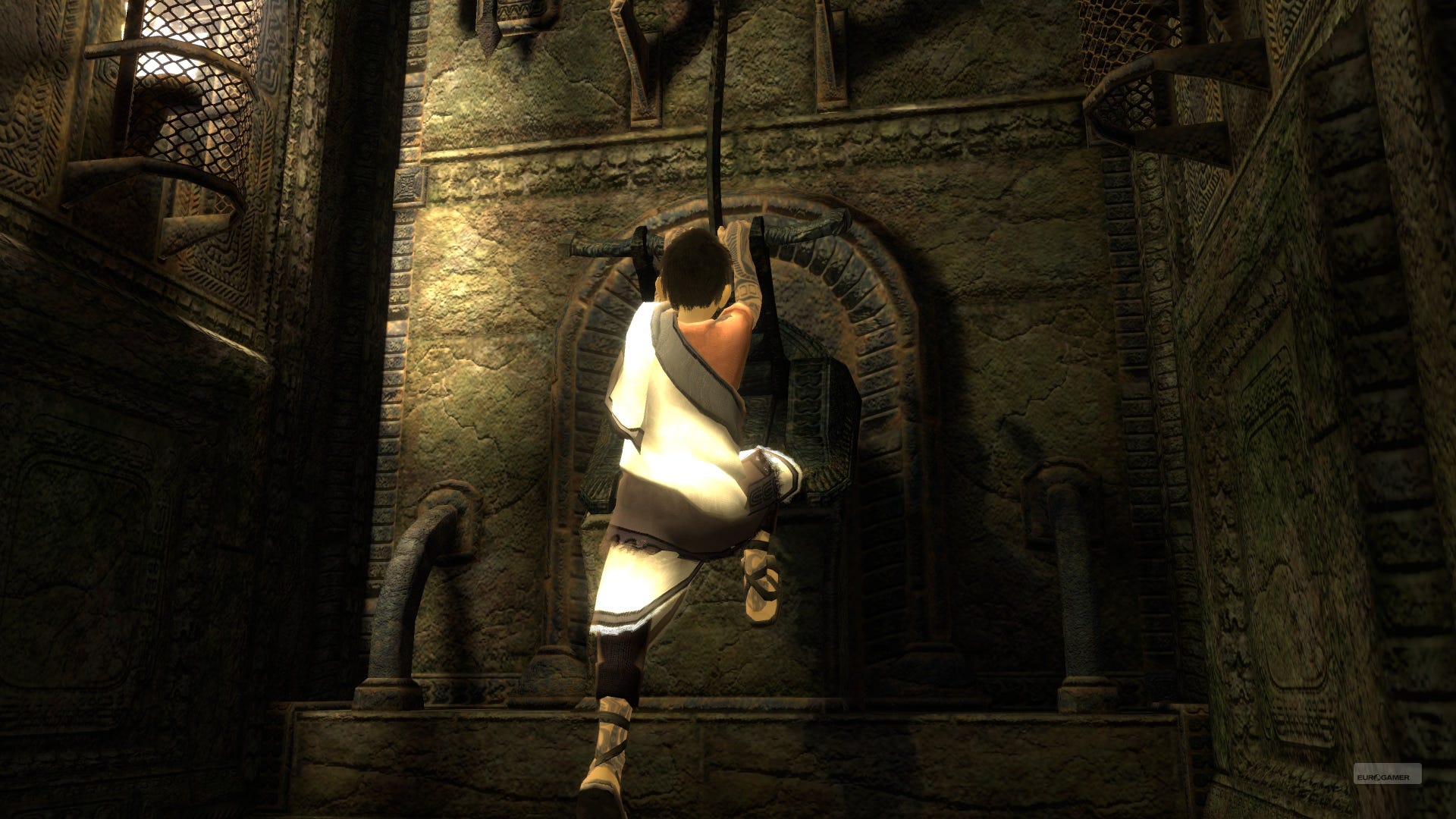
The boy is not strong, but he's light and quick-footed, and can shimmy up chains, navigate ledges and run across crumbling beams in much the same manner as the stars of Ico and Shadow of the Colossus. As in the latter, he has a stamina gauge limiting his ability to cling, leap, balance and climb, which appears in a hand-drawn and animated scroll above his head when he performs these actions. The controls and platforming style appear to be very similar to those in the team's two previous games.

The boy will encounter enemies, but being tiny, unarmed and dressed in a light toga, he's not strong enough to tackle them in direct combat. When he encounters a truly frightening guard grunting and clanking around in black plate armour, Ueda says that the best way to get past him is by stealth – crouching and creeping along walls.

There are other ways to lure, outwit and outrun the slow guards – who can't climb in their heavy armour – but if caught, you only have a short time to wriggle out of a guard's grasp or it's game over. Though the boy may learn some tricks, Ueda says, it's the powerful Trico who will be attacking enemies in The Last Guardian, and for the most part the player is not directly involved in combat at all.

More on The Last Guardian

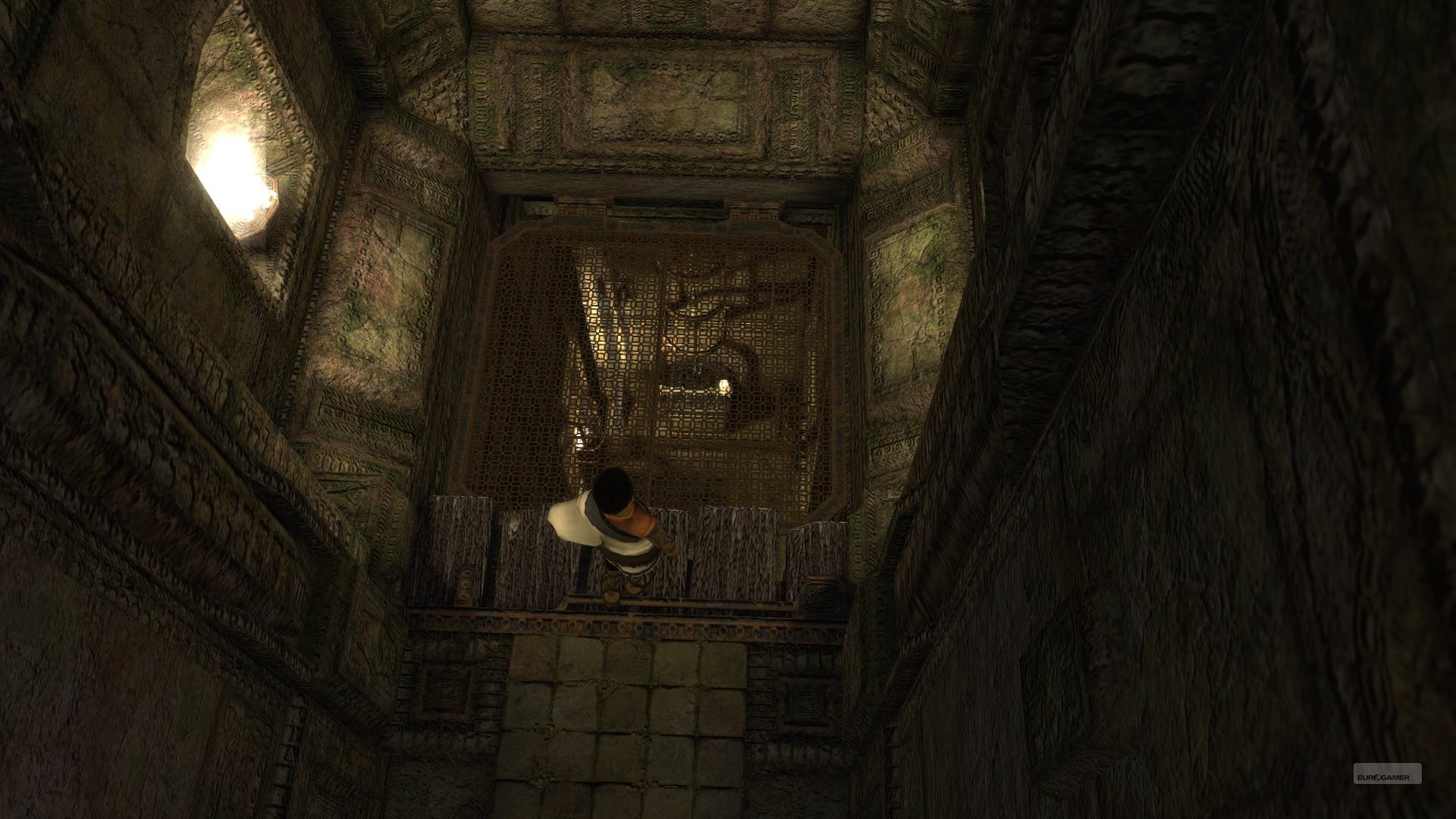
At the end of the demo, the boy finds himself at the top of a tall shaft crossed by slender beams and bridges, with Trico visible far below. He calls to it with a wordless, echoing cry, but the creature doesn't hear, or doesn't want to. "Normally he jumps straight up. Seems like he's in a bad mood today," chuckles Ueda.

It's an awkward moment, but at least it proves Ueda's talk of a free-spirited, recalcitrant artificial intelligence powering the huge beast. This will be difficult to fine-tune correctly if Team Ico is to preserve Trico's unpredictability and electrifying presence – as bizarre as it looks, it's impossible not to regard Ueda's creation with awe – whilst making him biddable enough not to frustrate.

After half a minute of calling, Trico takes notice, and thunders up the shaft in a series of crashing bounds that shake the stone, finishing by towering above the small boy and lowering its huge eyes to his. "You'll notice the very drastic difference in dynamics of how the boy can manoeuvre versus Trico – the gameplay will be a combination of using both of those skills to your benefit to make progress," summarises Ueda, blandly.

If you're looking for the key to Team Ico's brilliance, maybe that's it; a guileless willingness to keep things simple and let them speak for themselves. The great mystery is that there's no mystery at all. The Last Guardian is a story about a small boy befriending a giant animal, and that's all it needs to be.

I lied when I said that there were no clues to be had in the tour of Team Ico's office. From its high viewpoint, you can look straight down onto Tokyo's Imperial Palace, nested in its surrounding parkland. Unlike most royal residences or seats of power, the Emperor's house is hard to catch sight of from ground level and still retains an impressive, secretive mystique. But Ueda and his colleagues can look out from their windows and admire Japan's inner sanctum laid out before them, gleaming in the soft winter sun. Plain as day.

Comments (93)

Comments for this article are now closed, but please feel free to continue chatting on the forum!

  • Loading...hold tight!