When I lived in Japan, there was a girl who came to my local arcade on Wednesday evenings to play Beatmania and Dance Dance Revolution. I would go to watch her (not in a creepy way – I wasn't hiding in a bush or anything).
She was incredibly, unfeasibly talented at playing rhythm-action games. Playing Expert+ on Beatmania, she'd be utterly motionless except for her hands, which moved so fast in the flashing light of the arcade machine it looked like her fingers were multiplying. On DDR, if she was feeling particularly ostentatious, she'd play two-player by herself, contorting around both dance mats in a blur of hands and feet. It was mesmerising.
Dance Evolution would make even that girl look incompetent. Taking humiliation to the next level, the game digitises your image and displays you on-screen as a live-action 2D backing dancer, flailing desperately in the company of perfectly-animated 3D models. Kinect is so low-definition you become a poor-quality GIF with a shimmering outline of white pixels.
This, in combination with the brilliantly surreal songs and routines, makes Dance Evolution the funniest game on Kinect.
It's steadfastly and unapologetically Japanese. Not one of DE's 30 songs will be recognisable to anyone outside of Asia – they're a dreadful selection of relentlessly cheesy pop tracks, eurobeat travesties and strange R&B efforts.
There are only two dance models – a topless dude who looks extremely funny doing para-para arm-waving, and a platinum-haired lady in a short skirt.
The on-screen text suffers (or benefits, depending on your perspective) from weird, cryptic translation: "You played without the Dance Gauge, didn't you? Did you enjoy the dancing? When the Dance Gauge goes up enough, you can fly to the Parallel Universe! Take on the challenge of using the Dance Gauge to go to the Parallel Universe!" (No idea.)
The voyeuristic announcer enjoys saying bizarrely literal things like, "Heat up the floor with your hot moves!" without any trace of irony. And best of all, the dance routines are alien to everyone except Japanese teenage girls, relying heavily on para-para-style sweeping hand gestures – fig. 1 – and jumping up and down.
For most of us, then, there are barriers to overcome. Think of Dance Evolution as a journey of cultural discovery. If you have a thing for J-pop and want to dance like a Japanese girl, it's amazing. If you like comedy, it's definitely worth trying a few songs and spending half an hour convulsed with laughter. But I can't think of many people I know who might actually want to buy this game.
The visual language it uses – slowly contracting green, blue and orange circles, bright neon arrows – is much closer to traditional that featured in Japanese rhythm-action than Western dance games. It takes some getting used to, but after a while it's easier to understand than the movements of a motion-captured 3D model. It's also comfortingly videogamey, giving you targets to hit, a combo counter and a big obvious score monitor.
When blue circles appear you have to hit them with your arms or legs at the right time. You must keep your hands inside orange circles whilst dancing until they disappear. Arrows delineate sweeping motions and green silhouettes show when you have to strike a pose. Green ripples on the floor show you where to put your feet. There are tutorial videos but it's not hard to pick up, even though it initially seems more confusing than something like Just Dance.
Sometimes you have to shout or clap in time to the music whilst striking a pose. This makes you sound deranged as well as looking it, as the prompts are so sudden you'll probably come out with a surprised bleat.
The game is good at picking up your movements – though if you look at your GIF-self on-screen you'll start sniggering and lose track of the dance. It works best if you really throw yourself into it and prance about like a fairy on a sherbet-rush. Your willingness to do this is directly proportional to the amount of enjoyment you'll get out of Dance Evolution.
The dance itself doesn't change across the three difficulty levels – you're just graded on more of it. The Light setting only prompts you to imitate key poses or arm movements, while Extreme is a blur of intersecting arrows and circles and sudden flash poses. Stealth mode gives you no prompts at all and leaves you to imitate the dancer.
You naturally get better with practice, if you can stand to hear the songs more than once. Super Samurai is a particularly bad offender, with its horrible mix of super-speed shimasen, eurobeat and sort-of rap.
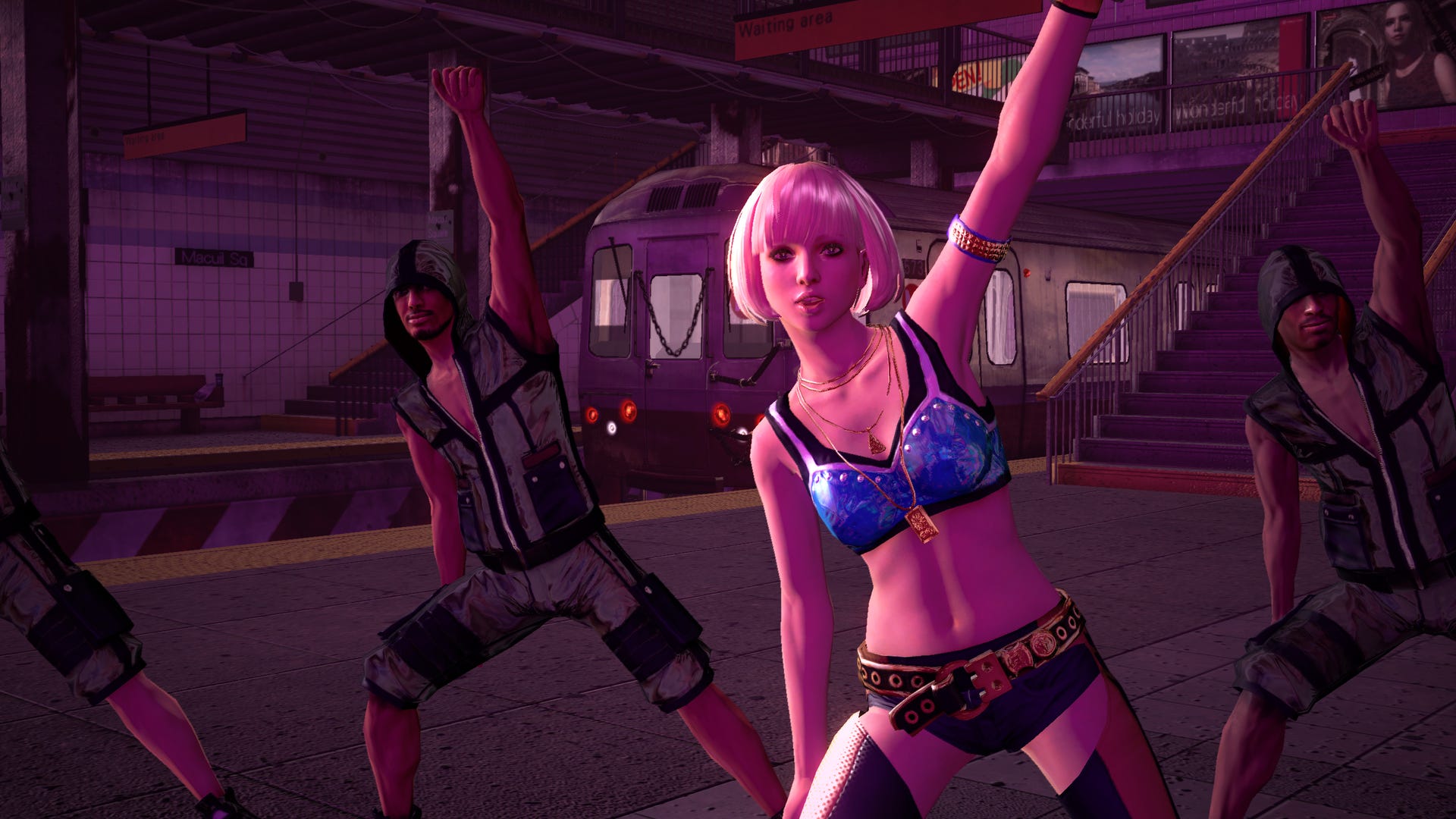
Sometimes she changes the skirt, or puts her hair up. Meanwhile, you're standing next to her in a holey jumper because the central heating's not working.
Outside of the dancing, there are a few technical annoyances that make Dance Evolution irritating to navigate. Its menu system is laborious, requiring broad sweeps of the arm to scroll through songs and options, and it doesn't always register choices well. It suggests holding your right arm up to your chest to select things, but that barely ever works – punching the air above your head is much more effective.
If there are two of you standing in front of the Kinect sensor you're likely to have even more trouble with the menus. However the camera tracks both of you with no trouble during dance-offs, turning both of you into pixellated backing dancers.
Amusing as that GIF-effect is, it gets annoying. Because of the noticeable Kinect lag, your on-screen self is a half-second behind all the other dancers - even if you're hitting all the moves in rhythm and getting a perfect score.
In its own unique, very specific and slightly broken way, Dance Evolution is brilliant. The dance routine and lyrics for A Geisha's Dream were so funny I couldn't keep up with the song - I was paralysed with laughter, and seeing myself doubled up on-screen next to all the backing dancers only made it worse.
But this game is also clunky, burdened with terrible songs and much too weird for most people. It's a quirky alternative to Dance Central, but not a competitor.
6 / 10
