Version tested: Wii
Reinvigorating the most widely recognised pop culture icon in the world is no mean feat. That Disney has chosen to reintroduce Mickey Mouse to the world through videogames rather than movies or TV should feel like a welcome validation of our beloved medium, but I can't shake the suspicion that it's also the safest route to take.
If it works, Disney looks innovative and forward thinking, and Mickey Mouse becomes a vibrant, active character again, not just a face on a t-shirt. But if it doesn't work, games are still distant enough from movies and TV that the result can be swept under the rug as a failed experiment. Certainly, Disney Epic Mickey has apparently benefited from the most laissez-faire use of the Mickey brand that Disney has endorsed.
It's curious, then, that so much of Epic Mickey feels overly familiar and not particularly memorable. This is a game that has arrived on the back a year of hype, promising the ultimate Disney game, the most important third-party Wii game, the most radical reinvention of Mickey that fans have ever seen.
Two vintage cartoons can be unlocked by collecting film reels.
As Flavor Flav so sagely advised us, don't believe the hype. What you actually get is the Mickey you expect in a 3D platformer that feels very much like it belongs in 1999. That's not really a criticism, since some of the best examples of the genre hail from that era, but it sits awkwardly with the bold claims of innovation made on the game's behalf.
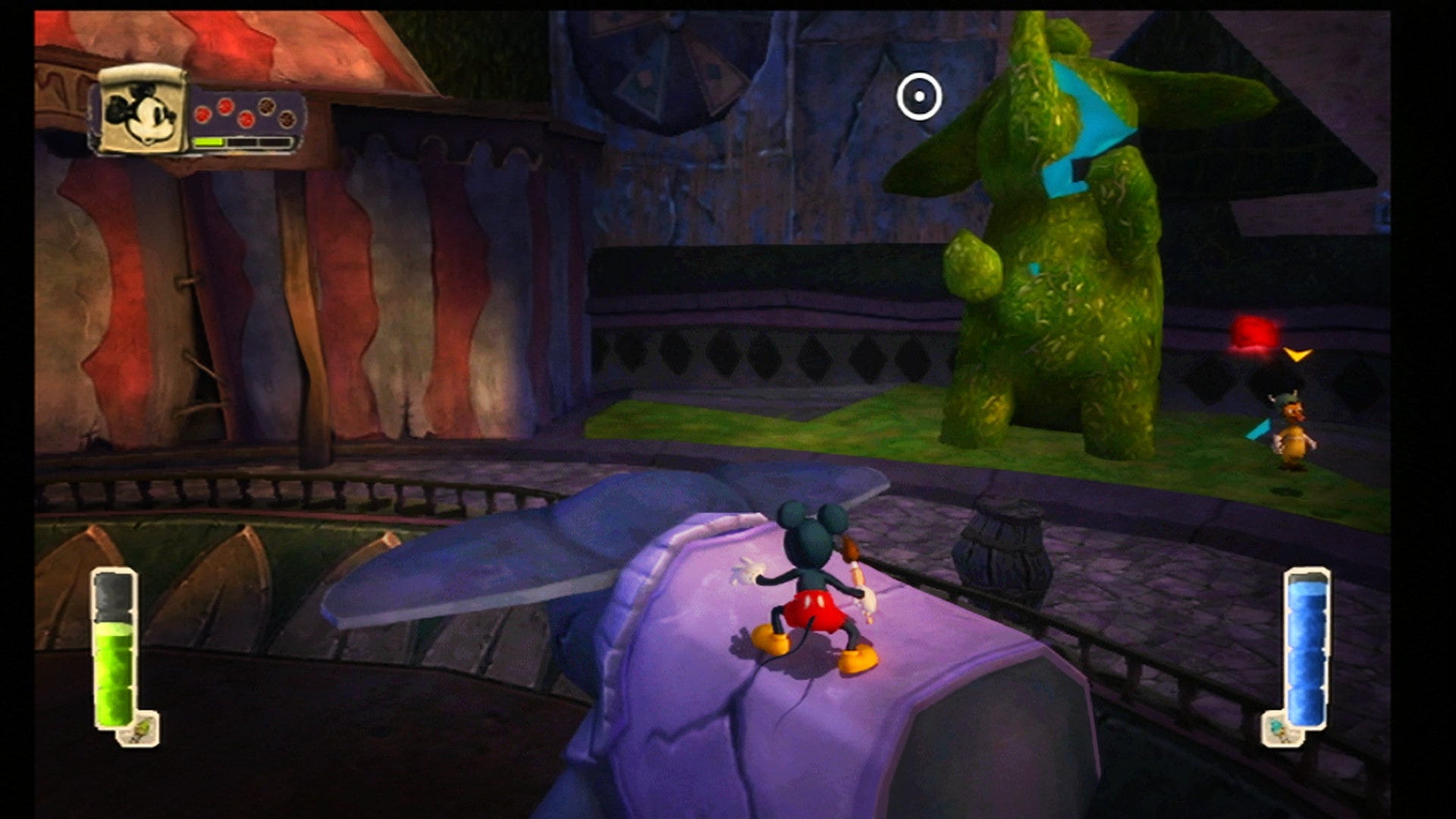
At its best, Epic Mickey plays like a Disneyfied spin on Banjo Kazooie, offering multiple pathways through an interconnected world. At its lowest points, as you scramble around uninspiring environments hunting for items, you might as well be playing Gex: Enter the Gecko.
The story is that Mickey is lured into an alternate world where unloved and forgotten Disney characters and concepts reside. Oswald the Lucky Rabbit is the bitter ruler of this place, an early Walt creation who predates Mickey and was swiftly abandoned once the mouse began his inexorable ascent to celebrity.
Oswald has turned his world into a bitter reflection of Mickey's domain, with miserable echoes of Disneyland locations and animatronic copies of Mickey's pals. Forlorn sepia cows mope about, trying to make the best of their depressed landscape, now made even worse by the invasion of the Phantom Blot, a destructive inky force unleashed by Mickey's clumsiness.
Mickey's already had some good games. Time for someone to make an effort on behalf of the Looney Tunes, I reckon.
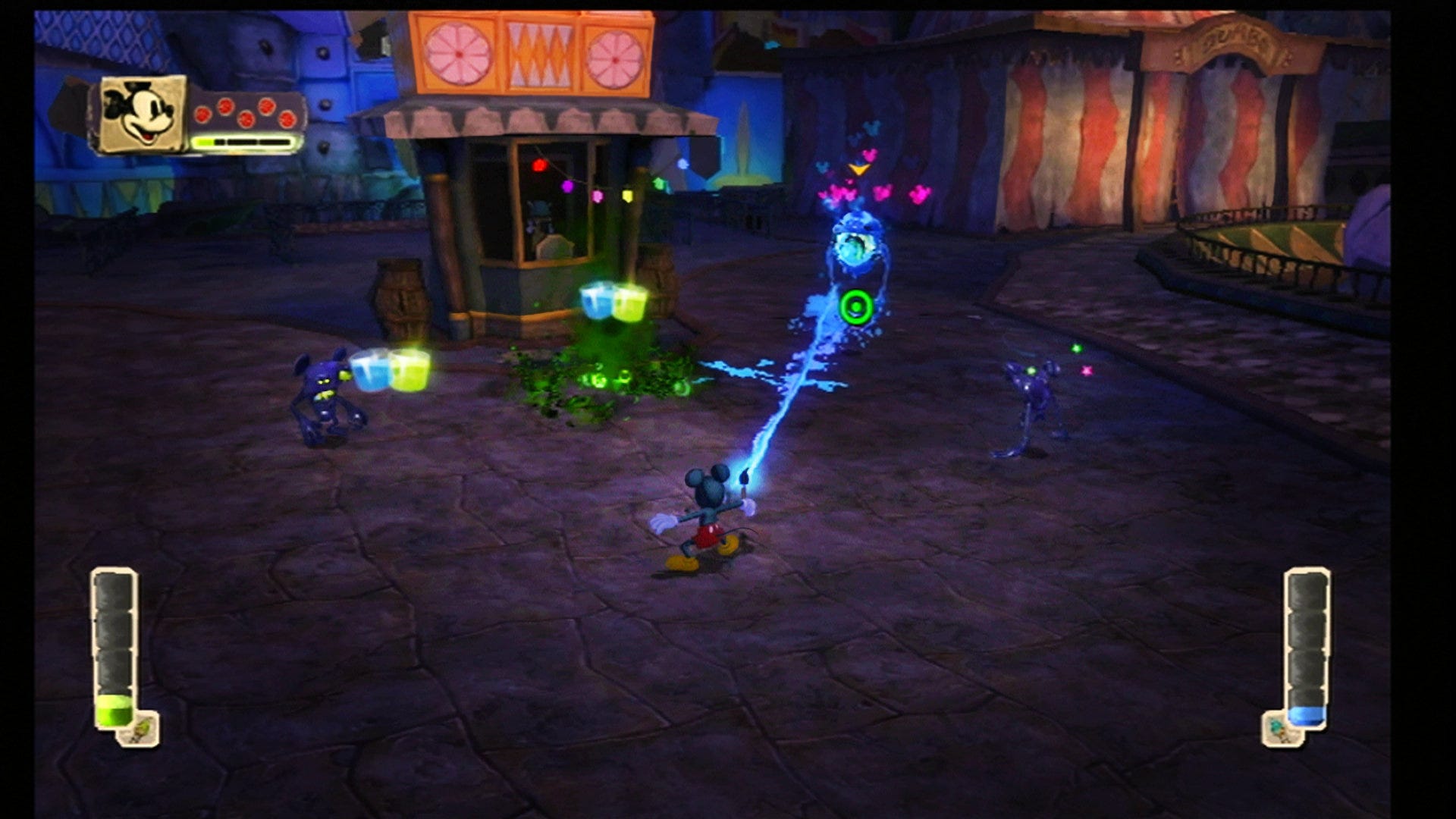
Control is much as you'd expect, given the genre. The nunchuk controls movement, the A button is for all your double-jumping needs, while a shake triggers a spin attack. Pointing the remote allows you to use the triggers on both controllers to direct a stream of either paint or thinner into the game world.
It's this mechanism that drives most of the environmental puzzles, as you're able to erase objects from existence or paint them back again. When the game bothers to play around with this concept, the results are memorable and clever. Wiping away the floor so that an obstacle drops into the abyss, before painting it back to cross safely, is one example of the options the paint and thinner system opens up. It's a shame that such moments are relatively rare though. For the most part, you're painting in obvious platforms to reach the next area, or simply filling in blanks in the game world because you can.
At all times, your decorating efforts are hampered by a fairly wretched camera – another throwback to the late-nineties genre staples, though this time not quite as welcome. Mickey has an irritating habit of squirting his magic goo all over his shoes, rather than the ground in front of him where you're aiming, and there's a lot of carefully inching towards deadly drops until the game relents and agrees that, yes, Mickey can now see what's in front of him and fill that ghostly platform.
The camera also blights the more perilous platforming sections, struggling to keep pace as you climb and drop, and it's an absolute pain during combat. Enemies can be destroyed or befriended, depending on whether you use thinner or paint on them, but that's only if you can keep them in view. There's a clunky lock-on system, but the camera still leaves you exposed in close quarters. Mickey often vanishes from the screen completely, or you're left staring at a corner, hoping you're not about to fall into a hole and die.
Graphically, the game does a great job of capturing the distinctive look and feel of Disney's 1930s cartoons, and the animation is thankfully up to the task. Characters lope and lollop about with the unique elastic gait that typified the early days of Hollywood animation. It's a style that is rarely seen today, and it helps give the game a unique visual identity.
The same can't be said of the places they inhabit. With all of Disney's fertile worlds to choose from, everywhere feels very drab and videogamey with lots of dark blue sheet metal floors, brown palm trees and pea green pools of toxic goop. It fits the idea of a twisted reflection of Mickey's world, but that doesn't make it any more fun to explore, especially with the aforementioned camera issues.
Taking Mickey Mouse on an existential journey through the dark side of his own legend is an undeniably bold move, but the game's stop-start narrative struggles to develop the themes into anything substantial, while the moment-to-moment gameplay frequently shoves the concept to the background in favour of clichéd platforming tropes and simplistic "find X number of item Y" quests.
Mickey himself makes for a curiously muted and blank hero. He never seems bothered by the situation, and is simply ordered about, fixing machines and collecting stuff because NPC characters tell him to. There's no voice acting, just a series of squeaks and burbles as you tap A to advance through reams of dialogue captions, and the much-vaunted elements of choice do little to flesh him out. There's no way they were ever going to let you turn Mickey evil, so your moral choices boil down to "be nice" or "be a bit selfish but still quite nice".
Traditional platforming jaunts through Mickey's early cartoons are used to link the different areas of the game.
There are other gameplay options open to you, however, and it's here that the touch of developer Warren Spector's Junction Point studio is most keenly felt. It's possible, for example, to avoid boss fights entirely, provided you've performed a task to help them out before the encounter. Gremlins freed along your journey will also pop up later with bonus assistance, while there's usually at least a couple of ways to proceed through each area. Free the right Gremlin and they'll fix whatever machine you've been told to repair, saving you the trouble of hunting around for widgets.
It's a cute idea in theory, but hardly a brave new dawn in interactive navigation. As the game's slightly lumpy construction makes exploring the world something of a chore, I found I was perfectly content to go with whichever solution I stumbled across first rather than wrestle with the camera in search of a notionally different way of achieving the same goal. That's a choice of sorts, I suppose, but the notion that Mickey inhabits a flexible, living world that reacts dynamically to his actions never really rings true.
Despite the promises, there's really very little that feels new or surprising here. Kingdom Hearts already did the Disney mash-up thing with more scope and daring, Mickey Mania took us on side-scrolling journeys through classic 'toons back in 1994, and it seems that almost every game offers some kind of half-hearted stab at moral choice these days.
Epic Mickey is at its best when it stops trying so desperately to reinvent both its star and genre, and simply concentrates on being a fun Mickey Mouse game. After a sluggish and frankly boring start, the story picks up after about four or five hours and the game's RPG adventure tendencies begin to take flight.
Snot funny.
You're still schlepping around, hunting for flowers, masks and other inventory trinkets, but a little breathing room makes them feel like actual quests, not just linear platform game objectives dressed up as something more. Whether the game's intended audience of families and kids will stick around long enough to find those nuggets of entertainment is another question.
For all its big ideas, Disney Epic Mickey never quite weaves its disparate strands into a convincing whole. Its conceptual ambition is let down by merely adequate mechanics, and Mickey himself remains a rather abstract figure at the centre of it all.
Fundamentally, Epic Mickey misunderstands what people love about Mickey Mouse. He simply doesn't fit in this grim, post-modern dystopia, dripping with bitter-sweet nods to forgotten corners of Disney lore, nor does he need to confront his dark commercial heart to stay relevant in 2010.
He just needs to be Mickey, with blue skies, wholesome adventures and bright primary colours. A game with the breezy aesthetic and technical polish of Super Mario Galaxy, starring Mickey, Donald, Goofy and friends would do more to rekindle our affection for the mouse than this admirable but flawed attempt at forced reinvention.
6 / 10
