Ever try watching ants? It's not that fun. All they do is crawl around, trying to hunt for food or whatever, just living their ant lives until they get stomped, eaten, or otherwise slain in some unceremonious fashion. Sounds boring, right?
That is, until you watch them with commentary.
As sports networks and the Discovery Channel have demonstrated, good announcers can make anything worth watching. A march of ants, a game of poker, elephant copulation – no matter what the subject, if somebody is commentating with enough excitement, it's hard not to get caught up in the fervour. It's even true when you're watching somebody else play a videogame.
Although your average game of StarCraft II: Wings of Liberty is more entertaining than your average colony of ants, both are far easier to watch when somebody's giving you a play-by-play. That's why hundreds of thousands of people regularly head to YouTube to enjoy professional StarCraft II matches broadcast by people like Mike Lamond. Lamond, who goes by the handle HuskyStarCraft, uploads around 100 videos a month – some in three or four parts – that have garnered a whopping 100 million total views. He's also very entertaining.
"I try to make the game as exciting as possible," Lamond tells Eurogamer. "When I'm watching this stuff, I'm getting legitimately excited, so that comes through in my commentary."
And there's lots to be excited about. Lamond moved to Los Angeles recently to take a full-time job at The Game Station, an internet-star-studded YouTube channel that he describes as "about gaming, made by people who actually play games." The popularity of his own channel helped make that happen – the HuskyStarCraft account currently has 250,000 subscribers, not all of whom are hardcore fans of the game.
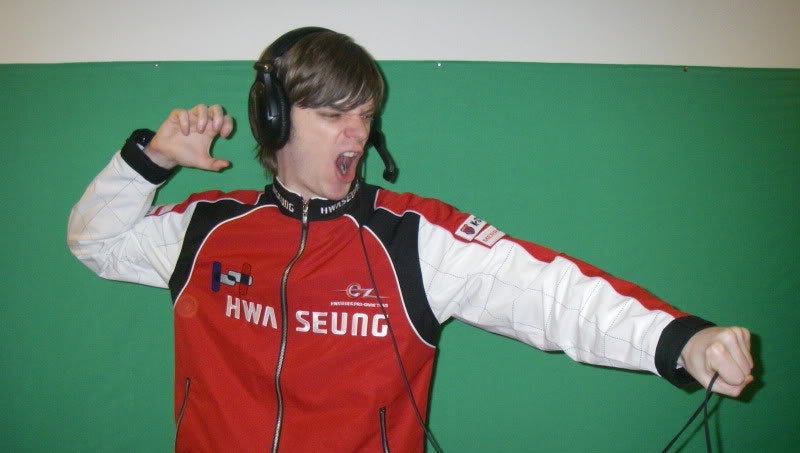
Mike "Husky" Lamond showing the immense physical strength required for StarCraft commentary.
"My style might appeal to someone who just wants to sit down after work and enjoy some StarCraft," Lamond says. "Or the more casual gamer, who doesn't necessarily care if he's going to beat the next 10 opponents or not."
But Lamond's brand of fast-paced excitement isn't for everybody. Some players might want less hype and more analysis, especially if they do care about beating the next 10 opponents. Enter Sean Plott.
Known as Day[9] in the StarCraft community, Plott has been playing professionally for 10 years and has placed first and second in a number of World Cyber Games tournaments. For almost a year now, he's been running the Day[9] Daily, a series of videos that he streams every weeknight with the goal of helping players get better at StarCraft.
"Everyone wants to know a way to win," Plott says. "That's pretty consistent in all games, whether it's players using a strategy guide, coach, or anything else."
If Lamond's videos are basketball matches, Plott's are 'Inside the NBA' – he stops games mid-battle, analyses specific plays, and often points the camera at his own face so he can "go on long random tangents and try to make goofy jokes." His natural charisma combined with a great sense of comic timing help keep the Daily engaging, despite the frequent breaks in action. In the past year he's cultivated a loyal group of followers; one of his most recent videos had over 12,000 live viewers.
And they do help. I discovered Plott's videos while trying to get better during the StarCraft II beta. Watching them helped me evolve from a mediocre Silver League player into a Diamond League player. I'm still mediocre, but now I have significantly more street cred.
What's particularly amazing about both Lamond and Plott is that their audiences grew on word-of-mouth alone. Both commentators have done very little marketing over the years; their videos have spread via message boards, Twitter, and personal recommendations. People were intrigued enough to click and hooked enough to keep coming back.
I asked Plott what makes a game worth watching. His answer – like all good answers – had three parts.
1. It has to have good competitive depth.
Not like Tic-Tac-Toe, Plott explains. "I don't care how flowery Tic-Tac-Toe can become, Tic-Tac-Toe is a game that always ends in draws. Always."
So what kind of games have competitive depth? How about... poker?
"Poker is a great parallel," Lamond says. "Like in StarCraft, you're trying to make good decisions while knowing very little about what your opponent is doing. You want the perfect build, the perfect unit composition..."
Similarly to how you want the perfect hand, then. But StarCraft is much more complex than poker; the variables, resource management, and split-second decisions all go way beyond the scope of a card game, no matter how competitive it may get.
Sean "Day[9]" Plott demonstrates his inner rockstar.
That said, competitive depth doesn't have to mean complexity – even simpler games like Halo meet the criteria. The real challenge is providing a balanced, well-thought-out experience that rewards skill and strategy over blind luck. And sure enough, it takes an astounding level of skill to master StarCraft.
"The professionals have to practice 8-10 hours a day," Lamond says. "There's no skill ceiling – you can always get better."
These professionals' bouts – some of whom make six-figure salaries through endorsement deals in South Korea – comprise a large chunk of the matches that both Plott and Lamond record. Names like IdrA and TheLittleOne are as distinguished in the StarCraft community as LeBron James or David Beckham.
People really appreciate the level of skill that professional players demonstrate in their matches, Lamond explains. Even viewers with just a basic understanding of the game can admire some of the techniques that pros use – such as the meticulous micromanagement of a single unit, or the near-perfect timing of a build strategy.
"It's fun to watch somebody take a game beyond what you think is possible," Lamond says.
2. It needs to have pizazz.
"People need to be able to look at this game and say, 'Hey, what's that?'" Plott says. "Kind of like how, if you say you're going to do a science-fiction movie, you need to have good graphics... games are the same way."
StarCraft II definitely has pizazz. It's no Final Fantasy XIII, but the backgrounds are gorgeous and each unit or building is aesthetically intriguing in its own way. Play it in front of other people and they'll be curious about what's happening; even if the game just appears to be a bunch of strange creatures roaming around a map, the graphical style makes it appealing.
"In the competitive gaming scene there have been many great games that haven't had traction because they're really old," Plott says. Is anyone really going to spend much time watching a game that looks like it can be played on an Amiga 500?
Of course, games that have already been culturally accepted don't need any pizazz. "A game like chess doesn't need to be pretty, because people already get it."
That's why StarCraft: Brood War is still huge in South Korea, Plott explains – it rose to popularity there very early.
"For a company in the West, it's impossible to say they picked up Brood War from the start," Plott says. "If they watched it now, they'd say, 'Look at this thing, it looks like a f***ing cartoon.'"
3. It must be observable.
Wait a minute... StarCraft is observable?
"You'd think it'd be hard to watch," Plott says. "But all of it is colour-coded. There's the blue army versus the yellow army – you can delineate each colour to a person."
Lamond agrees. "All you have to know is that each side is trying to destroy as much of the opposite colour as possible."
But what about the different races? The units? The abilities? Could somebody unfamiliar with the game really pick up on what's happening at all times?
More on StarCraft II: Wings of Liberty
-
Preview: Do you suffer from StarCraft 2 ladder anxiety? Blizzard hopes Heart of the Swarm will help you beat it
And prove it's more than just an eSports game.
-
Interview: The Hero Factory
Conversations with Chris Metzen, Blizzard's head writer.
-
Interview: Always Online with Blizzard
Co-founder Frank Pearce and StarCraft 2's Jonny Ebbert speak.
-
Screenshots: StarCraft Universe screenshots
"StarCraft is pretty damn straightforward," Plott says. "You don't have to know what psionic storm means, because you see lightning going over something, and you figure it out."
He compares it to Warcraft III, which "has a huge problem with observability". While StarCraft features humans and aliens, Warcraft adds heroes, elves, creeps, auras, undead, and a host of other bizarre concepts and terminology. It's far more difficult to grasp.
Plott sums it up succinctly. "For a game to be observable, it needs to be fairly clear what's going on without much explanation. In StarCraft, all you do is collect money and build up an army in an attempt to kill someone."
That might sound overly simplistic, but isn't that a summary of any StarCraft match? Strip out all of the nitty-gritty details and you have two armies duking it out, just like any other conflict or sport. Can't any audience understand that?
"I've shown [my videos] to people who've never even played a computer game and they've fallen in love with it," Lamond says. "I've met kids aged 7-8 who are fans, and I've met people in their 60s who are fans."
The demographics don't lie.
If you had told me a year ago that I'd spend hours watching other people play videogames, I'd have laughed in your face. Watching friends fumble around in Super Mario Bros. without holding the run button was frustrating enough – why would I want to watch gamers I didn't even know? StarCraft commentators changed my mind. Professional StarCraft II games can be visceral, hilarious, shocking, emotional, and above all, entertaining.
I don't know how large the competitive StarCraft II scene will grow in the coming years, but its immense popularity bodes well for the future of e-sports. If the game ever does grow as mainstream as basketball or football, talented commentators like Plott and Lamond will be a large part of the reason. Head to their respective pages and you can see their talents for yourself – even if you don't know a zealot from a zergling, these guys are worth checking out. That is, if you can tear your eyes away from the ant farm.
