Test Drive Unlimited 2

Roll playing game.

"New hairdresser discovered!" When this message flashes across the bottom of the screen in the middle of a time trial, you know you're playing a unique (and some might say, uniquely French) racing game.

You also know – if you didn't already – that it's a sequel to the inimitable Test Drive Unlimited, and that Eden Games' unusual preoccupations haven't changed a jot since that rough diamond was released back in 2006.

This is still a racing game that's as much about exploration and glamour as it is lap times and racing lines; a game where the customisation focuses on your threads and cribs rather than your cars' decals and differentials; a game with Second Lifestyle pretensions of persistence and wish-fulfilment. Here, your avatar isn't just a silhouetted crash helmet – it's a sexier, better you.

And that's just as well, because after a good few hours with a beta build of the game – not the very latest version, mind – it still seems to be a game whose immense charms are pegged back by basic handling and a cumbersome interface. However, the more you play, the less noticeable these issues become.

You may be familiar with the headlines already. Motorbikes are out and off-road is in. There's dynamic weather and an accelerated day/night cycle which, as long as you are logged in, are synchronised for absolutely everyone playing the game. And Test Drive Unlimited 2 offers the island of Ibiza as an entirely new free-roaming playground paradise, later taking you back to the original, but reworked, Oahu island in Hawaii.

1

There are rough edges graphically, with severe pop-in, but the realism and sweep of the scenery are some compensation.

Not that anyone who made themselves comfortable on Oahu four years ago will be experiencing severe pangs of homesickness at the start of the game. Ibiza is a subtly rather than strikingly different environment: a bit less ruggedly spectacular in its scenery, and studded with towns whose streets are narrower and more haphazard than Hawaii's spacious grids.

It's more European, in other words, and the implied four-to-the-floor Eurohouse thump behind it suits TDU's cheerfully cheesy continental vibe. But the predominant mood of marinas, holiday homes and the high life hasn't changed much. The island is knitted together by a similar network of motorways, mountain switchbacks, leafy suburban lanes and those thrilling, sweeping coastal straights.

The biggest environmental changes, then, are the dynamic weather and time of day. These have a mild effect on gameplay – you'll certainly lose grip on wet roads on the simulation handling setting, although Eden never quite dares to plunge you into the pitch blackness of night-time countryside. They do add terrific atmosphere as you raise your roadster's roof in a summer shower or speed through an inviting, twinkling town at night.

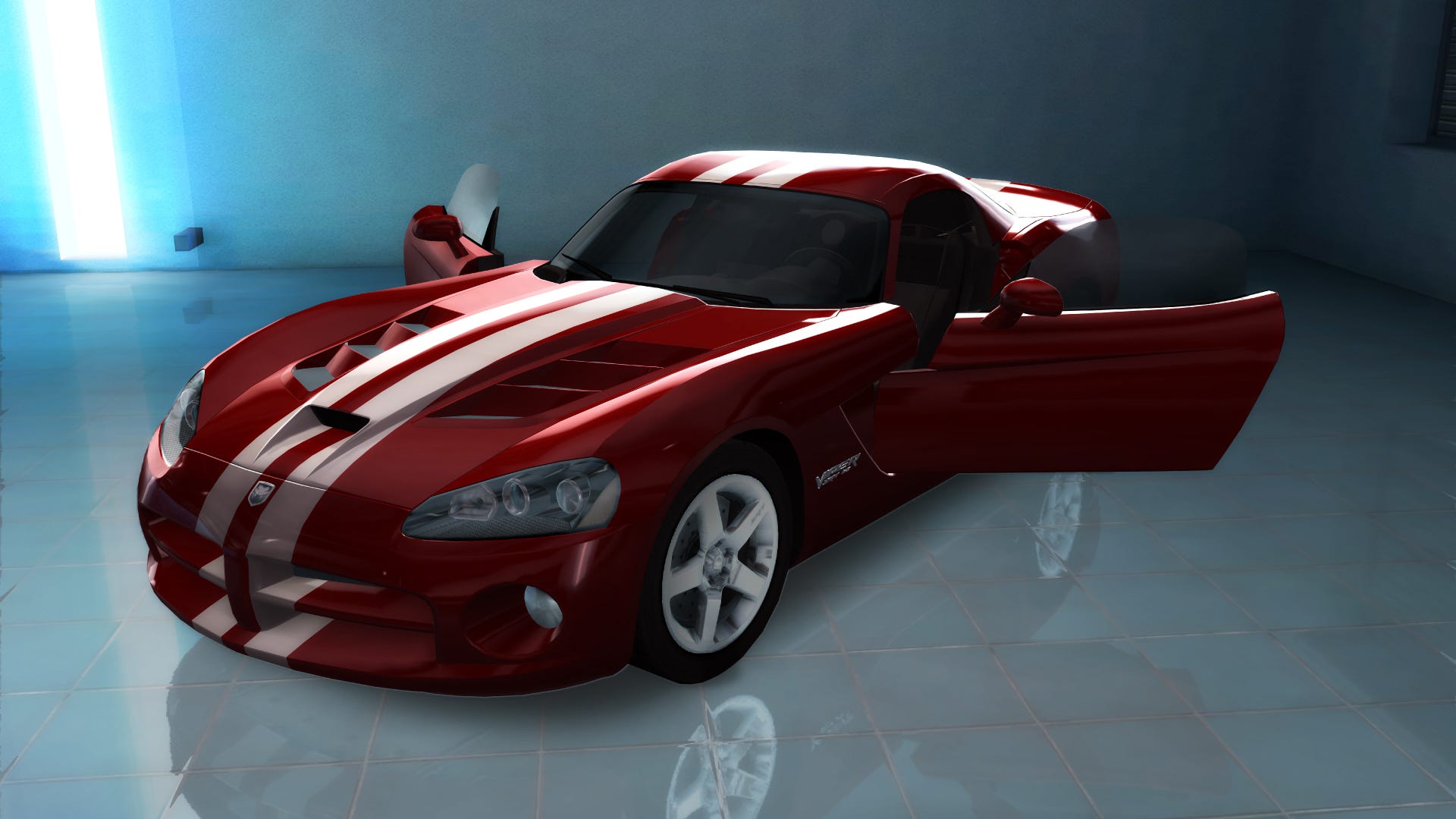
After selecting your avatar from a few distinctly uncanny valley girls and boys – dancing in creepy slow motion at a pool party – you're offered a Ferrari California as a birthday present. This isn't a riches-to-more-riches tale, though. It was just a dream and you're a humble hotel valet, but you still get to give a girl a lift in the voluptuous sports car before starting from scratch.
2

An enjoyably silly attempt at story pitches you against oddball, improbably glamorous rivals with names like Miami Harris.

Scratch, unconventionally, is the 'Classic' racing class, whose vintage motors have been segregated from the main 'Asphalt' cars and the 'Off Road' SUVs. They're not the quickest, but it's nice to start out in a seventies Lotus Esprit, Lancia Delta Integrale or Ford Mustang rather than a modern hot hatch for a change.

There are many significant changes to the game's structure. Instead of simply exploring the island to discover new events, you need to pass Gran Turismo-style licence tests (which the game's relaxed handling model and open-road driving style don't really demand, frankly).

Competitive single-player events like races and time trials are now clustered into Championships. You can warp between championship event locations at will, whether you've discovered them on the map or not, so these offer a practical advantage as well as a more organised structure. You'll still need to spend plenty of time following your sat nav and dipping into the sluggish map to uncover new locations and events, though.

Progression wasn't very well paced in this beta version, with grindy cash bottlenecks occurring before you could afford the cars to participate in the entry-level Off Road and Asphalt events. The acquisition of a house with third garage slot – you start with just two attached to a dismal trailer home – seemed to be a long way off, thus forcing you to sell one of your early cars.

Which to lose – Esprit or Hummer? Not much of a choice, especially since the early Off Road races on dirt tracks are lumbering and unexciting. There's still potential in this side of the game, though, hinted at by the licence tests on more rugged terrain; the SUV driving style contrasts nicely with the rallying we're used to. And the simple liberty to explore the island off the tarmac is very welcome.

It's another touch of variety for a game which was already bursting with it – especially compared to the lap grind of other "CarPGs" like Forza and Gran Turismo. TDU2 is simply overflowing with different stuff to do.

The first game's celebrated special challenges are back, now appearing and disappearing at random around the map – timers indicate how long they'll stay around, so getting to one can be a race in itself. Deliver a car without scratching it, give a car-sick girl a smooth lift, or even, hilariously, help a jealous boyfriend tail his cheating lover without being noticed; there are numerous entertaining twists that ask you to think about something other than just going faster.

There's multiplayer, of course. Although you only ever share your vicinity with eight other players these cycle at random, giving the impression of a true massively multiplayer environment. You can flash your lights at any of them to trigger an impromptu race challenge, betting your earnings in instant "revenge" bouts.

3

Off-road exploration is encouraged by the chance to find classic wrecks (and the comical site of a low-slung Lotus motoring up a mud bank).

The set multiplayer events even include some unusual co-op game designs. Some make more sense than others, but 'Follow the Leader' was a pleasant detour into cross-country convoy driving, with alternating players being shown the next checkpoint on their sat nav.

A fantastic event lobby lets you walk around, inspect and even sit in each others' cars parked on the roadside. You can even meet other players on foot in shops and event hubs, like in a real MMO. Sadly, finding and joining the same instance of the game as a friend can be unreliable and confusing

Covering longer distances on your own as you explore the island is enlivened by a system rejoicing in the quaint acronym FRIM, or Free Ride Instant Money. Using this, you can chain manoeuvres like jumps, drifts and Burnout-style near misses to earn extra cash, with an escalating balance of risk and reward as you decide whether to bank your money or gamble it.

Progression through TDU2's sprawling automotive activity centre is organised into 60 levels (you get access to the airport, and thus Oahu, at level 10). These are divided into 15 levels each of competition, discovery, collection (houses, clothes and cosmetic surgery options as well as cars) and social goals.

4

Cars sport some nice dirt and damage effects with use, but they're cosmetic only.

Devoting a quarter of the game's experience-based progression to social activities – participating in clubs and the like – is bound to be a controversial decision. It does seem like a forced attempt to push the game's community features, which had only limited traction last time. Still, the sheer breadth and choice of play styles offered by TDU2 shame its competition.

You can't be this ambitious and have everything, however. The casualty, as was the case with Test Drive Unlimited, is the car handling. As strenuously as Eden and Atari claim that the handling model has been completely revamped – and allowing for the fact that only some of the cars in the build I played had their full physics model applied – it's nothing like as satisfying as a race-tuned Forza or free-wheeling Hot Pursuit.

The huge range of roads, corners and situations that Test Drive has to handle forces so many compromises on the handling that it loses physicality, feedback and personality as a result – and that applies across its range of difficulty settings. Realism needn't be a target, but it would be nice for the cars' individual characters to come across more strongly than they do.

This is still the area Eden needs to work hardest on between now and the game's launch early next year. But the good news is Test Drive Unlimited 2 is still a charming and bold original. Four hours in, the game had easily excused its flaws by offering an addictive and unique driving experience. No other racer offers such a romantic, indulgent celebration of the open road. And no other racer has hairdressers, either.

Comments (28)

Comments for this article are now closed, but please feel free to continue chatting on the forum!

  • Loading...hold tight!