Version tested: Xbox 360
Editor's note: Reader beware! As a review of the second epilogue for a very narrative-led game, the following necessarily contains some spoilers for Alan Wake and previous episode The Signal. Proceed with caution.
When we last saw Alan Wake, victim of the world's worst case of writer's block, he was flailing his way through the all-consuming darkness of his own imagination in the game's first downloadable "Special Feature," The Signal. As we begin the second and final expansion, The Writer, Wake is still in that dark place, but he's not flailing anymore.
In fact, the hoodie-clad author seems to have popped a couple of quaaludes since the previous episode. In The Signal, and in much of the original game, Wake tended toward a snippy, bratty antihero, facing his plight with an air of unlikable petulance. The Writer is about Wake as Mr. Cool. He considers his circumstances with a careful methodology and then calmly pursues a course of action. The character's progression toward rationality makes sense in the context of the story, as Wake comes to grips with his own psyche. It is also quite boring.
He has gone from irritating to dull. Wake is also represented in the downloadable episodes by a jittery, deranged face on flickering televisions, and that's fitting. The developers' attempts to nail down their title character are reminiscent of adjusting the vertical hold on an old TV. Turn the knob too far, and the images on screen become obnoxiously kinetic, vibrating up and down the screen. Too far in the other direction, and the picture gets squeezed flat. In The Writer, Wake is spun too far the other way, flatter than a page from his prized manuscript.
Wake's dispassion is symptomatic of an episode that's mundane overall. The Signal was a mixed bag, but it did at least end on a high note of emotion and intrigue, which The Writer squanders.
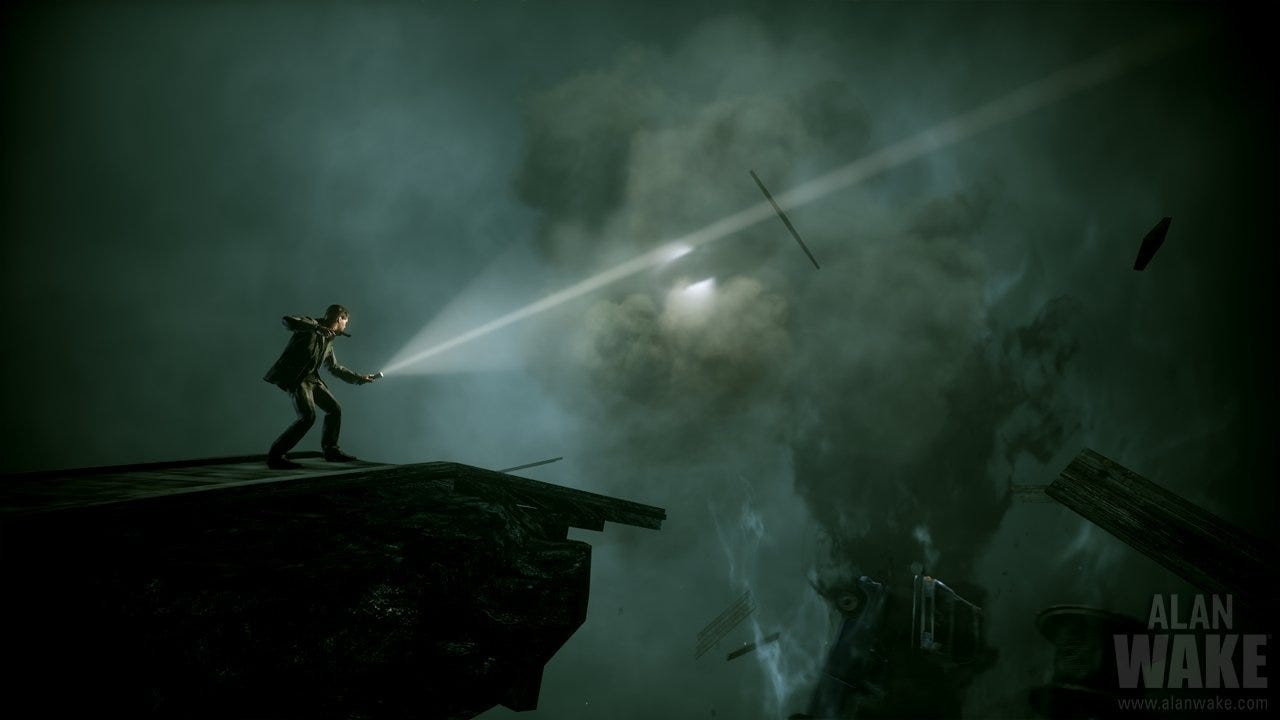
I was on a rooftop. I needed to get down. I would have to find a way off the rooftop.
Wake was in the depths of his insanity when Episode 7 faded to black, and the cliffhanger practically demanded that players see the story through this denouement. But The Writer begins on a relatively placid note and carries itself with no urgency; it simply shoves Wake back on that familiar journey toward the yellow dot on the mini-map. (This time, that dot represents the Bright Falls lighthouse rather than a nondescript GPS signal.)
There is still the trademark torch-and-trigger-finger combat, although less of it than you might expect. The developers seem to realise that they explored the limits of their battle system in The Signal; it's a shame they didn't reach the same conclusion in regard to the whole "shine light on words to make things appear" device. That dynamic takes centre stage in The Writer, to the point that it feels like a way to artificially extend this brief episode.
The march toward the lighthouse is marked by a slow departure from Barry, Wake's literary agent and wisecracking sidekick. There were points in The Signal where Barry's patter became daring enough that it poked fun at the somewhat ludicrous assumptions underlying the game's Ouroboros of a plot. If that thread were pulled any further, Alan Wake might descend into full-on farce, and while that would be pretty goddamn fantastic, that's not the kind of game this is.
So Barry fades away, and Thomas Zane becomes Wake's new Samwise Gamgee. You may remember Zane as the fella in the old-time scuba suit who, oh yes, also happens to be made of pure light.
Zane was a perplexing figure in the original game, but The Writer gives us our closest look at the luminescent interloper yet. It turns out that Zane is like the charmer who catches your eye with an insouciant smirk from across the room, except that when you approach, you learn he was just trying to work some spinach out of his teeth. His appeal lies only in his mystery.
In The Writer, we observe that Zane's hobby is stating the obvious. Hey! That's Wake's hobby, too. Soulmates!
Anyone who played The Signal knows that Wake is sinking into the darkness of his psyche and he has to fight his way out. Yet Wake and Zane delight in repeating this well-understood premise back to each other, in various permutations, a veritable Dueling Banjos of needless exposition.
If you wonder why I've focused so much on character in this review, it's because The Writer is an extremely character-driven episode, and not coincidentally, Alan Wake's weakest. The game is at its worst when it relies on character study, for the simple reason that its characters are not that engaging.
Yet Alan Wake is very good at crafting ambience, and that talent shines in the one memorable segment of The Writer, when Wake falls into a spectral house that has drifted free of its moorings. As I attempted to navigate a rotating patchwork of interiors from Wake's subconscious – his living room melts into a mining elevator, which descends into another memory fragment entirely – the movement controls felt inadequate. Wake slammed into walls, and I forgot which way was up.
And that was perfect, because the sequence evoked one of those nightmares where you forget how to run – where all of a sudden, the technique of putting one foot in front of the other is an impossible secret.
I gripped my torch as the floating words drew near. I would have to find a way to shine light on them somehow.
The dream spiral was a daring moment, and Alan Wake has had too few of those. The game initially seemed bold because its idea of a nuanced adult psychodrama was so much more mature and distinctive than the genre-based fare that surrounded it on store shelves. But having come to the end of the Alan Wake saga, I've concluded that the game represents a daring idea executed in the most timid manner possible.
From start to finish, Alan Wake has been plagued by a fear that you, the player, will abandon it. Every "push this blinking green button to advance" moment, every time Wake recapped the situation to be double-triple sure you understood, every bit of symbolism explained away (and deadened) by Thomas Zane's psychobabble – they're all idiosyncrasies of developers with an unforgivable lack of confidence in their work and their audience. The game's neediness is its most overwhelming disappointment.
The timidity is exacerbated by the game's format, a retail release plus downloadable expansions. What is the "canonical" version of Alan Wake? The game on disc? The disc plus the downloads? The creators don't know, so they've hedged their bets. The Writer sketches out an ending so pat, expected, and insubstantial that I had to laugh at how diligent it was in failing to make any progress beyond the original game.
At least those of us who played the expansions didn't get a leg up on the disc-only folk. This appears to have been Remedy's goal, after all. From the outset, they've dulled the bold strokes of the Alan Wake concept in a desperation to ensure that everyone got the complete experience. Well, I got it. And I'm left pining for what could have been.
5 / 10
Alan Wake: The Writer is released today on Xbox Live for 560 Microsoft Points (£4.76 / €6.72).