Castlevania: Lords of Shadow

Whipping up a storm.

Castlevania: Lords of Shadow has to be something rather special to really spark excitement, and not just because I had to get up at 8am on a Monday in order play it for this preview. Previous Castlevanias Judgement and Harmony of Despair have both left everyone justifiably wary of the words 'series reboot'. Perhaps only the words 'family-friendly remake' could be more dispiriting.

Lords of Shadow – which is extremely un-family-friendly, incidentally – reshapes Castlevania into a Devil May Cry-style action game. It's beautiful and violent and flavoured with more than a touch of Gothic horror. Just looking at the list of names involved with the game – Robert Carlyle, Sir Patrick Stewart, Hideo Kojima – suggests this is an important game for Konami. Important enough to involve Kojima Productions as well as Western developer MercurySteam.

The Metal Gear Solid creator's role on Lords of Shadow is an advisory one, as you'll know if you read our previous preview. However his studio's influence can certainly be seen in the game's flamboyant cinematography, which is both ridiculously beautiful and beautifully ridiculous.

In one of the opening levels, Gabriel speeds through a forest on the back of a sparkling, magic horse with eyes of blue flame and an unexpected Eastern European accent. He's pursued by goblin-werewolves riding hulking bear-beasts. It's a heart-racing vignette culminating in an improbable leap across a massive chasm as the steed melts away into the air.
1

"You are NOT going out dressed like that, young man."

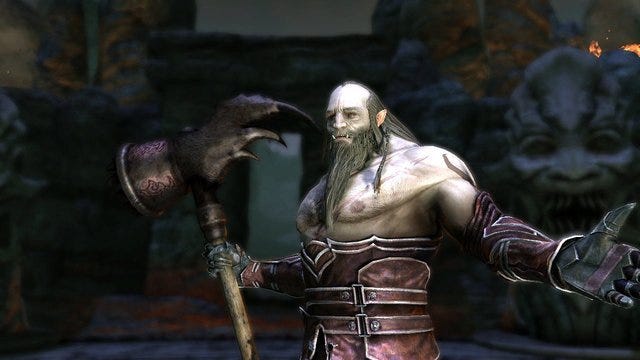
There's a touch of Gothic magic in Lords of Shadow's presentation. The forest that serves as the setting for the game's opening chapters is gold-dappled, overgrown and shimmering with dust motes. Its guardian, whom hero Gabriel Belmont meets at the end of his first journey, is a hunched, ram-horned, fang-toothed old creature clothed in bark and moss, looking like something straight out of Pan's Labyrinth. Birds rest on enormous tree-roots in the foreground as Gabriel runs through forest passageways.

Between levels the story is narrated in diary-form by Patrick Stewart. He plays Belmont's mentor, Zobek. His words unfurl across the worn pages of an old storybook which serves as the level select screen, its illustrations depicting scenarios from the levels themselves. The ability and item screens are also presented in this distinctive style, in keeping with the medieval art direction and the plot's mythological feel.

When you get to the first castle you find the aesthetic is no less impressive when applied to a more traditionally Castlevania setting. The game frequently interrupts itself with cut-scenes, giving the story ample room to stretch its legs or giving itself over to sweeping, wide-pan shots. These show the scale and detail of the vistas and constructions. Such self-assurance you'd expect from Kojima Productions, but not necessarily from MercurySteam. It's a pleasant surprise.

Belmont fights with the whip, with both an area attack for crowd control and a closer-quarters specific attack. Collectible throwing daggers deal instant death to weaker enemies and chip away sizeable chunks of larger ones' energy bars.

There are choreographed grapples; once Belmont has a smaller enemy in his grasp, a diminishing reticule shows you when to press another button to rip it apart. QTEs are used sparingly and involve more precise timing than other action games demand. They're often environment-dependent, too – at the end of the tutorial, Gabriel lifts a giant piece of wood into the air to stake a flying werewolf.

You quickly realise that the game is as much about avoiding hits as it is about dealing them out. A shoulder button both blocks and rolls, leaving room for a precisely-timed counter-attack. Slow-motion and telltale glinting give you your combat cues, warning you when an enemy is winding up for an unblockable attack. It's hot on Bayonetta's high heels, resembling Sega's genre masterpiece in its sense of rhythm - though not in stylish exuberance.

Health fonts are sparsely placed throughout the level, but a light magic system is introduced early on that lets Belmont regenerate his own health by attacking. Stringing up long sequences of attacks without being hit is duly rewarded – button-mashing really won't get you far. Though the game checkpoints generously, it expects a good amount of skill from you.

2

The Ice Titan was the most impressive thing about the demo - like much of CLOS, the gameplay owes a lot to other titles. But it's executed well.

More traditional Castlevania gameplay has not been ignored. Levels have alternate routes and hidden items – you can grope for their secrets on your first run through, but you must often return with better abilities in order to reach them. There are puzzles, involving matching runes or rotating plinths and other such familiar staples. There's rather a lot of platforming, too, climbing around mossy, vine-covered ruins or using the grapple to swing between between stonework ledges.

The game's first boss, the Ice Titan, combines fighting and platforming in a really quite masterful riff on Shadow of the Colossus. As Gabriel enters the frozen Oblivion Lake, snowflakes sticking to and melting on the screen, an enormous creature of ice and stone rises from beneath. Dodging its massive fists, you wait for the opportunity to climb up onto its body and smash the rune seals hidden on its gigantic form, holding one of the shoulder buttons to hang on for dear life as it tries to shake you off.

It's a mix of quick-reaction dodging and grappling and slow, steady platforming. You have to dodge the Titan's swatting hands, watching out for the metallic glinting on different parts of its body and grappling towards them with precise timing. A single mistake, and you're tossed back down to earth.

At alternating moments Castlevania: Lords of Shadow resembles Devil May Cry without the tongue-in-cheek machismo swagger, Shadow of the Colossus without the steed and sword, God of War without the gore. It takes inspiration from these games with unexpected self-confidence. It's garbed in fantasy presentation that calls to mind Tolkein and del Toro. It's got a spark, creative impetus and dramatic touch about it that the Castlevania series has lacked for some time.

Comments (59)

Comments for this article are now closed, but please feel free to continue chatting on the forum!

  • Loading...hold tight!