Need for Speed: Hot Pursuit

Social network king.

Top Gear, season 14, episode one. Clarkson, May and Hammond traverse Romania in a range of hyper-expensive grand tourers in search of the Transfăgărăşan: 90km of high-altitude tarmac that just happens to be one of the exciting, environmentally spectacular driving routes in the world. This is the experience that sums up the new Need for Speed: Hot Pursuit - a celebration of driving some of the hottest cars in the world on the most exciting routes to emerge from the designers at Burnout studio Criterion Games.

"Let's look at the environments. They were designed here and then the guys at DICE built the world. It's all designed around the most epic drive you can go on in these amazing, really fast 250mph cars. It's all built for that," says creative director Craig Sullivan.

"The roads in this game, they're very different to what we've done before and what other people are doing at the moment. You can drive from the coast up to the desert, through the forest and up into the mountains. You can go for a 25-minute drive without seeing anything twice and you're setting times as you go, seeing your friends' comparisons pop-up. You're doing that on your own or with seven of your friends in the hottest cars in the world."

The Need for Speed game world is an interesting evolution from what we've seen before from Criterion in Burnout Paradise. For a start, it's four times larger than Paradise City and its surrounding environments, and while there is a Free Drive mode that allows you to explore and enjoy the world on your own terms, actual events are selected via the game's menu system - no more driving about the map and pulling up at traffic lights. It's just not immediate enough for the audience Criterion wants with this game.

"There's a free drive for you to enjoy the cars and set some times on the roads but the competition element is more traditional in terms of a start and a finish," says Criterion senior producer Matt Webster. "A lot of the complaints we had about Paradise were about the whole restart issue, having to drive three or four miles to go back to the start. With Need for Speed we're going to be a bit more traditional in terms of serving up the play because the most important thing for us was to get people into it, giving them a simple structure in terms of picking play."
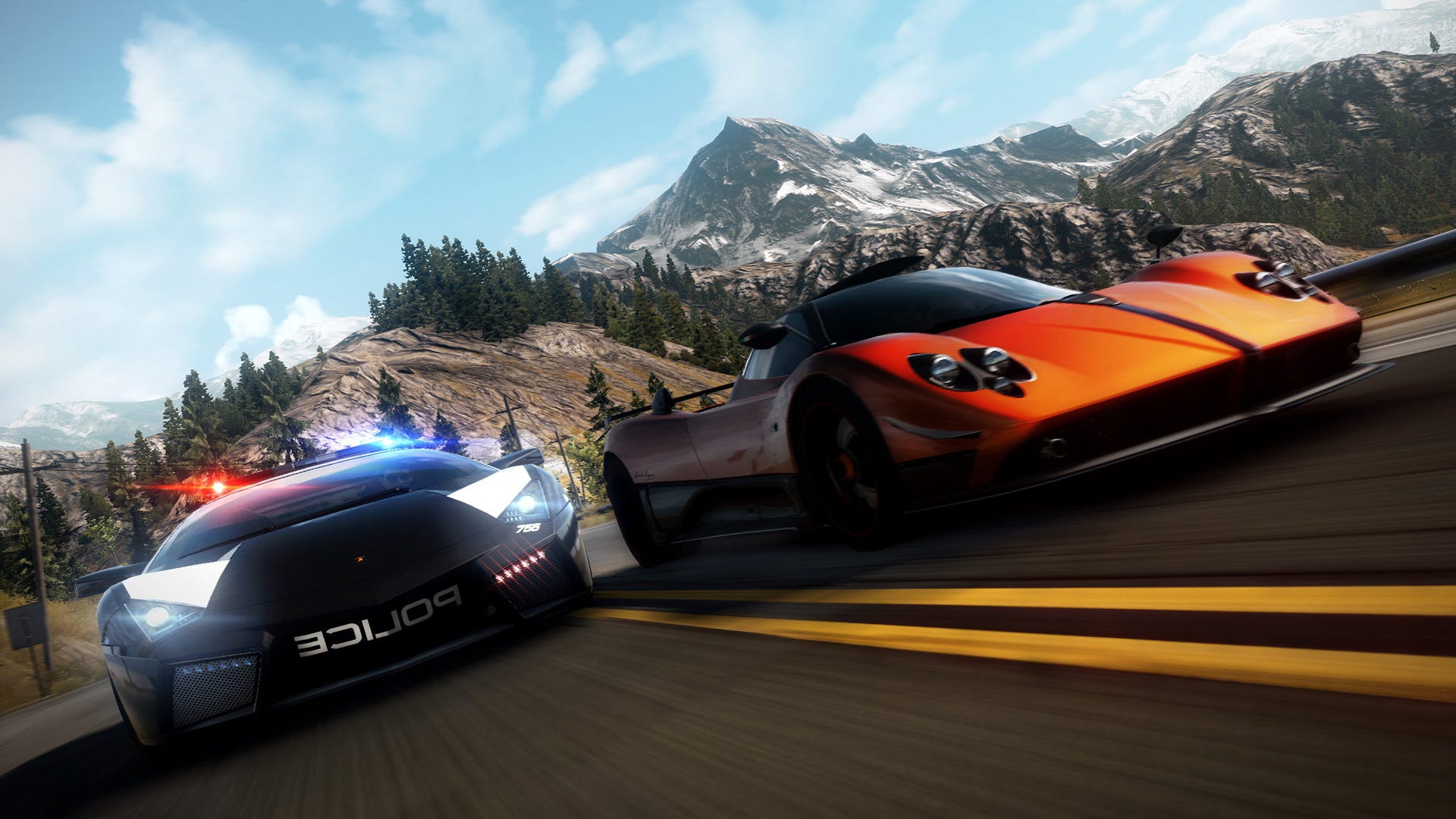
nfs1

Racers and cops each have their own path through the game.

"It's very different to Paradise City. We don't want people to worry about navigating when they're driving at 250mph. This is a faster game than Burnout. The cars actually go faster," adds Craig Sullivan. "We want you to focus on how you're driving down the road. Are you slipstreaming this guy, how am I taking the next corner, how am I going to drift around the next corner that's been designed to feel cool just to drift around..."

This game is all about some of the world's most powerful cars, and this entailed a huge re-evaluation of what worked and what didn't in Burnout Paradise. Sullivan is frank in his appraisal of elements of his previous game that didn't play as well as expected.

"In Paradise it's not very nice when you're having a good race and you take a wrong turn through no fault of your own and they just end up screwing up the race," he says. "That'll never happen in this game. Because of the way we've designed this world and the roads in it, everything should feel like an epic drive, like you're really travelling a long distance."

The team has instead focused innovation on how the various events are served up to the player. While Need for Speed: Hot Pursuit features a complete career mode for both cops and racers, you can play through the game without visiting the single-player stage selects at all. The big innovation is Autolog. Think of it as an entire social network built into the game itself, devised as an evolution in Criterion's thinking on how networked gameplay goes beyond simply playing against friends online.

Webster explains how the studio's history in creating multiplayer driving games has culminated in the creation of Autolog. "With Burnout 3, we were online for the first time - it was a whole new experience for us. With Burnout Revenge we started to track relationships between people, using stats in a human way. For Burnout Paradise it was about the friends you were playing with, not a meaningless ranking in a world leaderboard," he says. "We're more about people playing together, a social competition between people on your friends network on the console. Autolog is a suite of connective features that allow social competition."
nfs2

Autolog adds a social networking element to in-game snapshots and photo mode 'Dream Shots'. Dramatic in-game moments are easy to share.

If the core game experience is all about the joy of driving and racing, Autolog is the means with which you can share everything about what you've done in the game with your friends. Individual event performances and Paradise-style Road Rules times are constantly uploaded to the Autolog server, meaning that friends comparisons are automatically generated and displayed in just about all areas of the game.

More than that though, it's also possible to create Dream Shots within the game's photo mode for sharing, along with more immediate snapshots designed to easily grab a moment of exciting play and to share it with your friends. The innovation is that the player isn't just a spectator to this - one button puts him in the same event as the poster.

"We've got a live front-end page that changes depending on what your friends have been doing while you've been away from the game," Sullivan explains as he navigates through the Autolog screen before us. "It shows you friends, feeds, recommendations - constantly updating based on what your friends have been doing while you've been away. We've got news - that's our way of talking to the community, telling them what's coming up, what's happening. The store will allow you to buy stuff. I can sit in the feed and look at what people have been sharing from photos and what they've been talking about and what they've been saying what they've done and I can go play it straight away.

"That's a well-understood concept for this connected generation. Photos are autotagged too: where they were taken, what car it was, who's in the shot. Snapshots and Dream Shots work online. When we did Paradise, we asked players to take pictures from places where they shouldn't be or from fun places. The community loved that sort of thing, so now we have the ability in-game to go off and do that."

While the traditional single-player event progression system is in place for those who want it, Autolog offers an alternative way to experience the game, by playing the best it has to offer based on the experiences of your friends, served up to you in the form of social networking along with dynamically generated challenges derived from the best performances of those on your friends list.

"This is a network of people playing Need for Speed; everything the player does, everything your friends are doing, is being sent to Autolog and we've got this really cool piece of tech called a comparison engine, which takes that data and does a huge amount of comparisons against everyone in your network and delivers personalised, dynamic recommendations," explains Webster. "You can go and compete in events your friends have played that you haven't unlocked. The concept behind this is to link everyone up. It's a clever piece of tech really. There's a whole bunch of different things that just one piece of gameplay could say."

Need for Speed: Hot Pursuit allows for simultaneous online play with up to eight players, and thanks to Autolog, joining an existing player's online game is a simple matter of just pressing a button and joining in. However, another of Autolog's strengths is that it recognises that more often than not different people play the same game at different times.

"I hate the phrase, but asynchronous gameplay is very important. Being able to play against my friends when they're not online is really important. We've done it before: six players in Burnout 3, eight players in Paradise. We can do that directly-connected stuff, we know that.

"There's this whole other side where we all lead busy lives, it's hard enough to arrange to a bunch of people to go down the pub together let alone get online together. Here I can play what my friends have been playing, I'm getting these personalised recommendations and then when I act upon them, the results of what I do are broadcast into my network of friends and it's generating things to do based on that."

nfs4

More mainstream marques are represented, but only via their most exciting cars.

Criterion also sees the asynchronous play as being instrumental in maintaining the game's longevity. As players progress through the game amassing newer and more powerful vehicles, online records on the older races will fall, promoting new challenges and competitive play. "Friends comparison is everywhere in the game. Everywhere," says Sullivan. "Even if I'm playing this race for the 50th time and I'm pissing all over the guys I'm racing with, I can still go back and continue playing against my friends. there's always a new goal."

"That's what we found coming out of Paradise, we had asynchronous racing comparisons but they were never really at the fore," adds Webster. "When people had tired of the stuff we'd authored for them, the huge amount of game there, it actually started to be far more active on the async play side. Beating a time, seeing it go up, seeing the changes, trying to beat it - that cycle amongst friends is really powerful."

The Criterion guys are dismissive of the way that recent games have utilised Twitter and Facebook updates, and pledge to use these networks in a less intrusive manner with Need for Speed: Hot Pursuit. They're used as tools to enhance your friends network, and the game will rarely intrude on the outside world, for one very good reason. "Using Facebook, you're talking to people who don't care. First of all we need to start with the people who do care," says Webster.

"Also we can use Facebook, we can look through your friends list and tell you, 'Hey look, Craig's got Need for Speed'. Maybe you didn't know that. He might not be in your first-party friends network but he's in your Facebook network so we can join people together like that."

Criterion is so confident in the Autolog network that it reckons its dynamic nature will prove to make it a far more compelling proposition than the old single-player progression system.

"Autolog ties everything together," says Sullivan. "That's the key part: the friends comparison. The reason why we've done that is for the first time I'm choosing an event based on what my friends have done even before I've played it myself. So I might be looking around at some event but it'll be locked, but I can see that Matt and three or four of my friends have been playing it a lot, so I'll go in and I'll do that. The main way of navigating through the different things you can do in the game is through Autolog, through that menu system."

Webster sums up the Autolog experience succinctly. "When you go into the recommendations area of Autolog, it's almost like looking at the specials in a restaurant," he explains. "You've got the a la carte stuff, you've got the specials and you're like, 'Oh I'll take that'. It's that simple little wisdom of crowds stuff - five friends are playing that, it makes you want to get involved too."

nfs5

Cityscapes are gone in favour of organic scenery and what Criterion calls 'epic roads'.

Watching Autolog in motion, its various feeds backed by the throbbing soundtrack make it feel like the heartbeat of the game. Friends, data and photos continuously stream into view, all offering new gameplay opportunities and challenges. But what of the game itself?

Just like the brand new engine that runs it, Need for Speed: Hot Pursuit feels fresh and focused. Unlike Criterion's previous racers, it's 30FPS rather than 60FPS (though powerful PCs can reach the latter frame-rate), but thanks to some superb engineering it feels crisp and significantly more responsive than other driving games running at the same frame-rate. Drifts just feel right, and the make-up of the road layouts has been designed to get the most out of that.

Criterion's design team has taken specific areas of the open world and deploys them in each of the events, choosing the right cars for the right parts of the world, and even selecting the most appropriate time of day for the gameplay being served up. Yes, Need for Speed: Hot Pursuit even includes dynamic time of day, effectively showcasing the impressive lighting system created especially for the game.

"The cool thing there is that you can be on the same road you were on in the middle of the day, at night, and it's going to feel and look very, very different. You get a lot of visual variety that way. It changes the nature of how it is to drive," Sullivan reveals, before going on to explain how time of day can have a crucial impact on gameplay.

"On the shorter events, the races, it'll choose the best time of day based on the cars and how we want it to feel. On some of the hot pursuits, the chases can go on for five, six, seven minutes. We choose the time to start, then let the time of day cycle. In Free Drive, it just cycles through. We have enough to control so we can say that this event's going to be about chasing this black car at night - it's harder, he can turn his lights off and try to hide from you."

The use of lighting is just one of the subtleties Criterion has introduced to a gameplay setup that was pretty widely documented at E3. There are full racer and cop career structures within the game and cop editions of every racer car, all with their own distinct liveries.

"I've been playing Need for Speed since 1994, pretty much when the series began and I've been playing as a racer for pretty much all of that time. In some of the Hot Pursuit games I could play as a cop. That was cool but it wasn't a fully fleshed-out experience," observes Sullivan.

"We asked to do Need for Speed and when we knew we'd get a shot at doing it, we thought that playing as a cop would be pretty cool so we did a bit of research and found out that in nine years pretty much the most requested feature was actually to play as a cop. This was kind of cool for us as we were going to do it anyway."

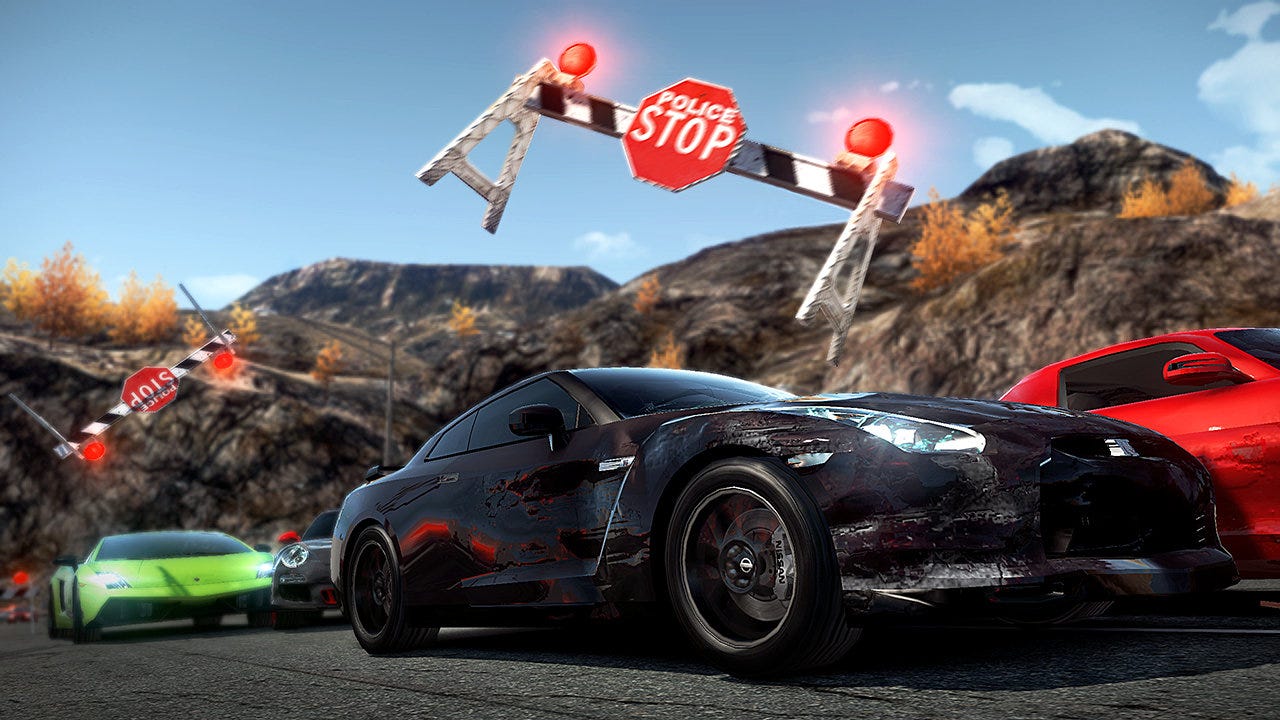
Equipment has been added to add to the mix, with racers gifted with tools to help evade the police including radar jammers, weapons jammer and "super nitrous", while cops get a range of roadblocks, spike-strips and chopper support that makes the player feel - as Sullivan puts it - like you're "rolling with the entire weight of the police behind you".

Another core mechanic in Hot Pursuit is the way in which the player is rewarded for doing just about anything in the game, whether you're playing online or offline. Sullivan likens it to the experience-point system that has gained popularity in console titles over the last couple of years.

nfs9

While there are a range of race-specific events with pre-defined routes, the advantages of the open world are obvious when it comes to the police pursuits.

"Everything you do on or offline either as a racer or a cop give you bounty. Basically bounty is our version of XP. If you've played Modern Warfare 2, World of Warcraft or pretty much any game online, XP is what it's all about," he explains. "It's the same with bounty. You get it for pretty much everything you do. If I beat a friend's time online, I get bounty. If I beat an AI racer offline, I get bounty. Bounty fills up that bar, which unlocks new ranks, which opens up new cars and content."

Races and events are split into tiers, with a different range of cars initially available for each stage. Criterion's objective is to make sure that the player gets to experience a big range of the cars built into the game as opposed to previous Need for Speed titles on the HD consoles that only let you sample a relatively small amount of the available roster of vehicles.

"There are two different ways we look at the cars we give you. In the first race, I get to choose between a BMW and a Porsche. I don't start in a bloody Astra or a Citroen or anything - we have super-cool cars right from the start. The second event lets you drive the Zonda through the desert," Sullivan reveals as he shows off the game's initial "Sports" tier of races (other tiers are apparent, going all the way up to "Hyper", but apparently these names might change).

"We don't want to grind it out for three, five, seven, 10 hours to get to the cool stuff. We do preview events that give you the chance to drive cars you drive more later on, we get to the fun cars really quickly, we mix it up as much as possible. By the time you've played through the first part of the career, you've probably driven seven or eight very different cars in nine events. That's more than I'd drive if I'm playing a lot of other games for over 10 hours or so."

While rumours still persist that car manufacturers are very protective over how their vehicles are represented in-game, Sullivan maintains that it's a pleasure working with them and that they've been very supportive in letting Criterion go to town on their creations. "Since this is the first time we've used real cars we thought there might be a lot of red tape with the manufacturers and a lot of umming and ahhing about getting stuff signed off. In matter of fact, it's been really, really cool," he says.

nfs7

Racers are equipped with radar and weapons jammers in order to stay one step ahead of the police.

"Is it OK if we smash the cars up a bit? Is it cool to create cop versions of these cars? They're like, 'Yeah it's fine. As long as the car comes across as looking and feeling really good, do what you want.' So we're pushing it as far as we can in terms of what you do when you crash the car and what you can do when you bust each other, but also in terms of how the cars look."

Playing the new Hot Pursuit, it's all a far cry from the existing HD Need for Speed titles, most of which start off by making you drive the slightly hot variants of ecobox hatchbacks, forcing you to work through hours of gameplay in under-powered vehicles before the really decent vehicles are wheeled out.

The more mundane licensed cars are still there in this new Criterion re-imagining of the franchise, but you'll never get to drive them. Instead they are relegated to drone vehicles - traffic to avoid on the roads as you burn though the environments in a range of exotics up to and including the legendary McLaren F1 and the awesome Bugatti Veyron.

"Real cars, real traffic cars for the first time. Usually it's fake cars, fake traffic, nothing's real. In the older Need for Speed you'd have been driving those to begin with," Sullivan smiles. "One day we came into work and decided what cars were going to be in the game. How cool is that? We had a list of hundreds and hundreds of different cars from different manufacturers.

"We started off with the super-hot cars and just kept going hotter and hotter..."

Need for Speed: Hot Pursuit is due out on 19th November.

Comments (47)

Comments for this article are now closed, but please feel free to continue chatting on the forum!

  • Loading...hold tight!