Brink
Smart casual?

Bethesda Softworks' war on ladders continues unabated. Yesterday we discovered Todd Howard's team has almost given up on them because they always turn out rubbish - hence no ladders in Fallout 3. But Splash Damage has banned them outright for Brink.
Lead designer Neil Alphonso tells us they detract from the game's elegant new movement system, SMART, which allows you to vault, slide and clamber around the game's environments. Poor old ladders.
Alphonso is quite right though, because SMART has a huge role to play in the three levels on show at QuakeCon. Container City, a towering fortress of rusting metal built around a derelict medical ship, is only so many corridors and chokepoints to begin with. However, once you start holding down that SMART button it's a 3D playground of clever flanking routes and alternative strategies.
During his QuakeCon presentation, Splash Damage founder Paul Wedgwood demos two other levels - an assault on a Security base where a Resistance pilot is held captive, and another battle for Security to liberate a kidnapped VIP in a dazzling undersea Aquarium. He comes under constant fire, but SMART usually saves the day.
At one point on Security Tower he runs straight into an AI-controlled Resistance fighter. He immediately turns right and vaults through a gap between two pillars, landing in a slide move to end up behind cover in a useful flanking position. It's a slick enough manoeuvre, but it's all the more impressive because he does it without thinking - and without any pause in his eloquent description of how the dynamic objective system works.
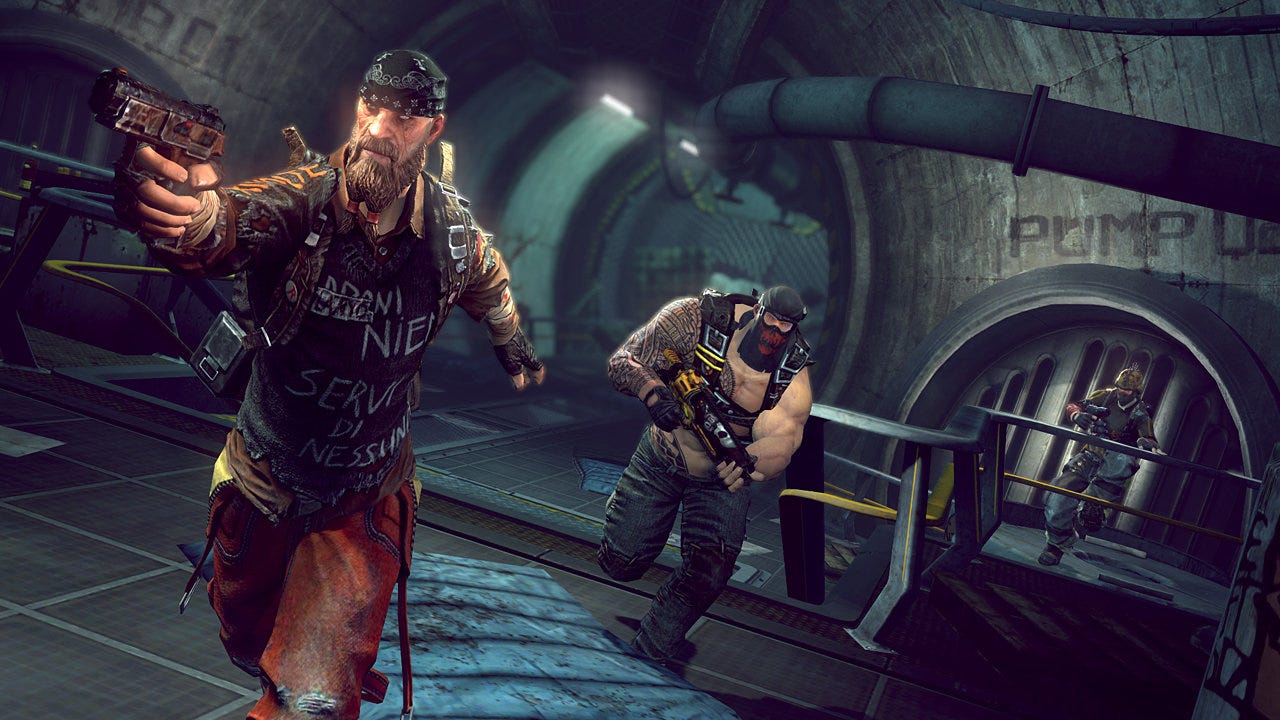
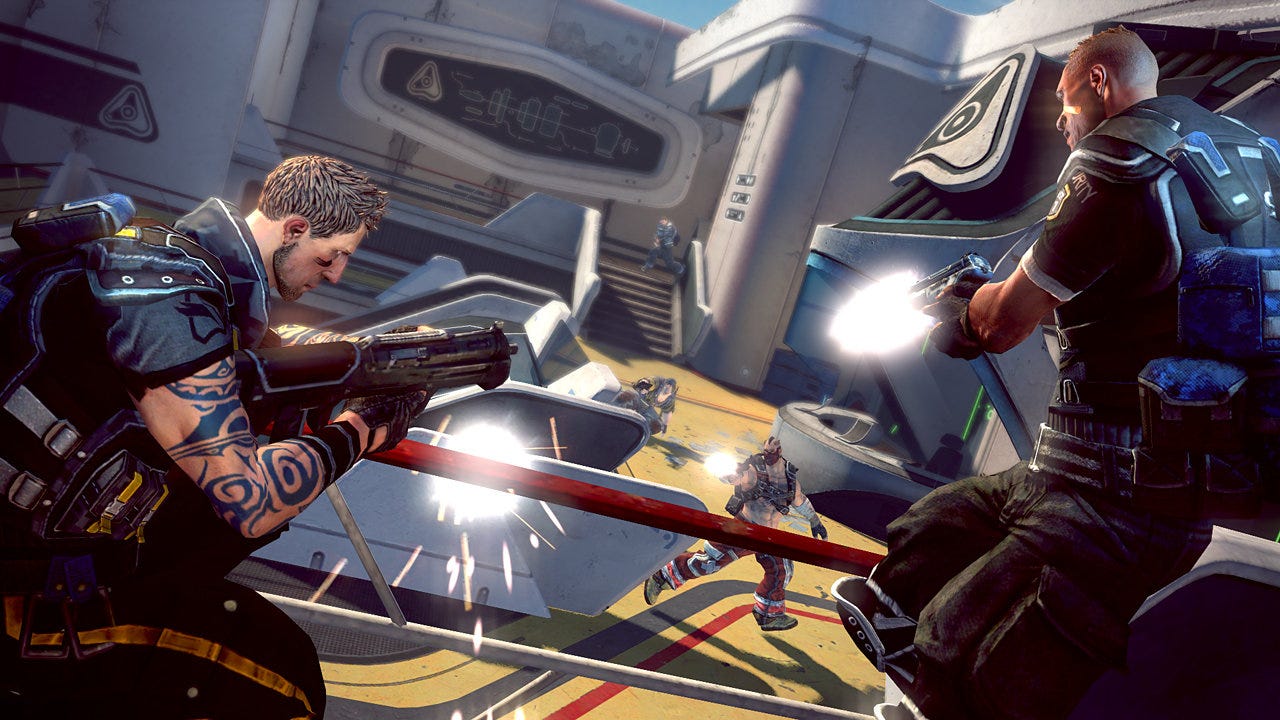

SMART is reminiscent of the platforming controls in Mirror's Edge, but it's virtually all on one button - although you can use ducks and jumps as modifiers to speed up your progress. You start to wonder how it would feel in other first-person shooters like the legendary Counter-Strike, where we've spent many a gruelling hour jumping up stacks of crates or falling off rooftops.
Container City has a strong Counter-Strike feel to it, actually. That's not too surprising given that it was designed by David Johnston, the man who brought us classic Counter-Strike levels Dust, Dust 2 and Cobble. Security forces are sent in to the stacks of shipping containers to retrieve a dangerous bio-weapon while Resistance forces believe they are defending a vaccine instead (contradictory intel is a common theme, with both sides convinced they're on the side of good).
Anyone who has ever played Dust at a competitive level, where hardcore Terrorist and Counter-Terrorist players switch to the knife to move quickly and sprint to engage one another with flashbangs and Carbines inside the central covered choke area, will recognise the initial rush for Security to plant explosives on a metal door while Resistance tries to stop them.
Planting the bomb involves holding it in position with a button press for a few seconds - long enough to be shot to pieces if you're unsupported. If the bomb is planted, Resistance forces have 30 seconds to neutralise it with a freezing agent, but this also involves leaving yourself vulnerable.
Should the action progress beyond the metal door, a mechanical cutting robot on caterpillar tracks rumbles through and the next phase has Security trying to protect it as it slowly inches down corridors formed by containers. All the while, it's coming under fire from Resistance troops who can assault it from straight ahead or elevated positions to either side.