World of Warcraft: The Burning Crusade Review

Blocked your Draenei?

Version tested: PC

Here's an interesting stat for you: almost as many people around the world play World of Warcraft as bought the Xbox 360 in the first year of its life. Or indeed just about any other console in the first year of its life. And they all pay a subscription fee. Putting it another way, there are more people playing WoW than the entire population of Greater London. Or, if you want it in cold, hard cash, conservative estimates peg the income from WoW subscriptions at about 100 million dollars per month.

That's the obligatory "World of Warcraft is very big, you know" paragraph out of the way - but it does serve a useful purpose, since it explains why there's so much excitement about something which non-players shrug and dismiss as "just an expansion pack". The Burning Crusade, the first commercial expansion to the game, launched last week - and it was marked by long queues at midnight openings, a Collector's Edition box which goes for hundreds on eBay, news headlines on prime-time bulletins and a lot of terribly excited fans. HMV at London's Oxford Circus, one of the largest game, music and movie stores in the world, dedicated its entire enormous display screen to the Burning Crusade trailer last weekend - an astonishing decision for any PC game, let alone an expansion pack.
1

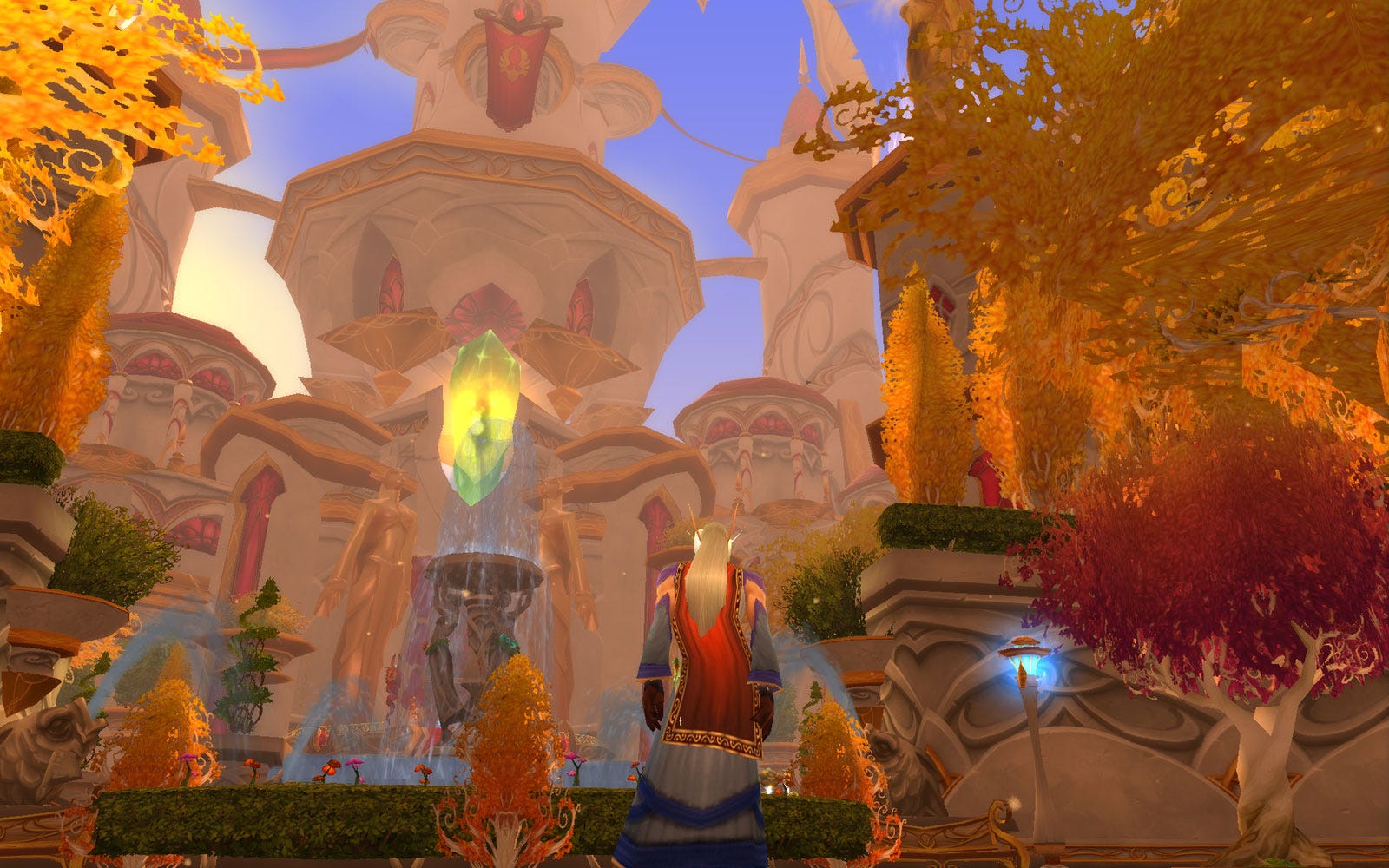
The Blood Elf home city, Silvermoon. They're bloody good at magic and they're making damn sure you know it.

The Burning Crusade presents an interesting challenge for a reviewer, however. How do you mark a game which will be played entirely differently by different groups of people - a game whose audience will include both entirely new players, and those who have already devoted months of their lives to World of Warcraft? How do you mark a game whose content will take weeks to explore, and whose quirks and overall impact on the experience will take months to assess? Certainly, we could write in very general terms about how the new zones look very nice, how there's lots of new content and plenty of new things to do, slap an eight or a nine on the end and be home in time for tea - but that wouldn't actually say anything useful, interesting or relevant about a game experience so subjective and so expansive.

Instead, what we're going to do is to assess The Burning Crusade over the course of a few articles - starting with this one. There are two key additions which have been made to World of Warcraft by this pack - a pair of new playable races, with their own unique cities, towns and areas to explore, and a whole new continent called Outland, which is only accessible to players who are already at level 60.

In this first "review", we're going to address the part of the Burning Crusade which is relevant to new players and people who aren't already at level 60 - the two new races and their zones. Later on, when we've had a proper chance to assess it, we'll run a feature delving into Outland and the new features in place for high-level players. If you're a new player thinking about trying out WoW, or an existing player planning to restart the game with a character from one of the new races, though, today's review is what you want to read.

Burning Rangers
2

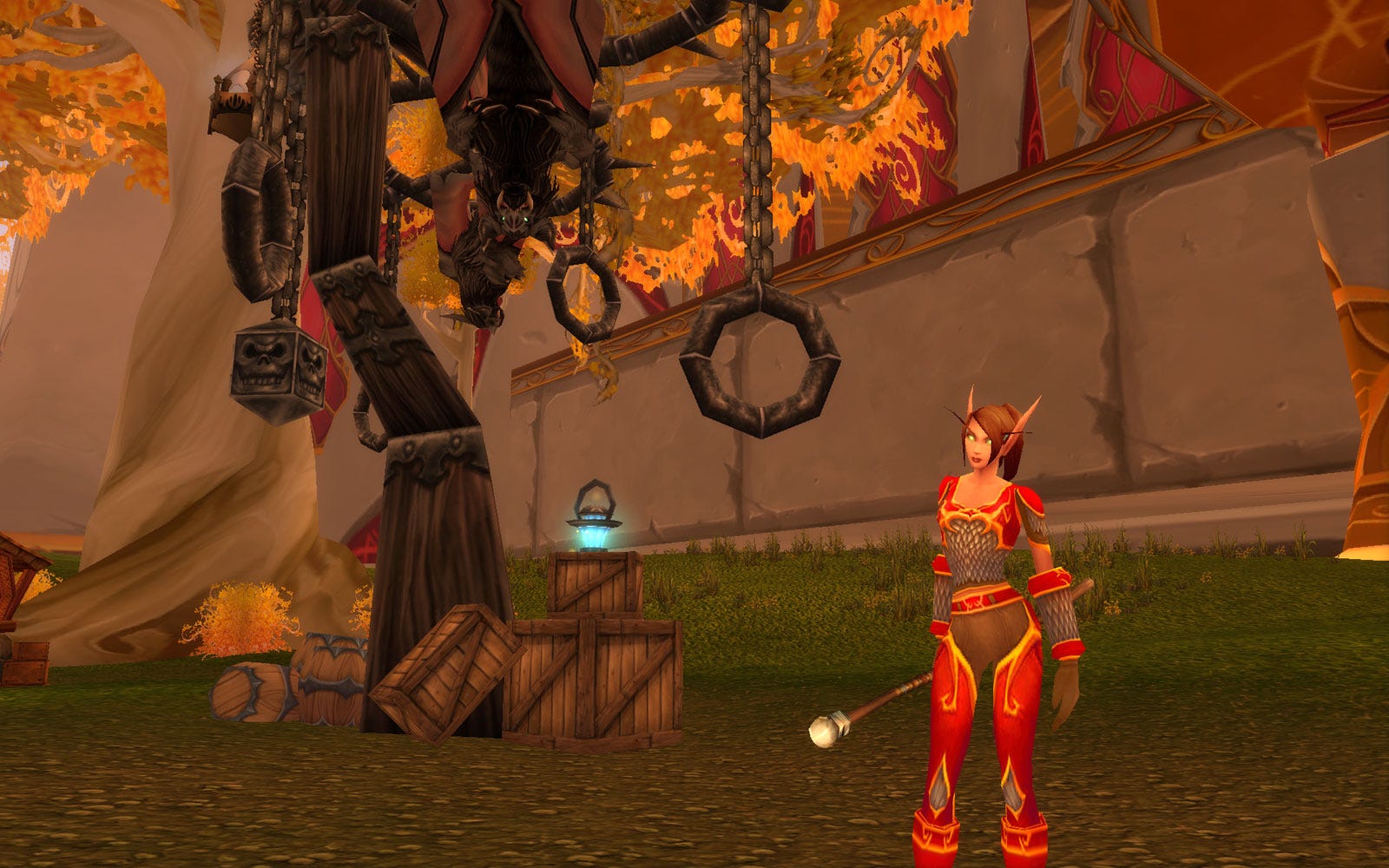
If you want to get from one place to another in a hurry, rent a hideously ugly giant bat from this lovely lady.

Where many MMOG expansions take the route of introducing new character classes to existing races, Blizzard has taken the opposite approach with The Burning Crusade. There are no new classes here - perhaps a testament to the argument that WoW has already boiled down RPG character classes to a solid and well-matched core set - but instead there are two new races, one on each side of the Horde / Alliance divide which lies at the heart of World of Warcraft's storyline.

On the Alliance side, the lumbering Draenei join the fray - a purple-tinged race with cloven hooves rather than feet, notable especially for the tentacle-like "beards" sported by the blokes (which makes them look like peculiarly cuddly extras from either a Lovecraft book, or Legend of the Overfiend). The Horde, meanwhile, gain their first "pretty" race - the Blood Elves, a group of slightly effeminate pointy-eared types in the Legolas archetype (you know, the mincing one from Lord of the Rings who was played by the mincing one from Pirates of the Carribean - no, the other mincing one).

Each of these races has their own capital city and a pair of brand new game zones, which are laden with monsters to kill and quests to complete which will bring you up to level 20 or thereabouts, at which point you're ready to head out into the wider world of Azeroth and follow broadly the same pathways through the game which other races tread. The new starting zones, however, are crucial to the game from a storytelling perspective if nothing else, as the time you spend playing there should fill you in on the background to your race and to the wider plot of the game.

Burning? More like Flaming
3

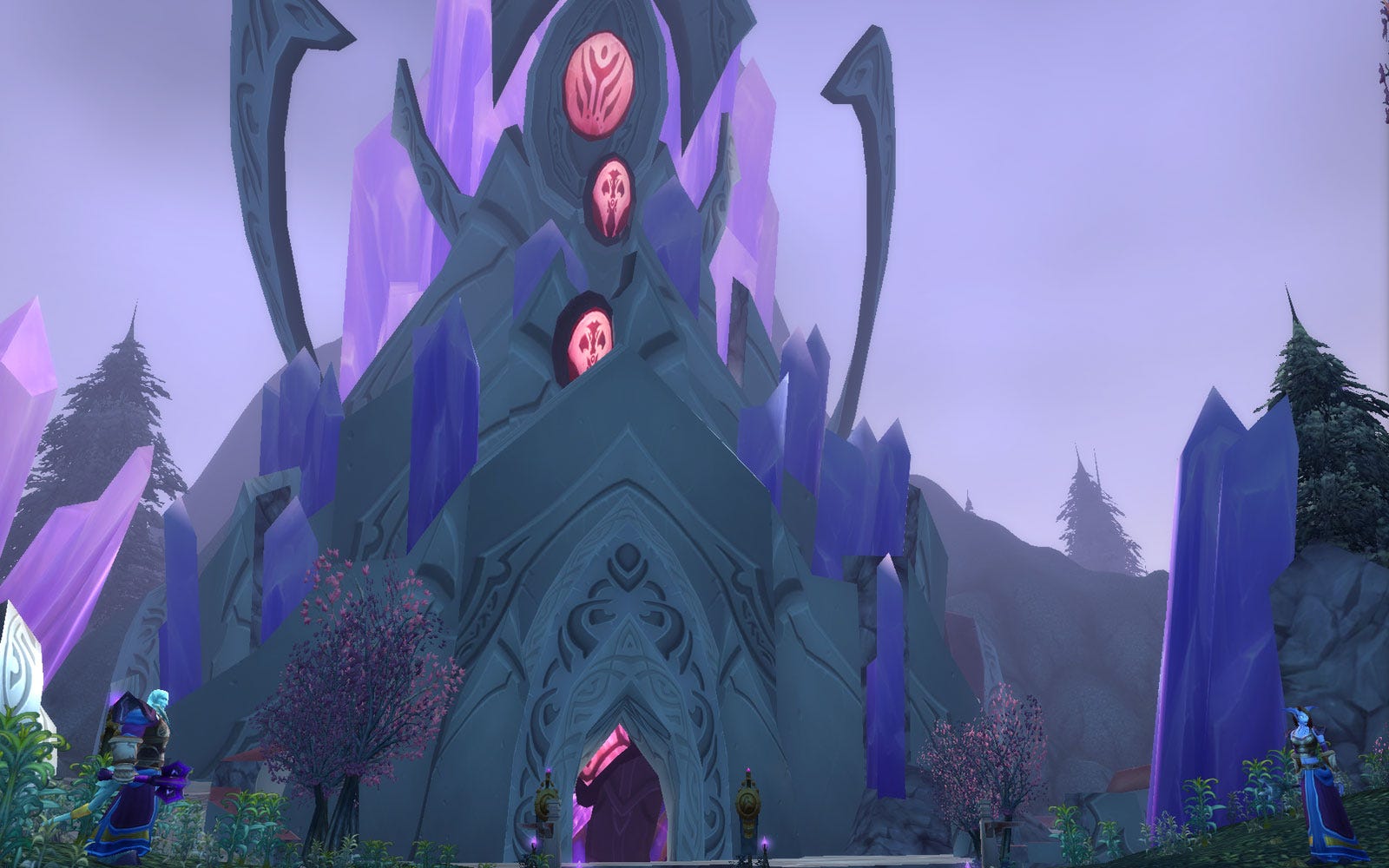
The Exodar - a ship so impractical looking that nobody's really surprised it crashed and made a bloody mess.

When you create a character in either of the two new races, you get the option of customising his (or her) appearance - and while this has never been a particularly strong point of WoW (with limited options resulting in all too many "clone" characters in the game), the Draenei and Blood Elves are both substantial improvements over previous races in this regard. Both races have a range of striking styles for various prominent features like hair, beards or horns - and the Blood Elves in particular appear to be a concession to the anime fan contingent in this regard, sporting haircuts that wouldn't be out of place in anything from DragonBall Z to Gundam Seed. You can even produce a pretty convincing replica of Final Fantasy VII's Sephiroth with the Blood Elf character options, if you want - although be assured that there are probably 20 clones called things like "sephiROXlol" already running around out there, so it's probably best not to.

It's not just visuals which set the new races aside from their existing counterparts, however. The Draenei have an affinity for light magic, so they get a unique heal spell and an innate resistance to shadow spells, as well as some unique abilities for their priests (healer class); the Blood Elves, however, have the racial ability to drain mana (magic casting points) from their enemies and use them for themselves in a limited fashion, as well as a small resistance to all magic spells. Blood Elves playing the Paladin class (more on that in a second) will also have slightly different abilities to other paladins, including a unique spell that drains your own health to do loads of damage to a foe.

That brings us on to one of the biggest changes of the expansion pack - previously you could only play a Paladin if you were a member of the Alliance, but they're now available to the Horde via the Blood Elves. Similarly, the Shaman class was previously only for the Horde, but the Alliance can play as them now thanks to the Draenei. This feature caused some uproar when it was first announced, but the game goes to some length to make sure that this change fits in with the storyline and there's certainly no sign so far of anything in the game being broken or undermined by it - although there are really rather a lot of Blood Elf paladins and Draenei shamans running around, perhaps due to the novelty factor.

Blood Money

The design of the starting areas for both new races is simultaneously unique and very much in keeping with Blizzard's design ethos for WoW. The Dranaei start on a pair of islands around their crashed interdimensional ship, the Exodar (which may sound like it's hopping into the realms of science fiction rather than Warcraft's normal fantasy setting, but it's a magical spaceship you see), while the Blood Elves kick off their quests in the villages around the beautiful city of Silvermoon, which was the capital of the High Elves before it was ravaged during the events of WarCraft III - one of the more memorable levels in that game, in fact.

4

Yes, he has a tentacle beard. We don't like to think about how shaving works under these circumstances.

In both cases, the zones in question are richly appointed and provide perfect examples of Blizzard's attention to detail. The islands around the Exodar are scattered with broken pieces from the ship's crash landing, with the landscape dominated by huge glowing crystal formations. The Blood Elf zones, however, are even more dramatic; partially overrun by the undead Scourge, they are filled with fantastically realised contrasts between a formerly beautiful landscape and the rotting plague which has consumed it. The entire area is split in two by the Dead Scar, a blackened slash through the landscape where nothing grows and the mindless undead roam freely - even the city of Silvermoon is divided in two by the scar, which is a fine piece of storytelling through level design, with the Scar serving as a constant reminder of the background to the Blood Elf race.

Overall, there's a feeling that Blizzard have learned much from watching millions of players work their way through the existing starting zones of World of Warcraft, and the new zones represent a new high for the firm's abilities at designing the first few hours of an MMOG. Quests are plentiful, varied and easy to find, and the game has you fighting against minor bosses and a wide variety of enemies from an early stage - but is extremely careful not to overwhelm players who are just getting started, with a beautifully pitched and gradual introduction of new elements as you proceed through the early stages. You'll never be stuck for something to do at any point between level 1 and level 20; each of these zones has been filled with content, and completing a set of quests will generally point you off towards another region where there's yet another set waiting for you.

5

WoW's obsession with really horrible giant spiders continues. We do not approve.

The quests largely take their lead from the more popular or successful quests in other zones of WoW, and experienced players will notice all the key quest types present and accounted for - from straightforward "kill X number of Y monster" quests, to collection quests, exploration quests and even cookery quests. New players, however, will appreciate the variety on offer, and the careful slope of the difficulty curve makes the new zones very enjoyable to play through - while the addition of features like an indicator for how many players it'll probably take to handle a particularly tough quest is an excellent piece of design for players who are unused to MMOG mechanics. Less excellent, perhaps, is the continued over-reliance on making the player walk all around the world for sport; WoW still spends far too much time on travel, and whatever debates may be had over the entertainment value of a level grind, there's no argument over spending hours walking around the place between quest objectives - that's simply no fun at all.

The cities, too, clearly reflect Blizzard's experience of the last few years - they're both relatively clear and easy to navigate (although the fact that the Exodar, which serves as the Draenei starting city, takes quite a while to walk into in the first place is a bit of an annoyance), and tiny features like having postboxes on almost every corner rather than simply one for the entire city, and multiple instances of busy locations like auction houses and inns, should help to spread the population out and keep framerates high.

Burning Desire

If we have one criticism of the new zones, though, it's that their connections to the rest of the game are a little tenuous. The Blood Elves can teleport instantly to the undead city, The Undercity, while a boat from a small dock next to the Exodar bears the Draenei away to a low-level area from which they can explore the rest of the world of Azeroth - but when you hit level 20 and strike out beyond your starting zones, the sense of progression doesn't seem as clear as it is for the other races, for whom the various zones of the game tend to follow fairly logically from one another. As superbly designed as the new zones are, they feel somewhat tacked on to the existing world - a minor criticism, but still a little jarring for a player who's just got into the swing of their character and suddenly finds themselves flung into the wider world.

6

The islands around the Draenei starting zones are littered with these giant crystals, presumably as a result of the crash.

But to Blizzard's credit, they have populated the rest of the existing world with Draenei and Blood Elf quests and NPCs (although we've yet to see how extensive this addition is at high levels), so it's not like you suddenly feel like your race is an outsider to the game once you get past level 20. The existing zones of the game still look fine graphically, too - perhaps not quite as neatly designed as the new areas in some respects, but this owes more to the improving skills of Blizzard's artists than to any actual technical difference in the new regions.

That improvement isn't just noticeable in the fantastic environments, beautiful cities and gorgeous, detailed player and monster models which have been created for this expansion - it's also clear from the presentation of the Burning Crusade as a whole. The hugely impressive intro video is one aspect, the gorgeous visuals another; the music, too, is worth a mention, with both new races having unique soundtracks to their zones. There's a mellow, almost tribal rhythm to the Draenei musical score, while the Blood Elf score stands out as particularly superb - filled with haunting, melancholic choral pieces and genuinely evocative melodies.

As to whether players who are starting out as members of the new races will find themselves wanted by teams tackling Azeroth's various challenges; yes, certainly. Horde teams will want paladins and Alliance teams will want shamans, of course - both classes are quite unique and useful in their own right, and once the novelty wears off they'll almost certainly settle down to become well-integrated classes with clear roles to play. The racial benefits of both new races will also be useful, of course - while the entirely new trade profession which has been introduced, Jewelcrafting, enables players to create and sell trinkets such as necklaces, earrings and rings, which were previously much harder to get hold of and far less varied in their function. Draenei get a bonus to this profession (which will also at higher level allow the creation of gems which slip into sockets on specific items, giving them stat bonuses), and it's likely to be a mainstay trade of many players of the new races.

A Just Crusade?

7

And here I am posing for a lovely holiday snap in front of the Dead Scar, and looking suitably androgynous. CHEESE!

Existing players of World of Warcraft who are already at level 60 have probably already bought The Burning Crusade; for those who are not, or those who have not played the game yet, the burning question (sorry) is whether this expansion pack really adds anything of value for new players, or for players starting anew.

The answer to that question is both yes and no. It is very much an expansion pack, after all; there are no significant new gameplay modes added to the early game, and the basic mechanics of how quests, combat, crafting and trading work are all exactly the same as previously, with few tweaks to a formula which has already proved to be hugely successful. If that formula left you cold before, it's unlikely that The Burning Crusade will change your mind, and the small tweaks on offer still don't fix fundamentally dull pieces of game design like the lengthy travel time between quest objectives.

On the other hand, there is no denying that The Burning Crusade is a triumph of design - in so much that it is everything which made World of Warcraft popular, fun and exciting, distilled down and refined by the developers after years of experience. The two new races represent the most polished and enjoyable way to enter the world of Azeroth - or, indeed, to enter the world of MMOGs in general - which makes The Burning Crusade's low-level content into an extremely welcome addition to an already excellent RPG.

8 / 10

Bear in mind that this verdict reflects our view solely of the low-end content in the expansion - the two new races and their starting zones, based on playing from level 1 to 20. We'll be playing the high level (60+) content further down the line, and giving that a proper once-over in the not too distant future...

Read the Eurogamer.net scoring policy

Comments (73)

Comments for this article are now closed, but please feel free to continue chatting on the forum!

  • Loading...hold tight!