Version tested: PC
What do Space Marines talk about? Dawn of War II's campaign answers that pressing question in its excellent tale of a handful of 41st-century hyper-squaddies. Between missions the muscular mega-men chat amongst themselves, explaining the story and making decisions about how to proceed. They even share some personal gossip. At one point, the long-haired scout character says something like: "Tarkus, Avitus, there's something I've wanted to ask you for so long, but I've been reluctant..." I couldn't wait to find out what he was going to ask, but I'll leave you to discover what he's talking about for yourself.
So, spoilers aside, why are space marines chatting at all? Shouldn't they just be stepping on the face of an ork, forever? Nope. No longer are these tower-shouldered killers mere drones, because in Dawn of War II a number of key marines have distinct personalities, and they take them onto the battlefield. Your squads are no longer cloned rent-a-soldiers from the space factory, they're characters engaged with the story, with their own opinions, secrets, and personal stats and inventory screens. Dawn of War II is, somehow, also an RPG.
In the campaign - which can be played solo or co-op - your armies are not simply disposable, and the squad leaders survive each mission to go on to the next one. If all squad leaders are incapacitated, then you have to do the mission again. As the game unfolds you come to be able to choose between a number of these squad leaders, including the astonishing dreadnought. (EVEN IN DEATH I STILL SERVE, etc.) Of course you've got plenty of doomed lackeys coming along for the ride too, but the hero characters persist, and you buff them up from one mission to the next, dispensing statistic points and loot as they progress.
Loot. Another thing that seems incongruous on the RTS screen: a set of green armour, a blue hammer! What? Isn't this straight from World of Warcraft? It sure is, and Relic's developers are keen to show you exactly what they've learned from too many hours in Azeroth. They've figured out that we love tinkering with our characters, and they've made it down to you to decide who gets which sword, and just how to buff up that talent tree. Indeed, this is the first time I can remember an RTS asking me to make decisions about how to min/max my particular characters in this most traditionally RPG way. Should I really go all-out for melee on my commander? (Yes!) And does Tarkus need to be well tanked, given the ranged role I want to give him? (Probably.)
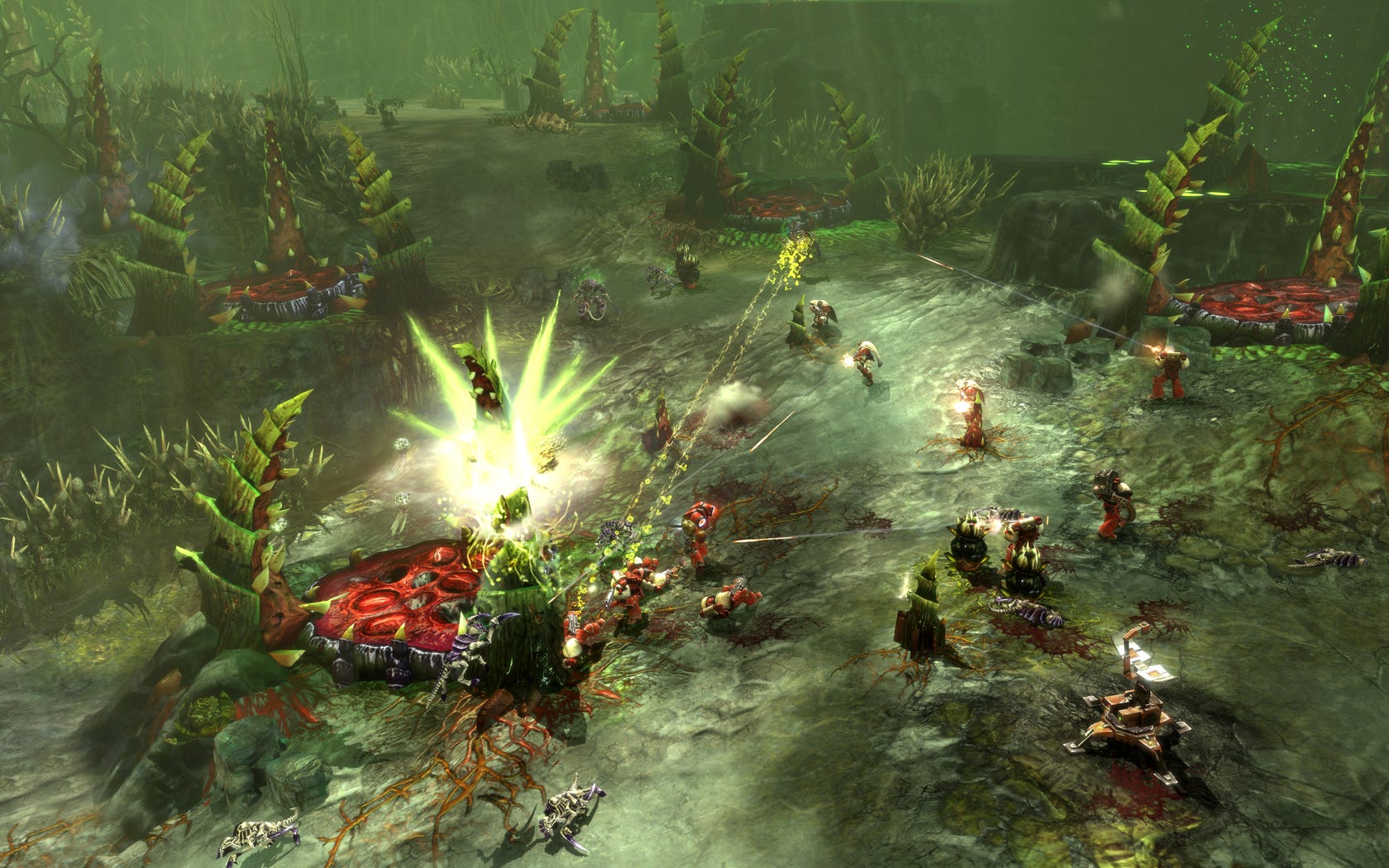
Battles are huge brawls containing a sparky menu of explosive effects.
What has happened to our Dawn of War?
Someone called this fresh take in the series "Diablo With Squads" and that's pretty accurate. Most of the levels of the single-player campaign are indeed close enough to dungeons. They're even filled up with "mobs" that you can set up to "aggro" once your men are positioned. A weird change of pace, indeed. Once you've figured out some of the basics - like sticking ranged chaps behind a piece of cover, and charging buffed melee dudes into the fray to finish the engagement - it really starts to gel. That fiddling on the squad loadout screen does pay off, in just the way that having your characters well-tweaked in an RPG does. My assault marines get in close and do some serious damage, leaving the support squads safe from harm behind a fallen tree, or a shattered bunker.
Fights don't always go well, but if you can keep squad-leaders on their feet, you can always pull things back from the brink. Capture points - similar to those of the original game - allow you beam in more squad members, while fallen squad-leaders can be revived by another leader. Your commander is the most essential of the lot - he operates alone, is super tough, and can be kitted out with some serious buff powers.
Take that, Ork scum.
And gone are the days when building a base was integral to success. While point-capture unlocks some useful stuff - and capturing a shrine to the Emperor can be essential on really tough missions - you're not going to be doing any turtling, at least not in single-player. In this you're going to be capturing points, defending points, and killing boss characters in great big end-of-level battles. Some of these are pretty challenging, and they make the best use of Dawn of War II's splendidly destructible environments. Seeing a space marine blasted back through a stone pillar, and have it tumble down around him, makes for brilliantly bombastic battle fun.
Yes, Relic's combat visuals have never been finer. From the moment a space marine drop-pod smacks into the earth you're treated to a carnival of thundering ordnance and bursting viscera. There are times when half the screen seems swathed in smoke and flying debris. Effects like those for the artillery strikes and heavy automatic weapons are scintillatingly violent, and they really do seem to sell the battles to you each time.
This visual fidelity stretches out into the entire game. The environments are brilliantly crafted, down the details of murkier, spore-ridden atmospherics where the Tyranids have taken hold of entire planets. Relic is fluent in Warhammer's operatic space hobby, and from menu screens to maps, to the awesome mini-cut-scenes between key missions, it's exquisite. No game has wrapped up and delivered the 40k universe in such robust and cogent packaging. The campaign story itself is pretty good, and the non-linear way that it allows you to hop between worlds - and missions - spices things up by providing a modicum of choice. You can decide where to take your team, and whether you'll be fighting Orks, Tyranids, or Eldar. All this dissolves a bit towards the end of the campaign - which is arguably too short - but it definitely seems like a worthy direction for the series.
However, there is a problem with all this, and it's down to the way that single-player missions play out. They're not all that tactically interesting. There's only one real tactic to speak of, and the moment-to-moment engagements never really stretch you once this has been mastered. It's as if the levelling up and other RPG progress stuff has somehow replaced the need for the RTS campaign to make you adapt. Once I'd perfected my squad movements, I seldom changed how they fought. I occasionally messed with their equipment, but the end result was the same because the objectives of the missions (to capture or defend a point, or to kill a boss) never really threw any spanners in the works.
I remember when you were all just Genestealers.
The tactical escalation is so limited compared to other base-free RTS games, and there's really not much novelty after the first dozen missions. What other games with similar aims have done in the past is to force you to adapt by making a particular conceit impossible - blocking your artillery when you've come to rely on it, or out melee-fighting you when that's become your thing. There's really very little of that kind of wrong-footing here, and as a consequence the campaign becomes rather uninteresting towards the end, despite some incredibly dramatic scripted sequences, reveals, and boss battles.
The multiplayer/skirmish, although better off in many ways than the single-player, suffers from some similar problems. Although there are bases from which units are spawned, the classical base-building joys have been surgically removed, leaving a pure combat model. This is simultaneously incredibly playable, and nevertheless lacking. Fighting real human opponents is vital, of course, because of their unpredictability, but even they can't make up for that lack of building-up-tech-tree tactical depth.
I couldn't help feeling that even in this all-options-open version of the game, that the new approach had lost much of what made the original game so compelling. Fortunately there's loads of master, as the multiplayer side of the game is where you get to play with the other races. The Eldar and orks are rather familiar, while the Tyranids are all-new for Dawn of War II. They were worth waiting for too, as their 'orrible biologic units are great fun to play, and even more fun to fight against.

The Tyranids really do swarm rather pleasingly.
What all this amounts to is a game that is bold, beautiful, and absurdly well-made. The production values are nothing less than stratospheric and - despite the inclusion of the deeply unlikeable Games For Windows Live - almost everything in Dawn of War II reeks of design talent light-years beyond those of most other developers.
It doesn't, however, fulfil the task of being absurdly entertaining. The failings in the campaign mean that for all its incredible fireworks and visual splendour, its not interesting enough. The fact that "Diablo With Squads" feels so natural, and makes so much sense when you're playing it, means that Relic is on the right track. It just hasn't made the vibrant campaign, nor the compulsive multiplayer game, that lives up to the idea it's conjured so colourfully.
8 / 10
