Tom Clancy's EndWar Preview

Go left. Gooooo left. LEFT. I SAID LEFT. (So, none of that.)

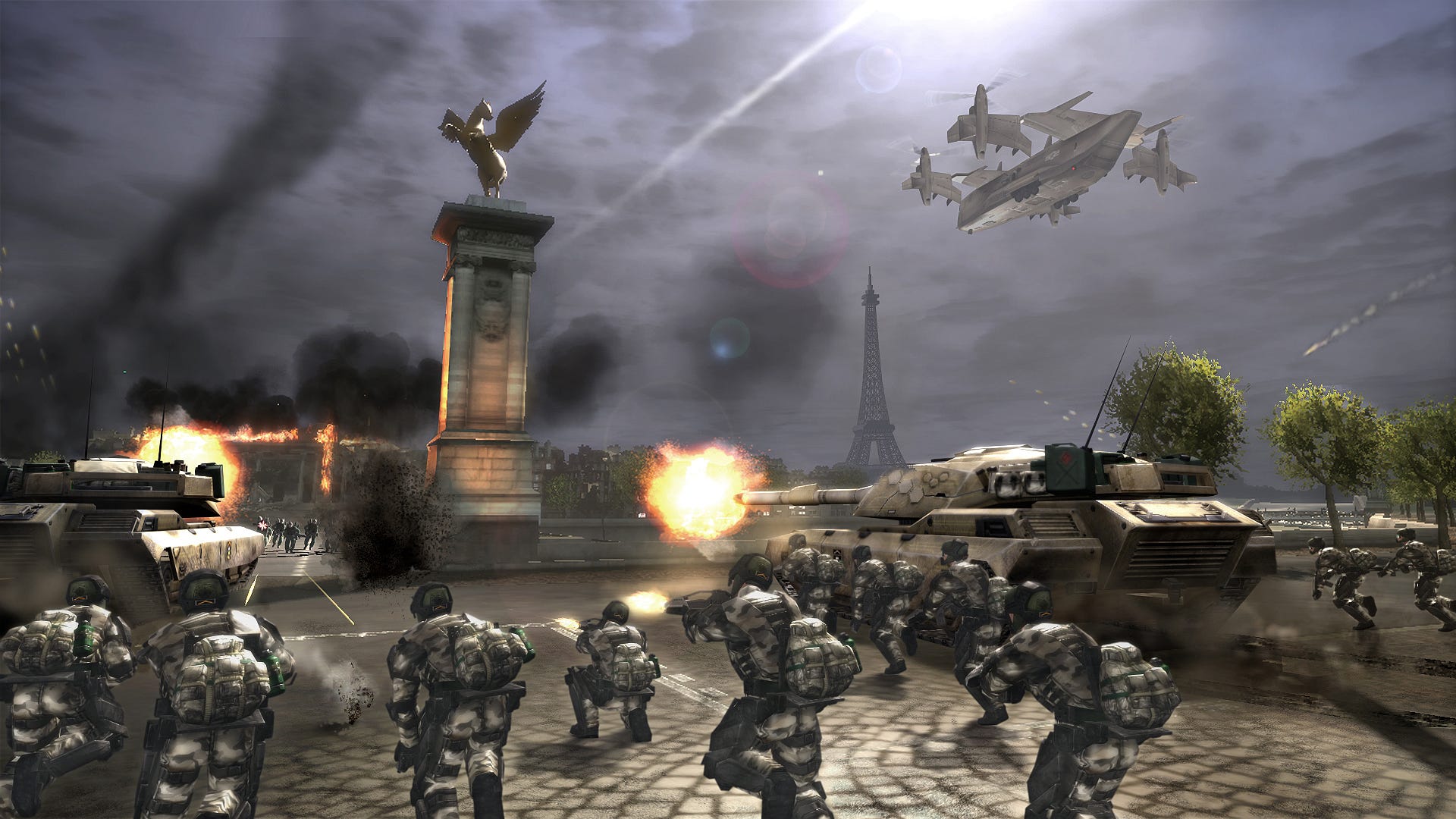
With its console focus EndWar might seem like an obvious riposte to EA's Command & Conquer and Lord of the Rings strategy games, but speaking to creative director Michael de Plater at UbiDays, we're told that's not the case. There's no base-building, the camera's almost third-person, and the focus is on battle tactics, with Total War-style squads - infantry, artillery, tanks and the like - issued orders via pad and headset, and relatively limited reinforcement available to bail you out.

"Anything that's not an interesting decision or a realistic decision you'd make as a General, don't put it in the game," de Plater says, when asked about the team's design philosophy. So not only do you not go around setting up factories and mining for dosh, you don't even need to give particularly complex instruction. "When you go 'Red Team, Assault Objective Zulu', the red team, which is made up of tanks and infantry, will get into a mutually supporting formation; they'll move from cover to cover, they'll observe the enemy, and they'll take advantage of flanking cover-and-fire positions," says de Plater. In other words, it's about high-level decisions, not grunt stuff and "housekeeping".

World War III forms the backdrop (it's going to happen in 2020, apparently - book your holidays now). Following the deployment of a missile defence shield that renders our nuclear deterrents void, and a simultaneous slowdown in the production of oil, everyone gets a bit rowdy. This game (described as "the first") deals with "the Atlantic theatre" - the East of North America, Western Europe and Russia. You can play as the US, Europeans or Russia, and the warground has been split up into about 40 different battlefields - Paris, Washington, Moscow and, er, Cape Canaveral space centre among them. But not London - apparently we're "kind of neutral", although that may change. As you may have read elsewhere, de Plater reckons Tom Clancy's new World War III setting is rife for further exploitation, so our time should come, even if we don't run out of tea or European Cup final tickets in this one.
1

The close-quarters camera perspective is for immersion's sake, says Ubisoft.

That the game offers voice command support has won it the most headlines so far. "In the previous four years the software for recognition has improved," de Plater says, anticipating our concerns. Plus, "with the power of the console relative to the PS2, you can dedicate more processor to it." In other words, they reckon they've got it to the point where you can confidently give orders and not expect to have to repeat them 18 times. Alternatively, you can rely on the pad controls, which are comparable to other tactical shooters. Very comparable apparently: "Our controls map almost exactly the same as Ghost Recon," de Plater says. So on Xbox 360, for example, that's d-pad or the left analogue stick to select units, the A button to give orders, X to hotswap around squads so you don't need to zoom in and out, and the right stick for controlling the camera independently.

Sketching out a typical scenario (invading Paris seems appropriate), de Plater explains that you might start by deploying light infantry, pushing them forward and garrisoning them inside some buildings for concealment, before bringing engineers up to lay mines. You'd then pull them out, set your artillery up, scout with your helicopters, and try and draw your enemy down into that hidden deathtrap, where you can ambush them on all fronts - blowing lumps out of their tanks with artillery and mines and then roaring in on foot if necessary. What's more, when you capture certain areas of the map you're able to call in off-map support - airstrikes, EMP blasts, satellite intelligence - to aid you in your fight. The environment will also have an impact on tactics, with much of it destructible. So then, the loss of resource- and micro-management hasn't dumbed the game down, at least in de Plater's view. "There's more than enough tactical and strategic challenge in this chess-game of moving your units to beat your enemy on this very dynamic and realistic battlefield," he insists.

2

Environments should be fully destructible.

Things seem to be kept fairly concise, unit-wise, offering plenty of strategic depth without overwhelming the player with options. There are seven types of squad - the riflemen act as snipers, heavy infantry lay mines and tank traps, and have anti-tank weapons, transports boast anti-aircraft rockets in some cases, and then you have artillery, helicopter gunships, light infantry and command vehicles for intelligence-gathering. There'll be some futuristic weapons, too, like a microwave gun that fries you under your skin, and the "Rods from God" that you might have spotted at the end of the CG attract-sequence shown during UbiDays' press conference: tungsten rods fired from space, which devastate huge areas, fallout-free. The Tom Clancy link also means you'll take control of some familiar units - the Ghosts and Team Rainbow, for instance. And de Plater says that with the potential for "1000 units" on the battlefield at any given time, it will scale up pretty menacingly as things develop. He also believes that the fact it does should help distinguish it from PC title World In Conflict, developed by Massive, which otherwise seems immediately comparable.

All in all it's piqued our interest, and with developers from the likes of Total War (de Plater's a veteran) and Command & Conquer on board, the potential for a "persistent World War" over the Internet (they cited EVE Online in comparison), and a public beta-test set for November, the game's creative director hopes the anticipation ramp-up will be as sharp as the biggest claim he pokes us with during our time at UbiDays: that the team wants to do for console strategy what Knights Of The Old Republic did for console RPGs. The game's up and running at the studio in Shanghai, so hopefully we'll be able to pop over soon and tell you whether it's any good, and whether de Plater's claim that Shanghai is like "living in Blade Runner" is accurate.

Comments (37)

Comments for this article are now closed, but please feel free to continue chatting on the forum!

  • Loading...hold tight!