Tom Clancy's EndWar
Fighting talk.

Yeah, it works. Best to get that out of the way early. Because if you've been paying the slightest attention to Ubisoft Shanghai's ambitious and risky attempt to reinvent the real-time strategy genre on console, it really all boils down to one question. And that, in short, is the answer. Voice command in EndWar? It works. Really well, actually.
The promise was of a war you could shape and control with voice alone. We get a lot of big promises in this game; and, like car tyres in the north of England, we're used to being brutally let down. So, shame on us, if our initial response was one of scepticism and a fear of gimmickry. Still, it's always nice to be proved wrong.
Anyway, for Tom Clancy's EndWar (to give the game its full, apocalyptic title) to be taken seriously, the voice command system must deliver the goods. It's critical to a title that is serious about stripping the RTS bare and redressing for a new audience with only the elements fundamental to, well, fun.
Team EndWar, many of which we chatted to during a recent visit to the Shanghai studio, are veterans of the PC strategy scene, not least project lead Michael de Plater, who's previous credits include Creative Assembly's revered Total War series.
But there's a shared boredom with the state of RTS. "PC RTS has gone up a bit of a dead end," de Plater told us. He blames the likes of Warcraft, C&C and Age of Empires for what he sees as the over-complexity of the genre and the move away from what it should be all about: gripping, spectacular conflict. Raw is war, if you like.
That thought process has led us to the present situation in China, sat in front of a 360 dev kit, barking orders into a headset with nothing more than a squeeze of the right trigger.
Can't we all just get along?
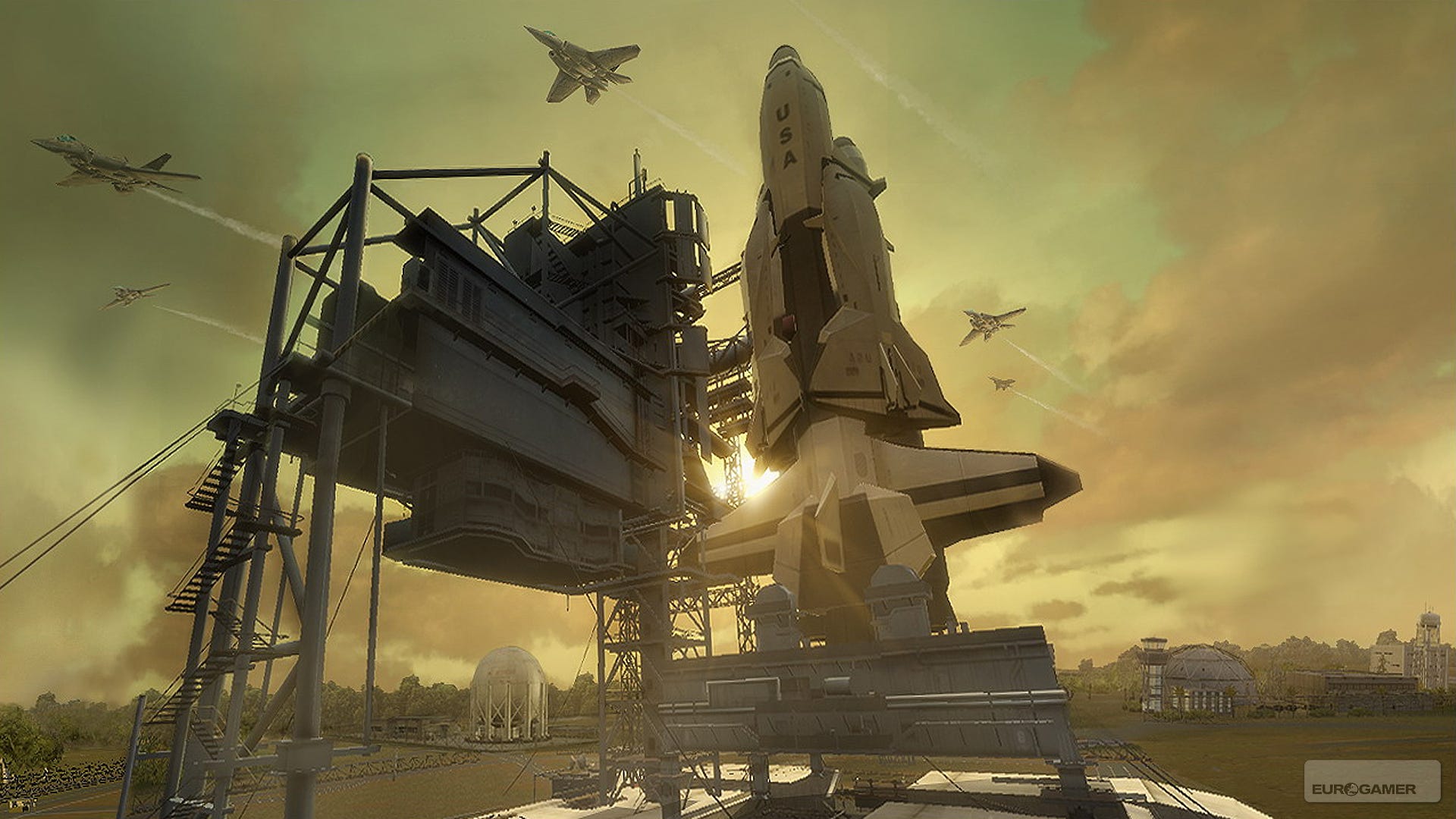
To recap, it's 2020 and World War III has started thanks to some hubristic men in ill-fitting suits pointing things at each other and stamping their feet a lot. It has always been thus, give or take the attire. 'EndWar' is shorthand for the end of strategic nuclear war, proclaimed by the US and Europe on successful completion of the Space-Land-Air Missile Shield in 2014.
This, like a Heat magazine sticker joke featuring a semi-famous disabled child, goes horribly wrong. Iran and Saudi Arabia bomb each other, oil tops USD 200 a barrel, dramatically emboldening Russia, and in response the US launches a massive military base in space to the condemnation of many men in bad suits. It's war, kids.
The first chapter in the EndWar series (there will, of course, be more, assuming you lot buy it) sticks to the Atlantic stand-off between the newly-formed European Federation and the US, and Russia. We've already provided you with details of some of the factions, and there'll be more of this to come in the run up to release, courtesy of our friend the PR Plan.
Our exposure to the game for our first hands- (and throat-) on was limited to two maps, playable in both single-player and one-on-one multiplayer via system link. But that enough to give us a decent handle of what to expect from the finished article next March.
As we've already noted, in a conscious drive to cast the net of strategy far beyond its traditional target audience, every aspect of the genre has been reassessed in terms of its accessibility, necessity and utility. Anything considering extraneous is out on its arse. And in EndWar that turns out to be a lot of stuff. So no base building, resource management, or any of the attention-diverting clutter the developer euphemistically refers to as "housekeeping".
How you feel about this proposition will no doubt shape your initial reaction to EndWar. But fastidious, micro-managing generals beware: in Ubisoft's RTS version of the tortoise and the hare, the hare always wins because it WMDs the shit out of the tortoise before it's even crawled an inch. Welcome to the Tom Clancy school of strategy.
Talking a good fight
If you're a mute, you'll need to know your way around the pad. This is how it works on 360: A is the general action button used for confirming orders and for your primary attack; Y is contextual, and used for secondary attacks; the D-pad lets you switch between units; clicking the right-stick zooms - it'll feel very familiar if you've played Ghost Recon. And that's deliberate.
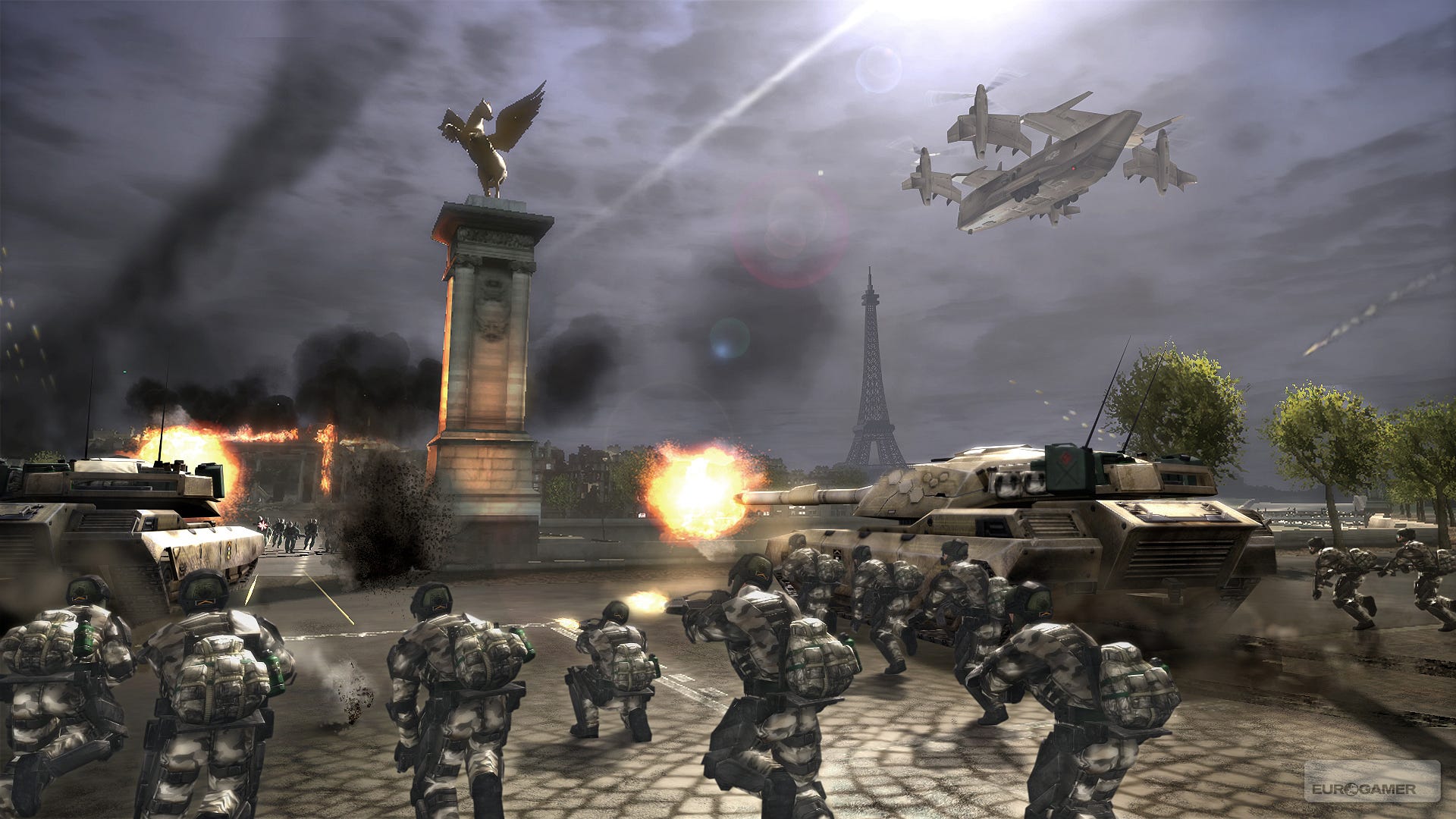
The essence of RTS, as refined by Ubi Shanghai, consists of seven unit types: Riflemen, Engineers, Tanks, Transport, Gunships, Artillery, and Command Vehicles. And there are two main single-player modes: Conquest (win control of most of the map) and Annihilation (wipe out the enemy), both of which we tried out.
But this streamlining of content is such that you can simply forget about what all of the buttons do, hold down the right trigger, and start jabbering away instead. Everything in-game can be controlled by the Who-What-Where voice command system. The headset effectively turns the pad into a walkie-talkie, activated with the right trigger.
This brings up a neat system of on-screen menus, listing every single available command before your eyes, so there's thankfully no need to memorise a manual's worth of orders.
The first menu consists of individual units, say "Unit 1", "Unit 2" and so on, and also general functions like "Calling All". Depending on your order, subsequent menus will pop-up with relevant commands until you've completed the Who-What-Where and you can enjoy Watch.
Say, for instance, you want to group off your gunship units to command under a single order. "Calling All", "Gunships", "Create Group". Easy as that. Want to dispatch a unit of tanks to deal with the enemy's frontline? "Unit 1" (Who), "Attack" (What), "Hostile 3" (Where).
For the first 10 minutes or so, a mixture of uncertainty and mild embarrassment caused us to bumble disjointedly through the steps. "Unit 1.... Um, er.... Attack.... Um.... Lima?" Hardly Henry V. But then, it just clicks, and orders start to flow with increasing assurance and authority. "Unit 4 secure Alpha!"; "Calling all gunships, attack hostile 5!"; "WMD Lima!". "DIE, ****S, DIE!"