The New Xbox Experience • Page 2

360, redesigned.

"For the first time ever, a console will be revolutionised through software." That's how Microsoft's Xbox Live, software and services boss John Schappert introduced his segment of the company's E3 press conference. That's how he raised the curtain on Xbox 360's new user interface, due to arrive via a free update to the console on Live and game discs in the autumn ("and not as a beta", one Microsoft representative told us, in a dig at Sony's PlayStation Home).

"Revolutionised through software." It's a very Microsoft thing to say; one of those rare instances when the company has allowed itself, in a statement about its Xbox business, to sound like a maker of computer operating systems. But that, of course, is exactly what has made Microsoft the richest company in the world, and Xbox 360's success certainly has more to do with its software and infrastructure - Xbox Live, in other words - than its capable but fault-prone hardware. If any of the console manufacturers can do this, surely Microsoft can.

As Schappert unveiled the features of the new front-end - 3D player avatars, a fully integrated party system, a live quiz game channel, streamed movies from Netflix in the US - it was easy to be impressed with how slick and comprehensive this revision looked. However, it was also easy to accuse Microsoft of merely reacting to its opponents' moves, of being not much more than a magpie: Nintendo's Miis and Wii Channels, Sony's XMB interface and many of Home's features seem to have been folded in to the redesign.

This, cynics would claim, is another example of Microsoft riding the coat-tails of more talented innovators, as those same cynics claim it has always done with Apple in the field of operating systems. Is the New Xbox Experience, as it's so blandly branded, no more than a desperate attempt to avoid being left behind? Or will it drive Schappert's revolution - take online gaming's greatest platform to the next level, transform a three-year-old machine into a brand new one and expand the Xbox audience into the bargain?

It started with a simple problem of navigation. Having originally expected Xbox Live Marketplace to carry hundreds of items Microsoft found itself hosting tens of thousands, and it was simply getting too hard to find stuff. The old blades system is only efficient if you know what you are seeking; browsing this burgeoning library is a nightmare. So the new interface is designed to highlight what's available and happening on Xbox Live, in the Marketplace and with your friends - as well as in a couple of other new areas - and to invite you to explore rather than head straight to your destination.

1

Although shown against plain backgrounds, the new interface will work with existing themes and look "beautiful".

The primary tool for this is the My Xbox 360 channel, the first of the lateral, graphical menus that you're presented with when you turn the machine on. Your gamercard, the disc in the machine's tray, links to your personal game and media libraries, and the settings appear here. The design - a 3D flip-book of large, bold images against a pseudo-3D background - is the result of a final and long-overdue acknowledgement that pictures work better than text on a television, HD or no HD.

Next up on the vertical channel menu, Spotlight is the most blatant attempt to "bubble up content", as Microsoft put it. This will play host to news and advertising highlights for the Xbox service, much as the rolling advertisements for demos on the current interface already do. Of all of the new interface's features, this one seems most custom-designed for Microsoft's partners rather than its audience. But a coherent shop window in once place is still welcome, not least because it will help keep the other channels functional and free of advertisement.

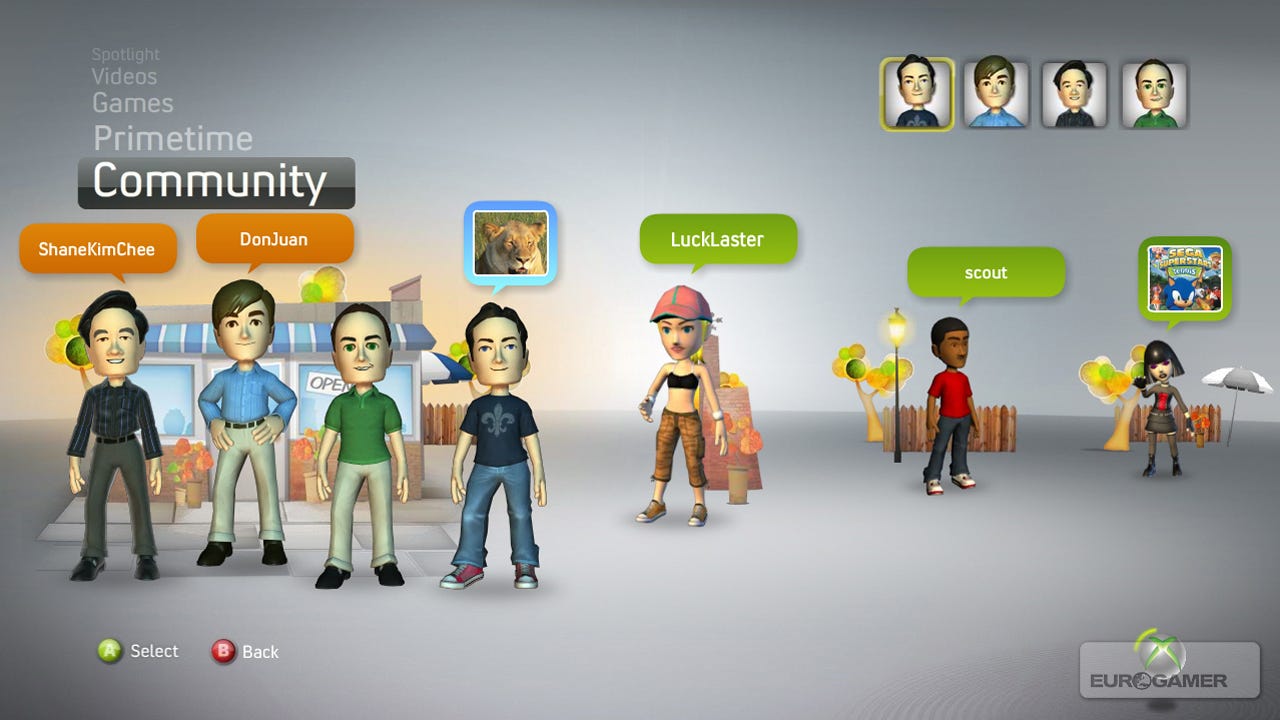
The Community channel is one of the riskiest features in the new interface, and one of the hardest to judge because we weren't actually able to see it working on a networked machine. This will essentially be a heavily graphical representation of your friends list, showing animated Avatars telling you what they're playing, grouped together in their online parties. It's supposed to be lively and engaging and it certainly sounds it, but - perhaps - at the greatest cost to utility and easy-access information.

However, you can also look at the Community channel - and the Avatars and party system that go hand-in-hand with it - from another angle. From one side, it's an extremely elaborate menu. From another it's actually a radically streamlined, and arguably much more useful, version of what Sony is attempting with its ambitious user-interface-cum-virtual-world, Home.

2

The interface will launch in the US and key European territories first; no word on Japan

Like Home, the new front-end will grant you an avatar to customise and express yourself with. Like Home, it will allow you to form parties and jump them instantaneously and in their entirety into any game, on Arcade or otherwise, bypassing the game's own lobby and party system completely. Like Home, you'll be able to watch streamed photo and video, including Netflix movies, synched to your entire party. Members of a party (maximum size to be determined, though we hear eight mentioned) can use voice chat together no matter what they're doing, including individual single-player gaming.

Without doubt the social features are completely seamless, cleverly engineered and very powerful. Of course, it hardly constitutes the genuinely massively multiplayer vision of a console's community that Home represents, and it doesn't give players the same "ownership" of virtual space. But in terms of tangible benefits to the console's user, they're almost all in Microsoft's new software, and in a much less cumbersome form that will be more palatable to more people.

The Rare-designed Avatars, it has to be said, are perhaps a little too palatable, a little too carefully focus-grouped. Blandly appealing, they capture neither the irrepressible silliness and charm of Miis nor the rather studied, realistic cool of Home avatars; they're very middle-of-the-road, very Microsoft. If they're to be embraced by families, casual gamers and Xbox's loyal hardcore alike, perhaps that's what's required - and in any event, the test of Avatars will be in their application, not their design.

"We don't pretend to have invented the concept of avatars," Schappert told us in conversation at E3, perhaps implying that Nintendo can't make the same claim either. In any event, Microsoft should be credited with looking a little further afield than Miis for inspiration. Downloadable accessories and clothing - whether purchased with Microsoft Points, doled out as Achievement rewards, or by developers as game promotions - are a very canny steal from the Asian free-gaming market pioneered by Nexon's MapleStory.

You can be sure that Microsoft will be more thorough in using Avatars, and encouraging third-parties to use them, than Nintendo has with its creations. The clearest example of this we currently know about is also, perhaps, the new interface's most exciting feature: the Primetime channel.

Schappert describes Primetime as the meeting point between gaming and TV; topical, social content, concentrating on quiz games at first, that changes on a daily schedule. Reality and quiz show giant Endemol - creator of the Big Brother phenomenon - is Microsoft's first partner in this venture, and will be bringing its 1 vs 100 format to the channel as a massively multiplayer online quiz game where the contestant, the host, the audience are all players, represented by their Avatars. Although there will be a jump-in mode, the main event will be daily quizzes held at a certain time of day; programmed, live entertainment, communally shared on a massive scale, just like TV.

Although it might have its genesis in the likes of Nintendo's Everybody Votes channel - and although similar concepts are already happening on TV, and starting to on the internet - Primetime is on another level entirely. It genuinely is the new kind of console gaming that Microsoft is billing it as, and it has enormous potential. We predict that this - not Scene It or Lips or You're In The Movies - is where Microsoft will finally make an impact on casual gaming. Localising it will be hard work, but Schappert promises that it will come to all the key European territories.
3

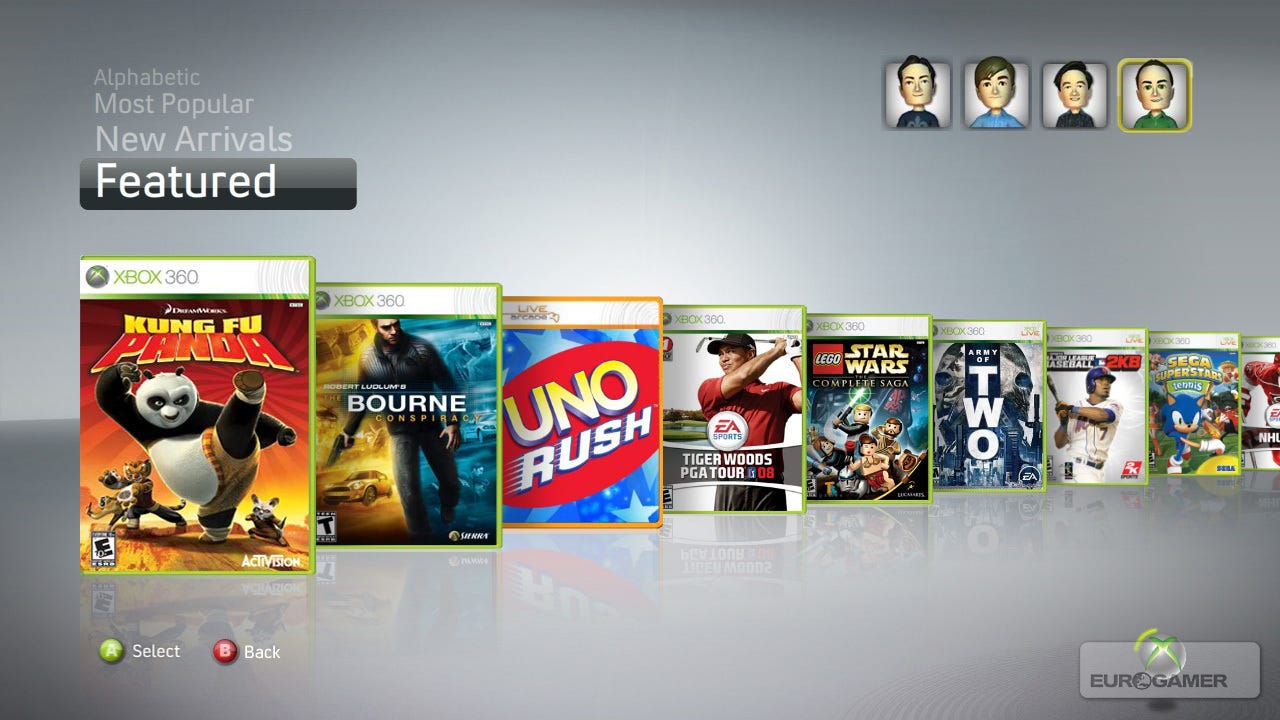
The games channel is a huge improvement over its current arrangement.

The other channels are more predictable. There's no single Marketplace hub any more, the relevant sections being accessed through the Games and Videos channels. Games will give you access to your stored Arcade games and demos, and run features such as "The Major's Picks". Videos will play host to the streaming film service for Netflix subscribers, one of the most enticing aspects of the new front end but, sadly, one that has little chance of reaching 360 owners outside the US.

The update will grant the 360 with a couple of other notable new abilities: you'll be able to install all DVD games to the hard drive and play them from there, increasing loading speeds by some 30 per cent (and, presumably, cutting noise too), although you'll still need to insert the disc to play. The Marketplace will also have a presence on the web; you'll be able to browse and buy downloads there, which will be automatically queued up for download to your 360 when you turn it on (or fetched immediately, if you choose to leave it on).

The most confident touch of the whole thing, perhaps, is the revamped Guide. Pressing the Guide button at any point, during gameplay or otherwise, brings up a neat, condensed version of the original blade interface with the entire front-end functionality available. This is the old-fashioned menu-drilling quick fix for when you know exactly what you want, and should make navigating the machine tremendously fast. Microsoft has cut out steps in the interface wherever possible; for example, to change between Arcade games, you will no longer need to back all the way out of one then drill all the way back down to the next. You'll simply bring up the Guide and hot-swap, directly.
4

Gamer pictures haven't been completely scrapped in favour of the Avatars - they'll still have a presence.

If any of the 360's established fanbase has its misgivings about the new face of the machine, the Guide should silence them. This update really will be all things to all men, and in terms of style and substance, form and functionality, Schappert is right - it will move the Xbox 360 further forward than any console has been moved in its lifespan before.

If there's a question mark, it's over Microsoft's vision of its machine as a casual and social gaming hub. Nintendo's success with the Wii stems from owning the living room, encouraging players to interact with each other in the same space. Microsoft's social engineering, by contrast, is purely virtual and wholly internet-focused. The vision of solitary users watching movies together in separate rooms, together alone, doesn't immediately suggest the expanded demographic that Microsoft is after.

Preaching to the unconverted that a software update really has made Xbox 360 a different beast will be a mighty PR challenge, too. But whether it brings in a whole new audience or not, the New Xbox Experience will subtly shift the battleground in console gaming away from the hardware arms race, and towards Schappert's precious software and services. And that is ground that Microsoft is a whole lot more comfortable on.

Comments (214)

Comments for this article are now closed, but please feel free to continue chatting on the forum!

  • Loading...hold tight!