The Last Remnant
Dregs on a bit.

Disappointingly for a game so vocal about throwing JRPG conventions out of the window, The Last Remnant suffers from one of the classic problems of the genre: an extremely slow start, made even slower by an astounding amount of loading. It's a good four hours before you're allowed access to anything interesting like combat and equipment customisation, and in the meantime you'll spend a lot of time staring at the five-to-seven-second splash loading screen that pops up every single time you start a fight, finish a fight, go into and out of buildings, encounter a cut-scene or walk more than twenty paces in a town. Even after so much loading, the game suffers from basic technical problems like shocking texture pop-in and juddering frame-rate, even in the tutorial battles.
One 12GB hard-disk install later and things have improved, but it's far from perfect. Load times are down to two or three seconds, and the in-battle slowdown restricted to conflicts of more than about thirty combatants. But the texture pop-in is still cringeworthily noticeable, the camera still goes mental in buildings to the extent that you have to spend five seconds turning it around before you can leave through the door that you're standing right in front of, and the old-fashioned animation and tearing in cut-scenes is still a definite problem. In a game where you spend as much time just watching as you do in Last Remnant, these presentation problems strip the sheen from what should rightfully be a rich spectacle, elevating them from mildly irritating to a crushing disappointment.
It's certainly not all bad news on the presentation side, however. The Last Remnant's visual design is generally very good, with characters whose distinctive appearance and facial expressiveness render them far more appealing than their serene, airbrushed counterparts elsewhere in the genre. The story and voice acting hold your attention, although as usual the English voice-overs aren't quite up to the standard of the Japanese - particularly in the case of main character Rush Sykes and the Marquis of Athlum (an American doing an English voice that veers between cockney and aristocrat in an amusing way, according to Friend of Eurogamer Simon Parkin).
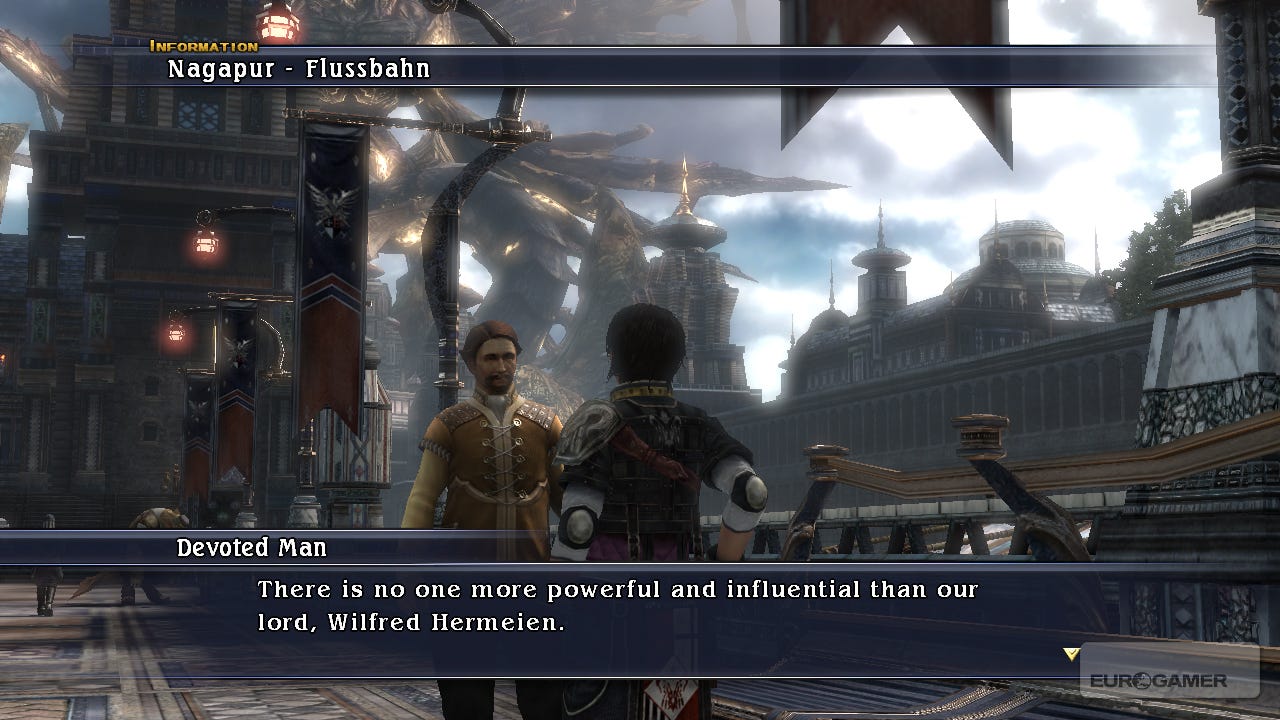
Rush is also incessantly energetic, insisting on calling Marquis David 'Dave' within ten minutes of meeting him. Meanwhile, the characters' general battle cries are slightly inane, although the Japanese ("We're FIGHTING these guys!", "I'm OK!") is marginally less annoying than the English ("Let's kick some A!"). Typically for Square-Enix, though, the high standard of direction and general production makes the game's important cut-scenes worth looking forward to regardless. There are moments - usually during the cut-scenes or wandering around in an impressive outdoor area - when the game looks quite beautiful, but unfortunately it almost always goes sharply downhill as soon as anything taxing starts happening on-screen.
It's a massive shame, because after the first seven or eight hours the combat really opens up into something nuanced and compelling. It's turn-based, but instead of controlling individuals you direct an army of anywhere between about five and thirty characters, organised into separate 'unions' or five or so, which share communal action- and hit-points. Give a union an order - all-out attack, watch yourselves, use a fighting or magic skill - and everyone within that unit executes that command to the best of their abilities. You spend most of the battle watching things play out in a cinematic series of animations, the camera swooping between unions and enemies as the battle runs its course.
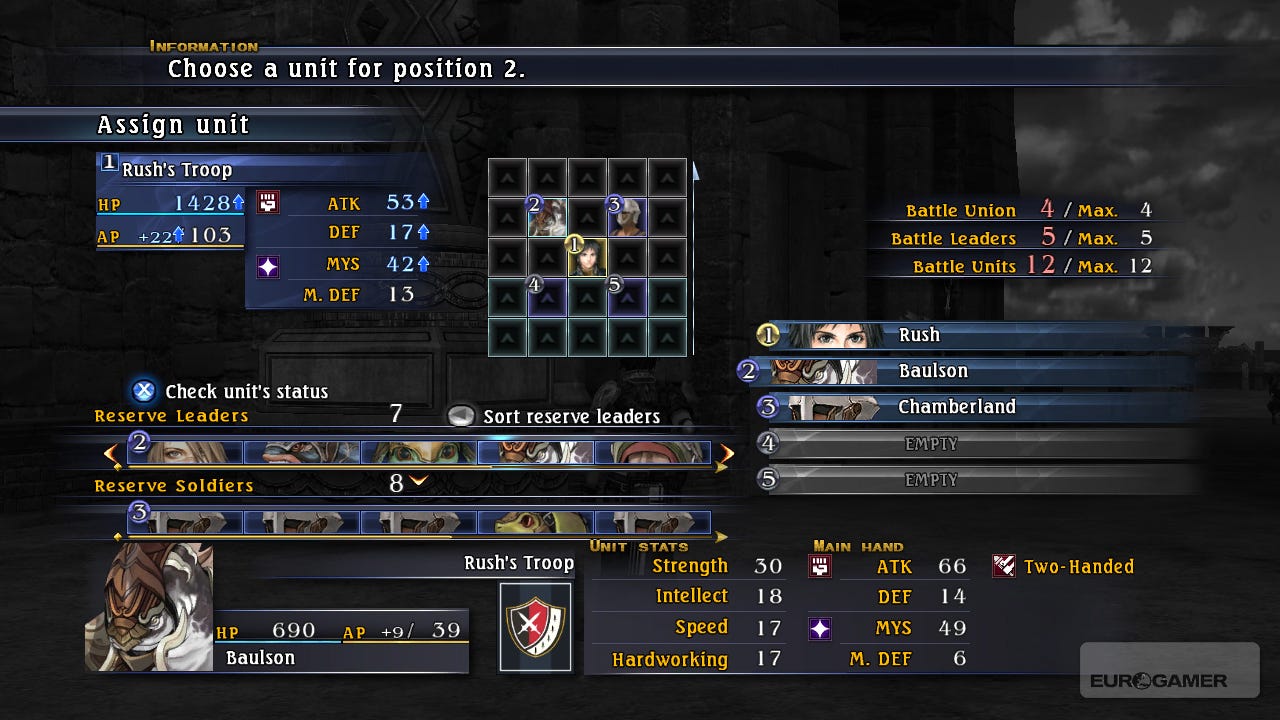
Give a union the 'Fighting Arts' command, for instance, and the union leader - usually a main character - performs a special move, whilst others perform normal attacks. Command 'Watch yourselves', and perhaps two characters will attack whilst others use healing spells or items. You find yourself playing a role halfway between combatant and strategist, issuing general commands to the unions and occasionally jumping in with a quick-time button-press to achieve a critical hit or block.
At first you feel completely out of control, especially when you're accompanied by 'guest' unions who operate entirely under their own steam, but the longer you play, the more options and customisation possibilities arise. As soon as you have a reasonable selection of characters under your control, playing around with union leaders and formations affects everything from hit-points to available commands, and has a huge impact on the battles themselves, especially boss fights.