Version tested: Xbox 360
I'm facing a bit of a dilemma, dear readers. You see, beloved colleague Rob Fahey got a bit carried away when he wrote the first impressions piece of The Darkness. He liked it so much, he not only played it all the way through (all 15 hours), but he detailed almost every interesting feature in-depth, told us about the excellent narrative and back-story, the tentacle-waving combat, and the darkness powers and summed up by saying the game was a "fascinating prospect" that any fan of first-person shooters or horror games should buy. Lucky for us we don't pay by the hour.
So what's left for me to say other than slap a deservingly high score on the end and expand on the online multiplayer side of the game? Fortunately for you, review fans, a fair bit.
There are things about The Darkness that will have you gurning with frothing appreciation and leave you in no doubt that Starbreeze is among the most talented developers in the world. Its ability to consistently inject new life into a resolutely tired genre shouldn't be underestimated. Just as Starbreeze managed with The Chronicles of Riddick: Escape from Butcher Bay, the pacing's exquisite in that the game twists and turns in new directions just when it's required.
As soon as you settle into a groove, a new darkness power unlocks and offers a new dimension to the gameplay, or a new type of darkling is made available to you. Far from being yet another corridor shooter to yawn your way through, it's a game that gives you a great deal of choice, and no set solution to get there. For example, rather like how FEAR gave players the option of whether to use time-slowing abilities or not (and an Achievement for those who didn't use them), The Darkness has a similar dynamic. The fact it's not a mandatory requirement opens up the gameplay variety considerably.
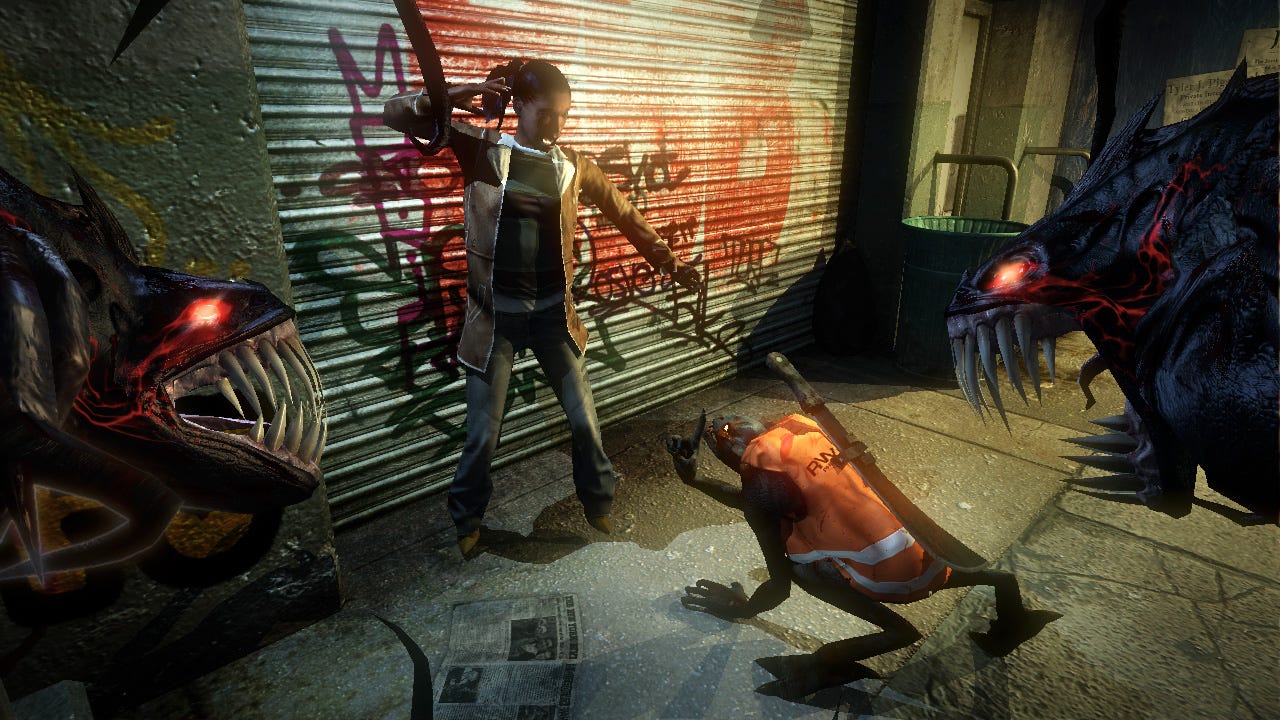
The Darkling tries a diplomatic solution before resorting to feasting on entrails.
In my case, I preferred to use the more stealthy Creeping Dark ability. Sending out one of your tentacles slithering ahead on a scouting mission, it lets you creep up on unsuspecting sentries, snap your slavering jaws in their shocked face and rip their still beating hearts out in a flash. Other players might prefer more traditional options such as using the regular tactical rifles and dual pistols and test themselves that way, or try and sneak up on enemies and pull off grisly close-quarter moves. There's no hard and fast route to success, and the game's all the better for letting players decide what kind of anti-hero they want to be.
Of course, you also gain access to four types of Darkling along the way. These scrawny little imps can run ahead into battle for you, taking out the lights, acting as a gunner, a suicide bomber, or just a general nuisance. On rare occasions they help solve puzzles for you, although giving you an example would give you too much of a clue, so I'll resist that particular temptation.
As you'll no doubt know by now, taking out any lights in your immediate vicinity is a key requirement if you fancy using your darkness powers to full effect, but also one that makes the approach to most combat situations a rather methodical process - maybe too methodical for some. Although I liked this more slow-paced, patient approach to the combat, others might see this as a bad thing. Having to pick off every sodding light bulb and strip light before you can reliably engage in full-power combat might irk players who prefer to just wade in all guns blazing, so it's worth bearing that in mind. It's not a game for everyone, but don't take that as a negative.
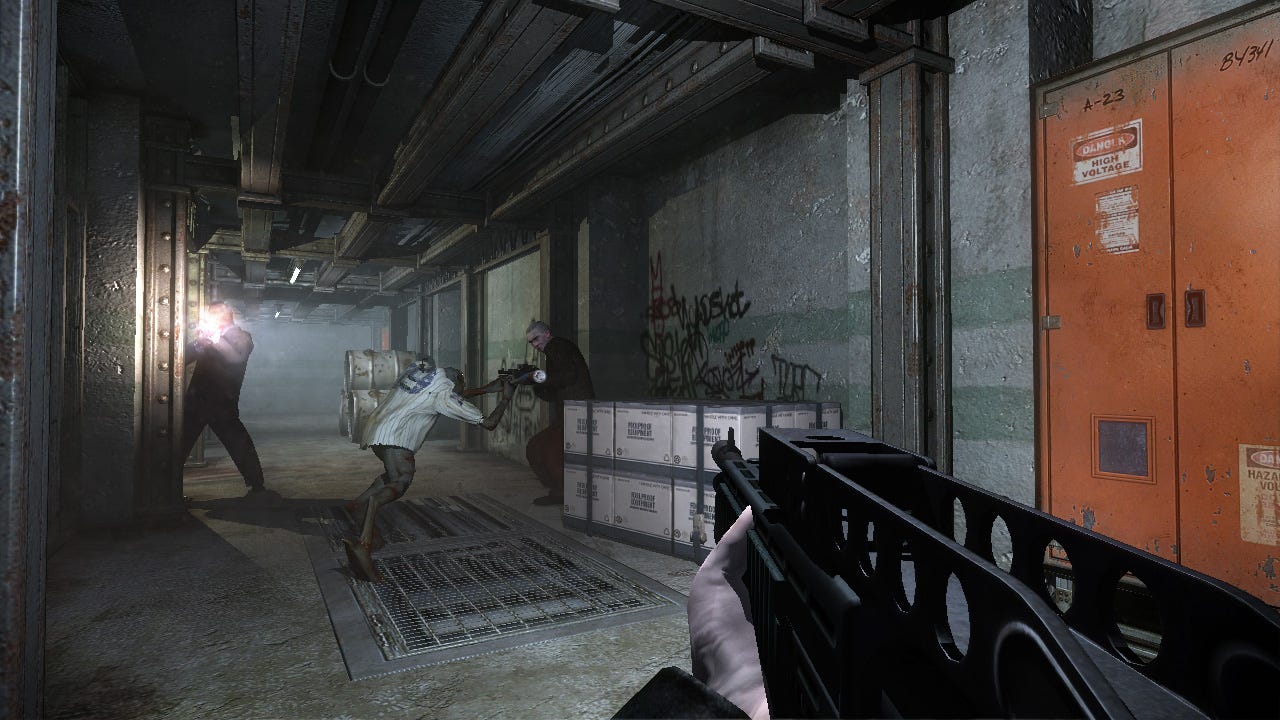
Possibly the most generic looking screenshot ever. Honestly, the game drips atmosphere, but this shot manages to make it look tired and boring. Whoops.
As Rob explained in his preview, the game's central hub is - for the most part - set around two underground stations in New York, with all the major locations available via the station exits. In common with Riddick, this gives Starbreeze a logical link point to some of the main mission areas, as well as a much-needed sense of freedom to wander around and do your own thing when you feel the need. And if you're ever lost, or in doubt of where to go next, the status screen and various helpful terminals dotted around the station make some otherwise frustrating navigation a piece of cake. And even when you get to your destination, various street maps on the side of the road ensure you'll never be wandering aimlessly - something that games risk doing as soon as they take the linear guard rail off the level design. It's as if Starbreeze identified all the little things that could prove an annoyance and took care of them in as unobtrusive a way as possible. The game never patronises you by barking at you for going the 'wrong' way, but the minute you do get lost in the gloomy streets of Lower East Side you don't have to do much to get back on track.
That said, the sections of the game where you travel to the 'otherworld' at times display ill-advised design that feels like the polar opposite of the well-thought-out New York environment. As a concept, the otherworld is a chillingly wonderful nightmare World War, with harrowing trenches filled with zombie Germans on one side, and literally stitched together British on the other, seemingly fighting a war they can never win or lose. As horribly atmospheric as these sections are, they just don't work as well as New York: all too often it's rather too easy to stray off-course and wonder if you're doing the right thing or walking the right way. The often featureless, murky and fog-ridden landscape might well do a good job of giving the impression of one man's hell, but playing within it is the game's undoubted low-point - like Max Payne's interminable dream sequences.
Getting back to New York provides stark relief, and a clear illustration of how much more enjoyable it is to play the game in this setting. In this case, unlike Riddick, the change of scene doesn't necessarily work as well as you'd hope, and as good as it is to have a break from the norm, it seems more a tool to make the player feel unsettled and uncomfortable than anything. If that was the aim, job done, but it's simply not as enjoyable an experience for the player and doesn't exactly show off the best elements of either the technical prowess of the engine or the gameplay. It feels muddled and incoherent, like a bad dream you can't quite wake up from. Hurgh.
As masterful as some of the artistry and atmosphere is, there's still a lingering feeling that the game world and accompanying physics aren't as fleshed out as they might be, with an engine that doens't seem to have moved on an awful lot since Riddick astonished us in 2004. For example, being able to use the demon arm to wield objects and smash them down on assailants ought to kill them, not merely disrupt them: it's physics lite. And what about the ghost town streets of New York almost entirely free of NPCs, and with barely a single building you can enter? It's all very well making the locations staggeringly detailed, but if they end up feeling like flimsy film sets, what's the point? Looking back, it's a shame so much of the game's life, ambience and general interactivity is shoehorned into the two subway stations, because it serves to highlight what's missing elsewhere. It might remove the need to slowly wander around to meet up with characters, but it ends up feeling slightly unfinished as a result.
Other little kinks and quirks started to chip away at our original intention to dish out a back slapping 9/10. Control niggles when controlling the Creeping Dark mean that your tentacle tends to snag on dead bodies and refuse to crawl over them. You'll also grow to hate the way your tentacle will sluggishly misread your intended direction and often completely disorientate you in the process. For example - elementary changes of direction such as coming down a wall and back down to horizontal alignment rarely happen as quickly or as easily as you think they should, and during the heat of battle such things can be a real annoyance. Indeed, snapping your jaws in the direction of an assailant doesn't always make a firm connection - often bafflingly so. It's like Starbreeze never quite nailed what it was intending to do, and one of the most crucial elements of the game design doesn't end up feeling as fluid as it should. Shame.
And if we're going to get our slavering (albeit misbehaving) jaws stuck firmly into the weaker elements of The Darkness, perhaps now's the time to turn our attention to how the AI fares - obviously it's a key part of what any heralded shooter should offer in 2007. The truth is, although it's perfectly respectable and challenging enough to offer regularly exciting and engaging firefights, it doesn't really stand up to close scrutiny compared with the very best FPS AI out there, feeling a little standard and unambitious. Enemies tend to merely stand and shoot, taking cover and popping out to return fire in a typically obliging fashion - it's no FEAR, put it that way. You won't see any evidence of flanking tactics or concerted attempts at teamwork; in fact, I'd go as far as to say you won't see anything majorly out of the ordinary. Once in a while you might notice that some enemies follow you downstairs, but it's a rarity, and a valid complaint that The Darkness doesn't test skilled FPS players often enough. At its worst, the AI (on normal setting, at least) is downright dim if you're savvy enough to use creeping dark against them. They react so late, it stretches credibility - oh look, a giant tentacle slithering towards me. Oh noes! It may well have been a deliberate balancing decision to make it as accessible and entertaining as possible to the widest possible audience, but that doesn't hide the fact that the game's enemies aren't that smart, put it that way.
Sack the screenshot taker Part Two: Yeah, this one's makes it look a bit rubbish too. Amazing.
Another interesting point about the game as a whole, is that the most spectacular moments in the entire experience are saved for the very end when you're not even in control anymore. Seemingly Starbreeze wanted to take an opportunity to show you how it had all these plans to make a 10/10 action spectacular, but couldn't quite work out how to let the player do that within an intuitive control framework. The three minute section near the very final moments of the game, for instance, are so wild and frantic, it brings into sharp focus what the game could have been if they had cut the player loose. You have to see it to believe it.
Rob's contention that The Darkness offers "little that's new or hugely ambitious in its gameplay" is fair, to a large extent. You shoot guns. You have special powers. You kill people. They try to kill you back. Big deal - it was never going to be the most innovative game ever, but it's not something that should put people off if you're one of the millions of people that love shooters. No one would claim it's the first game to offer numerous contrasting types of 'weapons' either, nor is it the first to offer the player one than one approach to slaying their foe, but all you can ask for is that everything this is in the game is well balanced, relentlessly entertaining and works as it should - and it does.
The thing that really marks The Darkness out, we'll repeat, is its "minute-to-minute gameplay". You can't argue with that. It's a game which offers thrills arguably as intense as anything the genre has to offer. It is, for the most part, an extraordinarily entertaining game with precious little fat around the edges,and often technically stunning. Not only that, it's complemented by a wonderfully engaging script, great (although sometimes cod amusing in the case of Mike Patton's attempt at voicing The Darkness with gravely malevolence) voice acting, and some of the best presentation you'll ever see in a first-person shooter.
It's not often we'll talk about 'game direction' in the way that a film reviewer might refer to a must-see movie, but this deserves to be held up as a great example of a game that got it spot-on. More often than not, you get the sense that Starbreeze's main aim was to keep its audience entertained and that everything else simply flowed from that central idea. Admittedly, it's a shame that the otherworld sections were a blight on the overall quality, but it's not enough to detract from how you'll feel about it.
This one's a bit better. The subtle ighting in the game is truly some of the best we've ever seen in a videogame.
More likely, you'll remember the little touches. The hidden items, for example, provide you with an almighty amount of amusement in the form of warped answerphone greeting from a procession of mentally unhinged individuals, while the ability to sit down and watch entire movies (like Flash Gordon, The Street Fighter, various cartoons and music videos) is one of those moments you'll pull a friend in from another room to giddily exclaim: "look!" It's fairly meaningless in terms of the game, but simply fantastic that we've reached a stage where long-form, real-life movies can be chucked into a videogame as a bonus. Another nice touch is to get entire comics as an unlockable - especially useful if, like me, you've never read the graphic novel the game's based on.
Talking of bonuses, Starbreeze has also gone one further than it did with Riddick by including the online (or System Link) multiplayer portion to round off an already essential package. In this instance, you're given the usual Deathmatch, Team Deathmatch, and Capture the Flag staples, along with a Survivor mode where everyone's out to get you. Only eight players are supported, which is an initial disappointment for those of you used to somewhat bigger matches, but on the plus side you won't have to worry about waiting around incessantly in lobbies like you do with game with bigger player support. With all three modes you have the option to play as Humans, Darklings or as Shapeshifters (where you can switch between the two during play), so what seems like a standard online add-on is actually given something of an extra dimension.
To add to the fun, there are also 23 different characters to choose from - 15 humans and eight darklings, which is a nice touch. My favourite is Sally Kreuger, for presumably being related to Freddie. If she isn't, she should be. Given that very few people appear to be playing online as-yet (no wonder, given the game's not out for another four days), it's hard to discern quite how the game's online facet will go down in the big wide world, but the time we have had online suggests it's a worthy addition, if a little limited.
In a year absolutely crammed with interesting-looking first-person shooters, you've got to come up with a game of extraordinary quality to rise above the competition. The Darkness has come along at simultaneously the best- and worst-possible time: on the one hand, it has arrived before it risked being drowned out in a fiercely competitive market, full of games claiming to be the Next Big Thing; on the other, it might well suffer from people holding off for what else is coming out. For what it's worth, I'd concur with Rob and suggest that any fan of first-person shooters needs to play this game, even though the occasional duff level, and the slightly pedestrian AI disrupts the quality at times. Once The Darkness gets its tentacles around you, resistance is futile.
8 / 10
