The Agency

Interrogating designer Hal Milton and director Matt Wilson.

Yesterday, we previewed this promising and extremely inventive MMO shooter for PS3 and PC from Sony Online Entertainment's Seattle studio. We also had a chance to interview lead designer Hal Milton - an endearingly enthusiastic crackpot genius, half George McFly, half Doc Brown - and director of development Matt Wilson about where they're trying to take the game, and MMOs in general. Read on for the results.

Eurogamer: The game's been designed with solo play very much in mind, and very little content that's exclusively for groups. How come?

Hal Milton: There's a designer who I've adored for years who's a good friend, called Dan Rubenfield, who puts this best. For player-versus-player combat, and for all those things that challenge the player, all of our online games are The Lord of the Flies. It's our job to protect Piggy from having his head bashed in with a rock. That stuck with me because it's absolutely accurate - we want to protect the sheep from the wolves.

So we make sure that that core experience that you paid to play, that you want to have fun with, is not a going-to-work simulator which punishes you for not playing it the way we want you to. It doesn't preclude the notion of having that type of gameplay - it just means that it's consensual and the player knows what choice they're making, and everything else is something you can get through with your own wits and skill.
Eurogamer: The proven successes in the MMO field are time-sinks - it's how they work, how they make that subscription seem worthwhile. Making a less time-intensive title, does that worry you at all?

'The Agency' Screenshot agency1

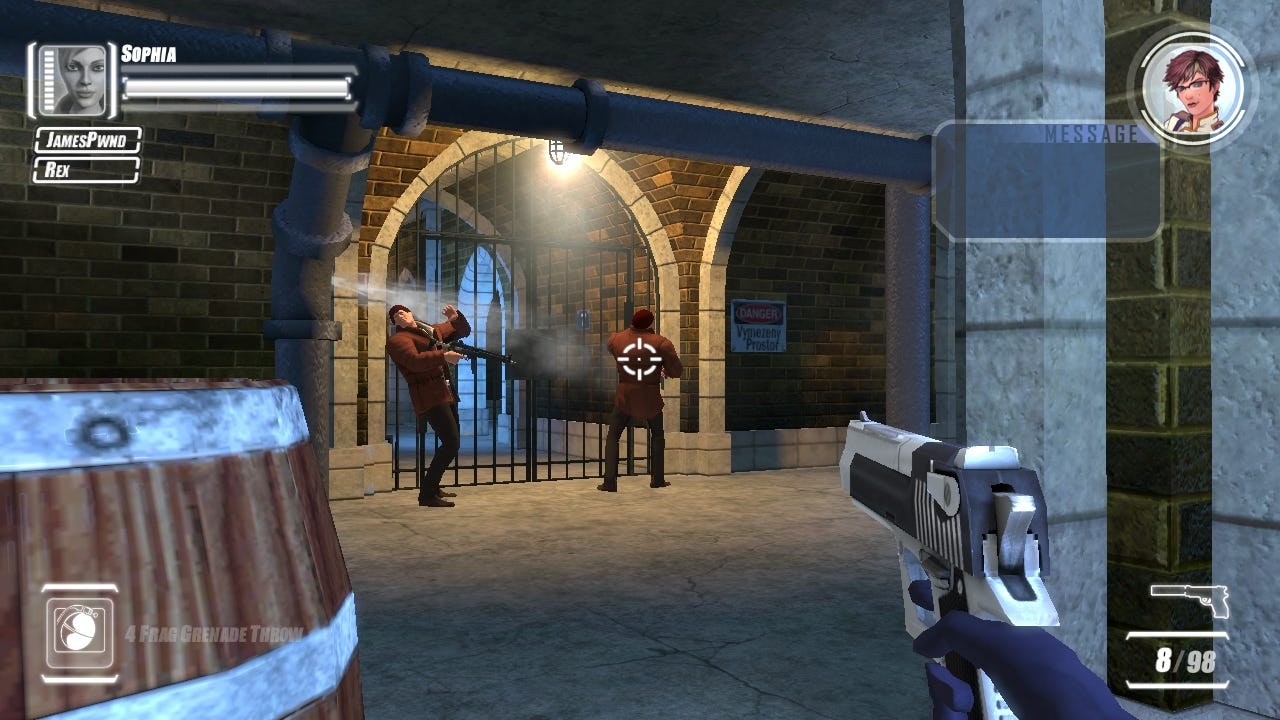
That's an operative getting in touch in the top right. Probably telling us not to shoot that guy.

Hal Milton: Absolutely not. The whole making sure I can't play any other game but this one, because if I don't play for 4 hours I'll get behind my friends - that's not why we make these titles. The way to keep people in your world is to say, hey, you can play for 30 minutes or three hours and you're going to have a great time, and if you go away for two weeks and come back, there's stuff waiting for you.

Multiple MMOs that require a time-sink are really difficult because of that time-sink, but I can play multiple shooters, I can play Animal Crossing, I can play a bunch of games that have pseudo-persistent elements that track over a year or more, and they keep me engaged.

To step back one second, I just have to state that a lot of the things that people considered part of the genre of MMOs - which is kind of arguable, whether it's a genre or just a feature-set added on to an existing game type - have been determined by a group of folks that started in college making MUDs, we all got rewarded for obfuscation, and then we all decided we're going to write down what the rules of an MMO are and what has to be there in order for it to be an MMO.

We challenge those assumptions by saying, if it's not fun, it shouldn't be there. If it's tedious, it's not gameplay. You can't tell me that something that's really only been around on a college and amateur level since the '70s, and then at a professional level starting in the '90s - that we've actually got some codified rule-set that can be applied broadly to everything. That's ridiculous wonkery.

Instead we're going to take proven mechanics, we're going to take some new ideas that we have, and we're going to make sure that the player has a fun experience that doesn't treat them like some guilt-ridden relative harassing them over the phone to "play me or you're not a good person".

Matt Wilson: The social aspects of online gaming fun are extremely fun, they're really important. The activities in online games have not been as fun, and what we're trying to do is really take more of a mainstream game mechanic like the shooter gameplay and add people, give them a world they can experience, make it a little more compact in play-time, give them more frequency. That's really the core principle - getting more of the ADD group into the space.

Hal Milton: That's a terrible way of putting it, but it's true.

Matt Wilson: It's what we've all come down to. Ever since TIVO, it's ruined my life.

Hal Milton: And we do have, well, the whole point of a persistent game: persistence, one, is my ability to effect change that others can witness. And two, it's being able to have that persistent experience play out over a long period of time, it's not just that it's persistent for my play session, the world is constantly going on. And I'm encouraged to come back from time to time to experience all the new content or all the gameplay I haven't played yet. It's taking cues from TV series and, I will reference it again, a title like Animal Crossing, which has this slew of marvellous persistent mechanics that no MMO has really put in yet, which is shocking to me.

Eurogamer: Your plans for giving in-game organisations a presence in the real world, or having your operatives send you texts and emails, are interesting...

Hal Milton: Our game has the luxury of being in a pseudo real-world setting, so that makes connecting it back to our own all the easier. But kinda like other titles out there like GTA, we have no delusions about representing political or ideological struggles that exist in the real world. We just want to have fun with an earth-like scenario, because the fact of the matter is that real-world ideological struggles are not very fun. There are other companies that are doing great work in creating gameplay around that, but we want our world to be something that players run to, not away from. The world is kind of a painful, dark, depressing place and capitalising on those crises feels... less than enjoyable.

Eurogamer: SOE recently announced that its deal with the real money trading firm, Live Gamer, would extend to include The Agency. What does that mean for your business model, and for things like the collectible Operatives system?

Hal Milton: This is something that we haven't announced, but we have some alternate mechanics for operatives that we may support with out-of-game transactions, and we may have the opportunity for players to spin up, at least, a random booster pack that gives them the opportunity to possibly recruit other operatives.

But I want to make this very clear. What that announcement was talking about was a new relationship which helps everybody about having another auction system for players to trade and sell goods. This is not a microtransaction system within The Agency to allow players to buy weapons, outfits, operatives to be effective within the game world. That's something that we're absolutely not planning on doing. We don't want players to have the BFG and screw up everybody's experience because they don't know how to use it.

'The Agency' Screenshot agency2

Third or first-person cameras are both available; probably best to switch between them for stealth and shooting.

Matt Wilson: We haven't announced our business model yet for two reasons. One is, we're still figuring it out as we go along, looking at what the markets are up to, how is the PlayStation 3 evolving from that standpoint. The other thing is Free Realms, another SOE product - it's launching and it's going to have a bunch of new business models that they play with, and we're interested in seeing how those play out before we decide what we're going to do.

The main goal for us is to lower the barrier for entry on the PS3. We're targeting an audience here that's not used to the MMO space, and so we've got to drop that barrier as low as we possibly can.

Eurogamer: A lot of people are developing multiple business models that will run side by side for their games...

Hal Milton: It's fascinating right now, I have friends working at Realtime Worlds on APB - basically, all of us are trying to... coalesce around something that doesn't make console players feel like they're being nickeled and dimed to death.

Matt Wilson: Although, Rock Band has nickeled and dimed me to death, and I'm okay with it.

Hal Milton: That's very true. That's why we're all trying to re-evaluate what MMO means... Call of Duty 4, Halo 3, Rock Band, these are games that have characters that can exist in an online community and play against each other... Xbox 360 is technically one of the largest MMOs in existence.

Eurogamer: Something like 60 percent of your team here is on the art side... how come it's such a large proportion?

Hal Milton: Content, content, content, content.

Matt Wilson: If I told you at the start of this project that we were going to build an MMO and it's going to be based on a shooter mechanic, stay true to that, and feature a hundred hours of content, you'd say we were crazy. And we probably are crazy to some extent. Shooter content is not the MMO content of today; that's just throwing a map down, you throw some spawns in there, you dress it up and throw your missions around it. But cover isn't important, where the AI is located isn't necessarily important. And then you look at how to build a shooter, it's a corridor system, it has cover elements, where the AI is placed is important, where the player actually shoots from is extraordinarily important. I used to always wonder why does it take so long to build shooters, well, now I know.

And there's a big difference between ten guns in your favourite FPS, and the 150, 200, 300 guns that we're doing, as well.

Eurogamer: Launching an MMO is a huge technical challenge, and there have been precious few that have had a smooth launch. Now you're looking at a market of console gamers on PS3 who have a whole different expectation of how well a game's going to work when they turn it on. How do you prepare for that?

Hal Milton: We have strict criteria that we put in place. As we push towards alpha, our goals are to have performance at the level that is has to be at. We're not going to be like, it's five frames per second now, but it'll be fine when we optimise three months before ship.

Matt Wilson: The big difference between the PC and the PS3 is that there's actually a certification group that we have to get our product through. The other nice part about the PS3 is that it doesn't have five different video cards in it. It's the pros and cons of a console. The pros are: there's a certification process. The cons are: there's a certification process.

Eurogamer: At the start of this year there were three big prospects for MMOs on consoles: your game, APB, and Marvel Universe Online. Were you surprised when Microsoft cancelled the latter?

Hal Milton: It's always saddening. I want more people to release MMOs, it's the only way that we'll get better. They're so tough to make and they're so expensive that our examples to learn from are few and far between. So yeah, Marvel going away is a drag, it's always a drag, it's another game that I don't get to play and I don't get to somehow look vaguely similar to Wolverine and say "bub" a lot. And I'm really upset about that. But to say it's unexpected... any MMO is always in danger, because of the risk it takes to create them.

'The Agency' Screenshot agency3

This being a spy game, ability to defuse bombs is actually a stat.

Matt Wilson: We want more people to push onto the console. Both Hal and I have always believed that the console is the gaming platform of the future or the present, really. It was great back in the day when people were like, there's no way you can do a shooter on a console, and then GoldenEye came out and they were like, alright, you can do one, and then years passed and Halo comes out and after that, I honestly think the shooter platform is now the console.

Eurogamer: Lastly, a tough one that I regularly ask myself: what makes a game an MMO?

Hal Milton: That's a question people are still trying to figure out, that's why there's a debate right now about whether it's a genre or a feature.

Matt Wilson: Some people define an MMO from the business model perspective.

Hal Milton: However you decide to monetise it down the road, at its core it's a group of unrelated people interacting with a game that has persistent results that all of them can experience over time. That's it. So if you have Halo 3 and you have leaderboards, you have a massively multiplayer experience for everyone that plays it. That's pretty much it, in my head.

Matt Wilson: There's what we think MMOs are, and then what people perceive them as: a persistent rental model that became a genre. So if you tell people the true definition - if I said Halo is an MMO, I'd get laughed out of the room. Or 360...

Hal Milton: But you have an avatar, it gets Achievements, you can play others, you earn points, you grind to get those points, you pay a subscription fee...

Matt Wilson: And my wife plays one of the bigger MMOs out there right now, which is Facebook. She's Scrabulousing non-stop. It's full of mini-games, its got persistence and guilds associated with it... That's where the barriers are dropping, honestly. Defined like that, Rock Band is an MMO too. We're on the edge, hopefully, of losing that MMO term, because it's not associative to what these games are really about.

Comments (7) Latest comment 4 years ago

Comments threads automatically close after 30 days, but please feel free to continue chatting on the forum!