Spore Creatures Review

Pocket monsters? It'll never catch on...

Version tested: DS

The DS version of Will Wright's galaxy-spanning evolutionary epic was always going to follow in giant footsteps, but there was no reason to think the game couldn't retain some of its creative sprawl when transitioning from PC to DS. After all, it's not like the diminutive handheld hasn't hosted similarly open-ended games in the past. Mix up Animal Crossing with The Sims and sprinkle on a dash of Nintendogs and you've got a winning recipe. Strange, then, that Maxis has instead opted to turn Spore Creatures into a frustratingly linear and repetitive action-adventure.

The game starts with you as a humble sea slug called Oogie. You slither onto dry land with your friend Little Oogie, but no sooner have you set about exploring your new home a mysterious spaceship attacks and beams up your pal. The game then becomes a quest to leapfrog up the evolutionary ladder in order to track down this alien interloper and save Little Oogie.

Spore Creatures quickly establishes the pattern that will dominate the gameplay. Split into a series of planets, each split further into sequences of small islands, your first order of business is to explore your surroundings and find a way to progress to the next area. Unfortunately the camera is a slippery customer, constantly shifting your viewpoint so that what was once up is now left, then right, then down. This means that trying to go in one continuous direction often makes you go in circles unless you constantly reset the camera with the shoulder buttons. Control is via stylus or d-pad, but both leave much to be desired. For a game based on exploration, the fact that exploring makes you feel queasy isn't a good sign.
1

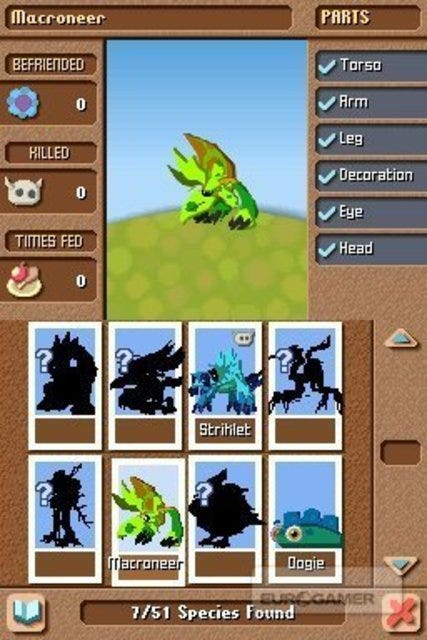
Each new species you find gets added to the Sporepedia, although the limited number of creatures makes it less than compelling.

You're not alone in the world, however, and interaction with the other species is central to the experience. Docile creatures can be befriended by stroking them with smiley face icons, or by triggering a basic rhythm game in which you tap flowers as circular dots pass over them. Once you've earned their trust, creatures may give you additional body parts, or send you on further mini-quests. Inevitably, this means conflict with the less-agreeable denizens of the gameworld, and you have to swap strokes for strikes, slashing with the stylus and - later - deploying bio-attacks that you've added to your virtual frame.

These two basic types of interaction really do form the core of the whole game, and you can expect to spend most of your playing time alternating between the two. It soon becomes problematic since making friends can become a long-winded chore with no variation, while combat feels fiddly and unsatisfying. Your attacks feel disconnected, and fights usually end up as frantic stylus-mashing affairs, reliant on brute strength rather than tactical decisions. Most areas introduce new enemies who routinely kick your ass, sending you back to respawn at the nearest nest, until you find or earn the new body part that will make you strong enough to defeat them. Once this happens, battles that were once impossible become far too easy.

All of which wouldn't matter so much if the game's downsized version of the Creature Creator allowed you to create some lovably unique personalised creations, giving you some personal investment in the mundane action. Sadly, while there's an admirable range of body parts to drag and drop, the finer details are rather opaque, often only giving you vital info about what powers a part will bestow after you've equipped it. If you just want to sling pieces together to make something that looks silly, it's fine. If you want to actually create a creature designed to survive in the game, it's less helpful. If you can't remember which mouth type gave you the fire-breathing ability, you'll just have to go through each one to find it again.

Even so, you can create plenty of-fun looking monsters - only to find them transformed into rather ugly jumbles of jangling pieces when they burrow back into the game-world. The graphics use 2D sprites, sort of like loose-jointed puppets made of paper shapes, in a 3D polygon environment and the effect just doesn't work. It's hard to tell where body parts end and begin, and unless you stick to clear, simple designs any quirky details get swallowed up in an overlapping mess of legs, arms and mouths.

It doesn't help that the strictly linear progression of the adventure means that your design choices are constantly being overruled by the needs of the game anyway. While it's theoretically possible to come up with all manner of wild creations, there's a fairly specific series of body part combinations that will actually allow you to make progress. The most common way the game has of funnelling you down particular design paths is via the environment. Some terrain is deadly, so you have no choice but to locate and use the appropriate body parts to get past it. Quite apart from the illogical aspect of having a tiny patch of ground that will kill your creature simply because it's been designated as "desert", reducing the player's creative choices for the sake of a lame obstacle just seems to go against everything Spore was meant to do.

2

What's that splodge in the corner? Answers on a postcard...

Back in March, producer Jason Haber told us that you could play as a carrot if you wanted to, and he wasn't lying. You can create any creature you want, but you only unlock most of the body parts by playing the adventure, leaving your initial options severely limited. Even if you keep things simple, your beloved carrot creature would be unable to leave the first island, and would die the moment it met an unfriendly adversary, so it's not a remotely realistic gameplay option. You can trade your wilder creations via local or Wi-Fi connection, but all downloaded creatures do is pop up in the game and wander about as an NPC. What could have been the focal point of an imaginative and sociable sandbox game feels like an afterthought, stuck in an uninspiring cycle of fetch-quests and grinding.

That's really the central problem with Spore Creatures. The wonky camera and repetition is annoying, but it still just about works as an average exploration game. What it doesn't offer is any sort of Free Play option where you can do your own thing. You can indulge your creative desires or you can play the game. You can't really do both at the same time in any satisfying way, which suggests that "linear action adventure" simply wasn't the right direction to take the Spore concept for its handheld outing.

5 / 10

Read the Eurogamer.net scoring policy

Comments (28)

Comments for this article are now closed, but please feel free to continue chatting on the forum!

  • Loading...hold tight!