Shin Megami Tensei: Persona 3 Review

Shoot yourself in the head.

Version tested: PlayStation 2

Part of us sullenly rebels against powering on the PS2. Standard definition, without even the consolation prize of innovative controls? No online features, no Achievements, no downloadable demo or add-on content? So quickly have we become accustomed to the luxuries of next-gen that our trusty consoles of yesterday feel only a step away from banging rocks together.

As anyone with half an eye on the industry's boring statistics can tell you, though, the vast majority of people are still perfectly happy to play on their PS2s, unswayed as yet by the lure of connected, high-def, controller-waving gaming. Even from our lofty perch of tech-fetishism, surrounded by the blinking lights and sparkling gizmos of the next-gen, there are moments when we think they might have a point. Persona 3 is one of those moments.

The ego

Actually, it's rather more than a moment. There are easily fifty hours of gameplay in here if you choose to explore and admire the scenery; probably more like a hundred if you're really committed. Like top-notch role-playing predecessors such as Disgaea and the divisive Final Fantasy XII, it's a feast you can gorge yourself on or merely sample through an eminently satisfying tasting menu. Like both of those games, those who are hooked will be gorging for a long time.
1

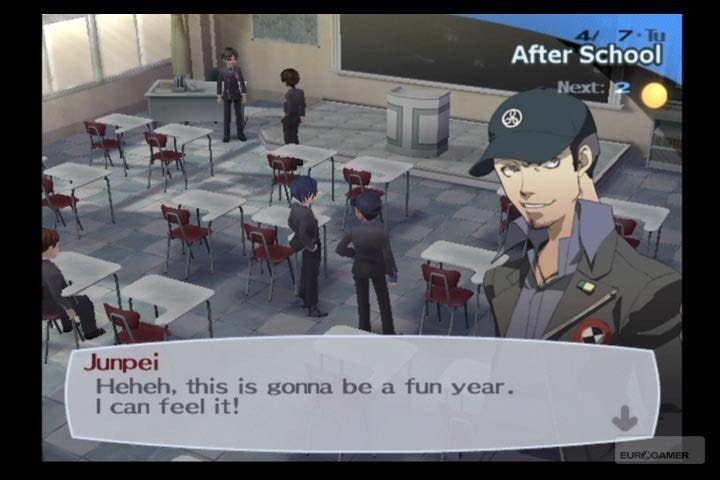
So, it's a cute Japanese high school simulation, where you make friends in class...

So what is Persona 3? Well, to begin with, it's a bundle of contradictions. A spin-off from the dark, apocalyptic and sprawling Shin Megami Tensei series, it's actually the fourth Persona game - Persona 2, on the PlayStation, was divided up into a pair of volumes, each an individual game in its own right. Connected only thematically with the rest of the series, Persona as a whole is a light-hearted, funny and generally sunny simulation of high school romance - interspersed with scenes of violence, demonic possession and teenagers shooting themselves in the head. Another contradiction: it's an RPG with randomly generated dungeons to crawl, but is still really, really good.

You play a newly arrived student at a prestigious Japanese high school, staying in a dormitory with a number of other characters. These people, it transpires, go out at night after school to fight an evil, demonic legion called Shadows, who mostly appear in an enormous, hideous tower that sprouts in the place of the school at midnight. In an entirely unsurprising twist, you share their powers, and are asked to join them in their fight.

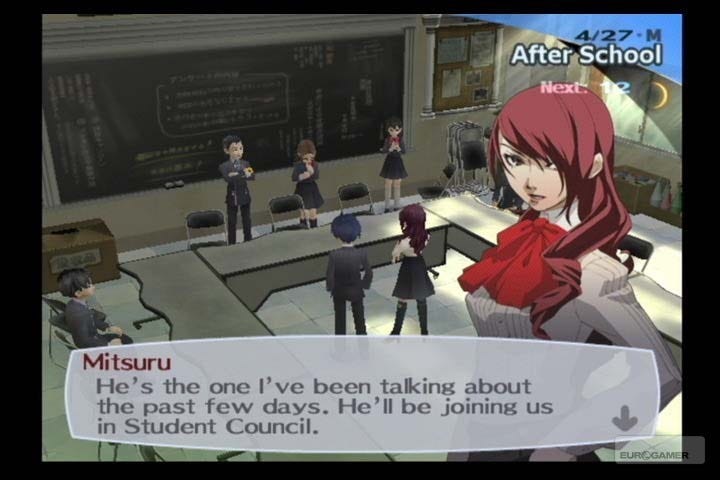
So far, that's a couple of hundred different anime series and at least a few dozen games in a nutshell - but Persona 3 sets about presenting this well-worn material with extraordinary gusto and creativity, reinventing the rules of such stories wherever it sees fit. The result is two games in one. During the day, you play a teenager making his way in a new town and new school. In a style reminiscent of classic Japanese dating sims like Tokimeki Memorial (hey, don't diss it - it's where Hideo Kojima cut his teeth), you progress through the school calendar befriending different people and choosing which ones to spend time with and what to say with them. This section gently encourages you to explore the town further, to find certain items, or simply to go and spend time at locations that provide a boost to your three core "Social" statistics of Academics, Charm and Courage. Levelling those up presents the possibility of meeting new people or expanding existing relationships.

It's all cute, sunny, compelling and filled with colourful characters (in a very literal sense). It's not quite as free or ambitious as something like Shenmue, in that your actions generally boil down to a small set of options (such as who to hang out with after school, or where to spend your evenings), but it's presented with wit and charm.

The id
3

... Climb through the student social ranks and chat up improbably endowed seniors...

The other game in Persona 3 is the more traditional RPG, in which you battle the forces of darkness with the select group of your school friends who have the power to do so. Each evening, upon your return to the dorm, you have the option to travel to Tartarus - the aforementioned tower that appears in the school grounds - and battle through a few more stages of enemies. Additionally, there are some events which roll around on specific dates (often when the moon is full) that won't be optional, which means that it's important to make sure your characters are fairly strong and well-equipped by that point.

The basic objective for much of the game is simply to explore Tartarus, something which you're left to do at your own pace for the most part. Every floor in the tower is randomly generated, so it changes each night, with the exception of boss floors that are interspersed throughout the ascent. Each boss floor includes a teleport device that gives you instant access to that floor in future. If you can't quite make it to the boss on one night, you still level up and gain new abilities and equipment, so you're better prepared to face the challenge next time.

The game has no random battles, instead offering you the ability to avoid or pre-emptively attack enemies while you explore. Once into the battle, the system is loosely turn-based - but you only have direct control over your main character. As well as using generic weapon attacks, each character can also act by using a Persona - an expression of their subconscious that can launch more powerful physical attacks, cast elemental magic or use healing, protection and status-effect spells. Each of your support characters (up to three of them) can be given general orders, but will act fairly intelligently by themselves, leaving you to focus your strategy on your main character.

This actually makes quite a lot of sense, because the game heaps much of its complexity onto that one character. While every other character in the game can use one Persona and one class of weapons, the protagonist's special ability is that he can use multiple Persona, switching between them each turn as needed. This allows you to adapt to the elemental weaknesses of your foe - essential here, because only by striking each enemy in its weak spot can you earn additional battle turns and powerful group attacks, both of which you need to master as you progress.

On the plus side, only managing one character means that you can treat the others effectively as support - their actions are fairly predictable and can be integrated into your own strategy easily, and you don't have to learn a host of confusing spell names and summon types for every character, which is definitely a bonus. Unfortunately, the single-character focus also brings with it some interface problems. It's especially annoying that you have to talk to each team member separately in order to upgrade their equipment, and can't see what they're using when you're at an equipment store.

Despite such niggles, however, the dungeon-crawling sections manage to remain surprisingly fresh and interesting for a very long time - not something we're caught saying very often about games which randomly generate their dungeons. Battles strike a fine balance between being very fast and being very tactical, and the game is clever enough to make weak enemies run away from you - so you won't face anything that's so far below your level as to be worthless.

The superego

4

... And then use the power you gain from your social links to summon hideous creatures from your subconscious...

So, what's the connection between that and the Grange Hill stuff? Well, there are two connections. The first and most simple is the game mechanic you use to create new Personas. You acquire Personas in a card shuffle at the end of most successful battles, but these are simple and often quite low-level Personas - if you want to start really dishing out some pain, you'll need to combine those cards to create new, merged Personas.

The system for doing this is well-considered and intuitive, giving you all the information you need right from the outset - so you won't be taking shots in the dark and throwing away perfectly good cards on rubbish combinations. However, there's another key influence here. Each Persona has a certain "type", and that type is connected to a Social Link you've made in the game - a connection with a person or group of people. The stronger the Social Link, the stronger the Persona you can create of that type. So, yes, what we've just described is a system where you go through a bright, happy school environment making friends and relationships - purely so that you can then feed on the strength of those relationships when you need to summon up demons from your own subconscious.

This is the other key link between Persona 3's two distinct games, and the element which lifts it from greatness to magnificence. Persona 3 is a little bit wrong. It knows it's wrong, and it revels in it. Summoning those Personas we mentioned? That's accomplished by taking out a gun and shooting yourself in the head. Oh, it's dressed up - it's not a gun, it's an "Evoker" - but ultimately the animation, each time you invoke a Persona, is of a young teenager placing a gun to their skull and blowing their own brains out. Some of the earlier (beautifully animated and stylised) cut-scenes show extended, harrowing scenes of kids summoning up the courage to do just that.

5

... By shooting yourself in the head.

It doesn't stop there. Vivid, nightmarish dreamscapes where those without Persona abilities are frozen in coffins that litter the streets are ten a penny. Humans caught by the Shadows gradually start to litter the town, essentially brain-dead and drooling on street corners. Teenage sex, drugs and drinking are all on the menu, often overtly.

This is a game that builds up a castle of lovable cuteness, supported by a bouncy and eminently catchy Japanese pop and hip-hop soundtrack, and then takes delight in tearing the whole edifice down with bloodied claws. It's a wonderful marriage of light and dark - one which bounces from one theme to the other until your head spins - and you love every minute.

Surprisingly, too, it looks great. Even to our next-gen trained eyes, it has a lovely sense of style - supported by a wise decision to use 3D characters and environments for battle and navigation, but to fall back on lovely 2D artwork to convey expressions and emotions. (PS3 owners take note, it looks especially gorgeous when upscaled.) The dungeon levels do get rather repetitive, admittedly, but some very original monster and Persona designs definitely help to lift the visuals on that side of the game.

Granted, there will always be those for whom story-led gaming and turn-based battles are a complete turn-off, and for those people, Persona 3 is unlikely to be a Road to Damascus experience. For the rest of us, though, this is one of the finest RPGs on the PS2 - and that, in itself, is a huge accolade. If your PS2 has been gathering dust, now is definitely time to bring out the old warhorse - and if this is its last gallop, then at least it's also one of its finest.

9 / 10

Read the Eurogamer.net scoring policy

Comments (82)

Comments for this article are now closed, but please feel free to continue chatting on the forum!

  • Loading...hold tight!