I just feel sorry for the guys on GameFAQs. They do such a difficult job for so little, and once Scribblenauts comes out they're going to do their usual amazing work, explaining how they overcame all of its many puzzles with objects summoned into the world using the staggeringly versatile Writepad, and then they're going to get hundreds of emails going, "No, you're wrong, you don't glue a pillow to the spike and then fly up with a jetpack, you get the Starite by putting a table over the spike and then electrocuting the shark and putting on a diving suit. IDIOT." At least we can probably agree that a brick is the best way to hit the switch. (Or, thinking about it, you could fly a jetpack up there and do without the brick, therefore using an object fewer and getting a better par time.)
Games that empower you to solve puzzles with creative tools are easy to get excited about, so it's no surprise that Scribblenauts has everyone falling over themselves at the very concept. The common goal is to do something with objects you've pulled into the 2D world by writing their name down with an on-screen keyboard. Using a system called Objectnaut, summed up in our first preview, developer 5th Cell has been able to handle possible relationships between objects elegantly, so if something emits fire the game will understand what it can burn intuitively rather than having to be told. This has given the small team more time to draw and label things for use in the game. Pretty much the only things you can't have are copyrighted items or filth.
Ellie happens to have a copy as well, and two of us have spent the afternoon giggling childishly as each recounted completely different strategies.
There's a danger with relying so much on the player's imagination, of course, as we discovered with Crayon Physics Deluxe, a game where you had to transport a ball to a star by drawing shapes and building contraptions out of them: as soon as solutions became elusive, it was much too easy to pull out a box, rope and weight and shortcut levels completely. But Scribblenauts manages to evade this for the most part. You might use a jetpack quite a lot, but 5th Cell boxes levels in to compel innovation, and in practice you're compelled to play around anyway because of the unprecedented wealth of possibility. As one E3 attendee discovered and then related to NeoGAF, zombie robots are no match for a dinosaur you've recovered from the past using a time machine. 5th Cell is paying attention to feedback too, and even celebrates it: if you buy Scribblenauts, try summoning "post two one seven".
There are two types of level to play through - Puzzle and Action. Puzzle levels give you some props and a clue - there might be few flowers dotted around and a woman with a basket, and you have to use your character, Maxwell, to deliver flowers to her to be awarded the level-finishing Starite. Action levels simply show you the Starite somewhere on the screen and leave you and Maxwell to find a way to retrieve it - there might be switches and doors in between you and it, or a tornado, or, indeed, virtually anything you can imagine. Almost everything I've typed in after clicking on the Writepad icon has come to life and behaved as expected: I've driven cars, thrown baseballs, trampolined onto high platforms, deployed lions to fight witches, and glued pictures to walls (items have attachment points that allow you to string them together where practical, although they can only be pinned to real-world objects rather than the level walls). The game even understands that Brits don't use the same terms as Yanks, so I can ask for a bin and you can ask for a trashcan boy howdy.
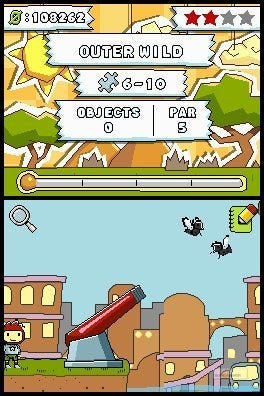
Levels have a "par" associated with them, which is the number of objects the developers reckon you may need to use, and using fewer objects means bonuses, as does picking stylish options and completing the level quickly. Using an axe to cut down a tree is effective but obvious - why not use a sword instead? Or termites? The better your score for a level, the more "Ollars" you receive to spend on things in the shop - avatars and songs, in the build I have. You can also earn "merits" for things like not using guns. Plus there's a level editor, which offers you the existing layouts as a template and lets you insert your own objects using Writepad and then script behaviour for them (bear protects porridge, for example, or lion attacks crocodile) with a few taps of the stylus. Replay value is a potential concern, or at least it was until I replayed a level and discovered "Advanced" mode, where you have to complete the same task three times in a row without using any of the same objects on subsequent attempts.
The physics are a bit too rigid sometimes - it's nowhere near as much fun to beat a level by lucking through it thanks to a physics spasm, accidentally bouncing a girl into a pond with a wall, as it is to implement an elegant outcome, finding a way to divert her ascent up off the diving board deliberately. As the difficulty increases, 5th Cell also introduces more fiendish level designs. There's a Starite in an ice block suspended over lava, with an unavoidable trip-switch preventing you reaching it before it falls; later there's an underground level where you have to contend with big gaps as well as total darkness to lead a boy back to his father. You could do with more hints in these situations, and you might discover control quirks kill you off unexpectedly. For instance, instead of climbing a ladder and hopping onto the next platform, Maxwell sometimes falls into the pixel-wide gap between it and the ledge until you go back and forensically reposition it. It would also be nice to stop the camera resetting to Maxwell after a few seconds of inactivity - sometimes you just want to stare at a setup on the other side of the level and ponder it.
Spoilers are rather different to the sort we're used to. I won't tell you how to electrocute the shark, for example, because you'll have enough fun thinking it up for yourself. And yes, it was Ellie's idea to electrocute the shark. It always is.
On the whole though the controls are intuitive and graceful, and levels are quick to reset if you want to try something else. It really shouldn't be taken for granted just how miraculous the Objectnaut system at the heart of Scribblenauts is, either, but the truth is that the reason the game works so well quickly blends into the background, and you never find yourself questioning it or wondering about anything other than what's in front of you. Where there's potential for confusion, the developer's rigorous playtesting has nixed most of it (and so you're offered multiple choices if your chosen word is ambiguous, or if you try to perform an action with an object that could be thrown, placed or whatever), and elsewhere the goodwill the game elicits within half an hour of your turning it on overrides any niggling concerns.
Typically if a creative-solution sort of puzzle game is going to go right, it's down to the clear definition of its rules and the developer's own creativity and intuition. Portal and World of Goo are very flexible, for example, but their success owes just as much to the skill with which Valve and 2DBoy wielded their respective concepts as it does to the Aperture Science Handheld Portal Device or smiley faces and blob physics. Having played through 40 of Scribblenauts' 220 levels, it's not quite accurate to say that it's an exception. Level design can afford to be rudimentary for a while, because in the absence of perceptible limitations your level of enjoyment is determined by how much you invest in it, and by sharing solutions with other players. But as the novelty wears off 5th Cell will need to answer with levels that up the ante without bamboozling you completely, and it won't be possible to tell whether it's done that until we see the other worlds in full, which we should do closer to the game's 25th September release. To say I'm looking forward to doing so, however, is an understatement.
Scribblenauts is due out exclusively for DS on 25th September.
