Version tested: Xbox 360
Playing Risen is a lot like being a Dickensian waif, frostbitten nose pressed up against the window of some well-to-do household on Christmas Eve, empty belly growling as you gaze at the lavish feast laid out within - so tempting, but forever out of reach. It's just that where Risen is concerned the feast is a deep and rewarding RPG, and the window is made of horrible graphics, opaque design and clumsy combat.
The latest effort from German developer Piranha Bytes, it finds you washed ashore on the mysterious volcanic island of Faranga, beginning your adventure with just rags on your back and a stick in your hand. The land is blighted by mysterious ruins that have erupted from the Earth, spewing monsters like cut-price Oblivion Gates. This leads to a social schism between idealistic bandits living in the swamp and the religious fervour of the Inquisition. Both are plundering the ruins for gold and artefacts, as well as warring with each other, and you can work for either faction, if you're able to win their favour. It's about as generic as RPG world-building gets, and you're stymied from the start by a game engine that feels half-finished, making these initial forays into Risen's gloomy medieval world an exercise in frustration and disappointment.
Playable only in third-person perspective, movement is jerky and imprecise while the camera's twitchy lurching responses lead to motion sickness as you whirl around trying to work out which way to go in environments that too often lack distinguishing features. Combat is basic and graceless, a simple matter of bashing the A button to attack the giant sea vultures, gnomes and wolves that populate the area. The game employs a vague lock-on system that automatically kicks in when an enemy is up close and directly in front of you, but it apparently can't be arsed keeping tabs on an enemy should they suddenly feint around to flank you, which is, of course, precisely when a lock-on is most necessary.
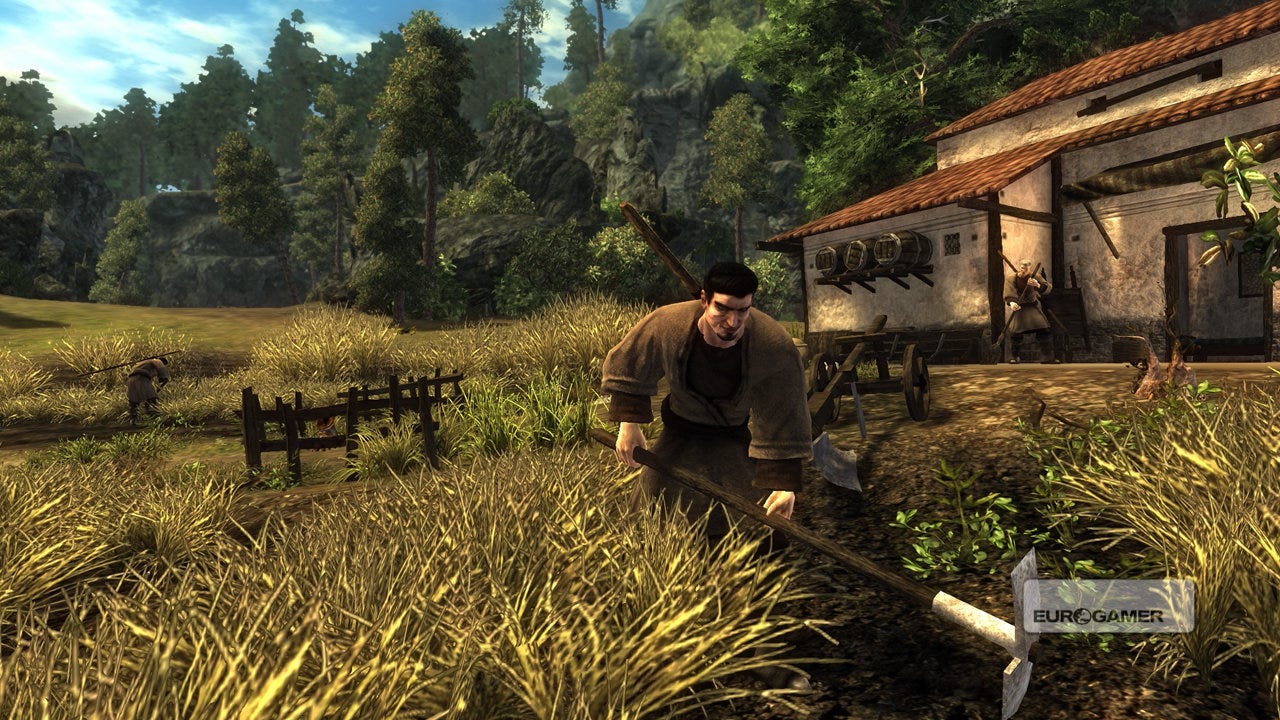
RPG life ain't nothin' but witches and hoes.
This leads to immediate frustration as you grapple with your first few battles, and while experience dulls the pain over time it never stops being an annoyance. Fighting more than one enemy at a time is particularly aggravating, as they swarm from all sides, knocking lumps off your health bar while you flail and spin, wrestling with sluggish dodges, ineffectual parries and slippery viewpoints to line up a successful strike. The infrastructure seemingly goes out of its way to be as unintuitive and impenetrable as possible, too. A variety of busy, imposing menus are assigned to the d-pad. There's absolutely nothing to tell you what each menu button is for, or even how to perform basic functions like equipping items or assigning them to face-button shortcuts.
Anyone with a little RPG experience will work it out, of course, but that doesn't excuse the crude way the game throws you into a hostile world and then makes your support system so persistently unhelpful. You can always play with the manual to hand but that simply shouldn't be necessary in this day and age. Even the option to view the control layout would go some way to demystifying some of the stranger button allocations, but there's literally nothing in-game to illuminate the often arcane jumble of elements that are familiar yet needlessly elusive.
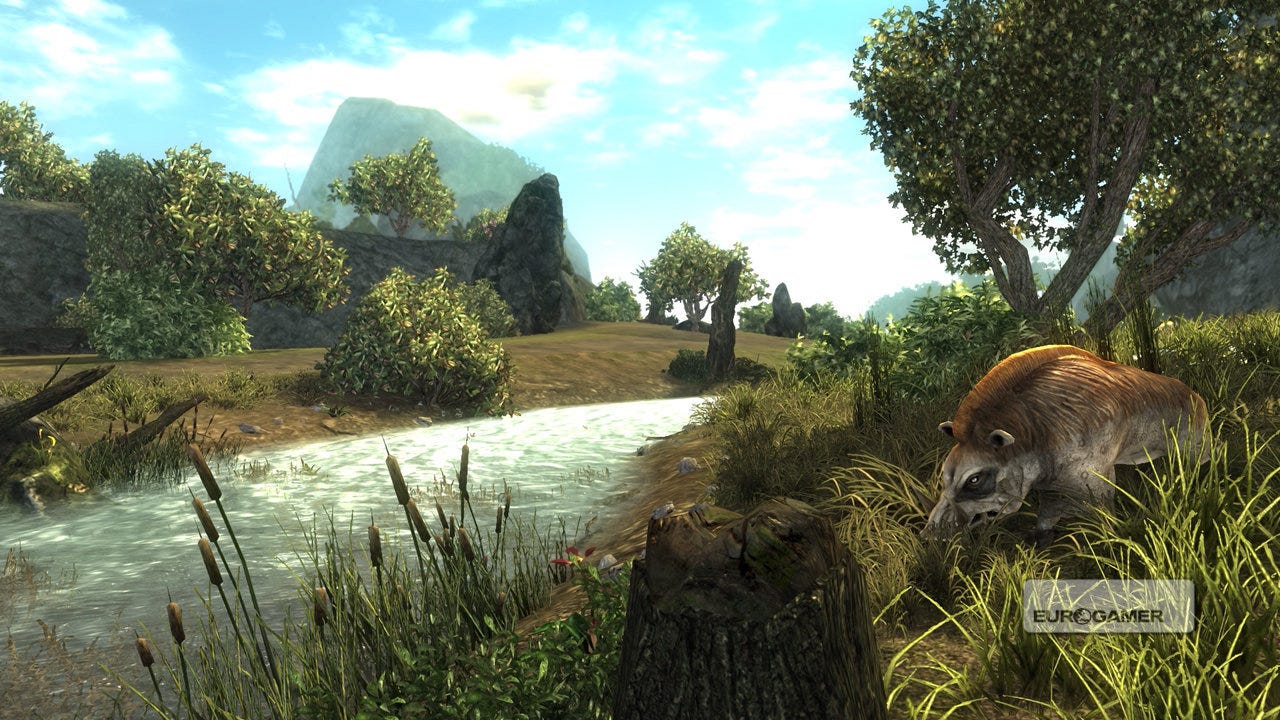
The game never looks this good in reality.
For example, pressing right calls up an overlay showing what clothing, weapons and items you have currently equipped. You can highlight each item, but can you change them from this screen? Apparently not. Instead you have to press up to access the sprawling inventory in a different overlay and choose your equipment from there, before going back to the first menu to see the effect of your changes. It should be as simple and streamlined as possible, especially since the game doesn't pause while you're in the menus, but Risen seems determined to make basic housekeeping tasks long-winded, confusing and utterly unnecessary.
The map is similarly obtuse, making simple navigation a needless chore. Maps must be found or earned, but only appear as static images. You can't highlight areas of interest to see what they are, and there are no waypoints or fast travel. Even more irritating, the vital function of finding a quest objective is buried under a sequence of menu navigations that must be performed every time you check the map. So you open the map and, since there's no single active quest, navigate across the various quest factions in the left-hand window and then down through an ever-expanding list to the quest you want to locate. You then have to use the right-hand window to scroll over to the quest map, which simply shows your location as an arrow, and the quest-giver and objective as coloured dots. If you want to check that you're still on course if a battle turns you around, you need to do this all over again. It's a maddening, ponderous chore that bleeds the life out of simple exploration, the lifeblood of any RPG.
Another genre cornerstone that gets short shrift is levelling. Rather than assigning your own priorities after each level attained, experience is instead converted into "learning points", which can be cashed in with characters that teach you new abilities or increase your attributes in a certain field. These characters also demand payment in gold, even if you're recruited into their army and training you is their job. With limited opportunities to swell the coffers in the early stages, this mercenary attitude leaves you spinning your wheels as you grind away to become strong enough to begin the adventure proper. It feels too much like a really dull MMO with no other players, looting chests to scrape together enough trinkets to trade for enough gold to earn Strength +1, and it does little to encourage continued play.
With so many quirks and flaws in the RPG basics, it doesn't help that the game looks absolutely terrible. Character models look like they've wandered in from an MS-DOS game and their constant inexplicable arm-waving during dialogue undermines the decent voice work and naturalistic script, giving proceedings a distracting Thunderbirds atmosphere. The environments also fail to inspire, maintaining the low-tech aesthetic with ugly textures, repetitive detail and a draw distance that fills in the horizon with jagged diagonal chunks. The frame-rate ping-pongs up and down, movement is hampered by snags and glitches and reloading a previous save can take up to 30 seconds, even if you're still in the same area. With such consistently mediocre performance it comes as no surprise that when installed on the Xbox 360 hard drive the whole game takes up a meagre 2.5Gb of space. Hardly the sort of footprint you'd expect for a massive open-ended RPG in the HD era.
Quick! Use the Iron Greaves of Breath Freshening!
Many of these features - and their attendant criticisms - will be familiar to anyone who followed Piranha Bytes' fine but flawed Gothic series, which now resides with another developer. Indeed, so many elements - from the narrative use of mages and monasteries right down to the way you cook animal meat in your frying pan - are blatantly lifted from those past glories. So much so that it's difficult not to see Risen as the developer trying to reboot its golden goose under a different name. Sadly, rather than improving, Risen suggests that the formula is deteriorating, as minor niggles from previous games are now far more prominent and problematic. The move to consoles must surely play a part as well, since so many of the issues with unintuitive controls suggest a development team unused to the world beyond keyboard and mouse.
It's something of a tragedy, since there's clearly a really good RPG buried under all this technical mediocrity. The gameworld may feel like a patchwork of other RPG settings, but it flows seamlessly and once you've picked up enough equipment and skills to make the control problems more manageable the urge to explore becomes much stronger. With dozens of varied skills to master, hundreds of quests and a potentially rich system of magic, potions and scrolls, there's no shortage of depth for players with the fortitude to battle past the wonky exterior. I begrudgingly began to enjoy myself after about 20 hours of play, but not so much that the thought of the hours ahead didn't feel like a sentence.
It ultimately comes down to effort versus reward, and Risen requires a lot of effort on your part. Not just the usual time investment needed to get the most out of serious role-playing but a conscious decision to put up with the crude interfaces, to tolerate the stodgy combat and to generally make the best of a game that is fundamentally unappealing in too many core areas. Even for players who put in that level of effort, the reward is only worthwhile when considered in isolation. If this were the only console RPG available the numerous flaws might be worth suffering, but when compared to the ambition and polish that other games have brought to the genre in recent years Risen demands far too much and offers too little in return.
4 / 10
