Risen Review

Grinders keepers.

Version tested: PC

Not many games get a second chance to make a first impression, but enough readers felt Risen's shonky Xbox 360 port shouldn't count against the apparently superior PC version that we thought we should investigate that one as well. I was duly dispatched to the volcanic island of Faranga for a second go-around and, yes, it's true that the PC version is a marked improvement over its console cousin. It's immediately clear that Piranha Bytes is much more comfortable working on its native platform, and this familiarity certainly smooths some of the rough edges.

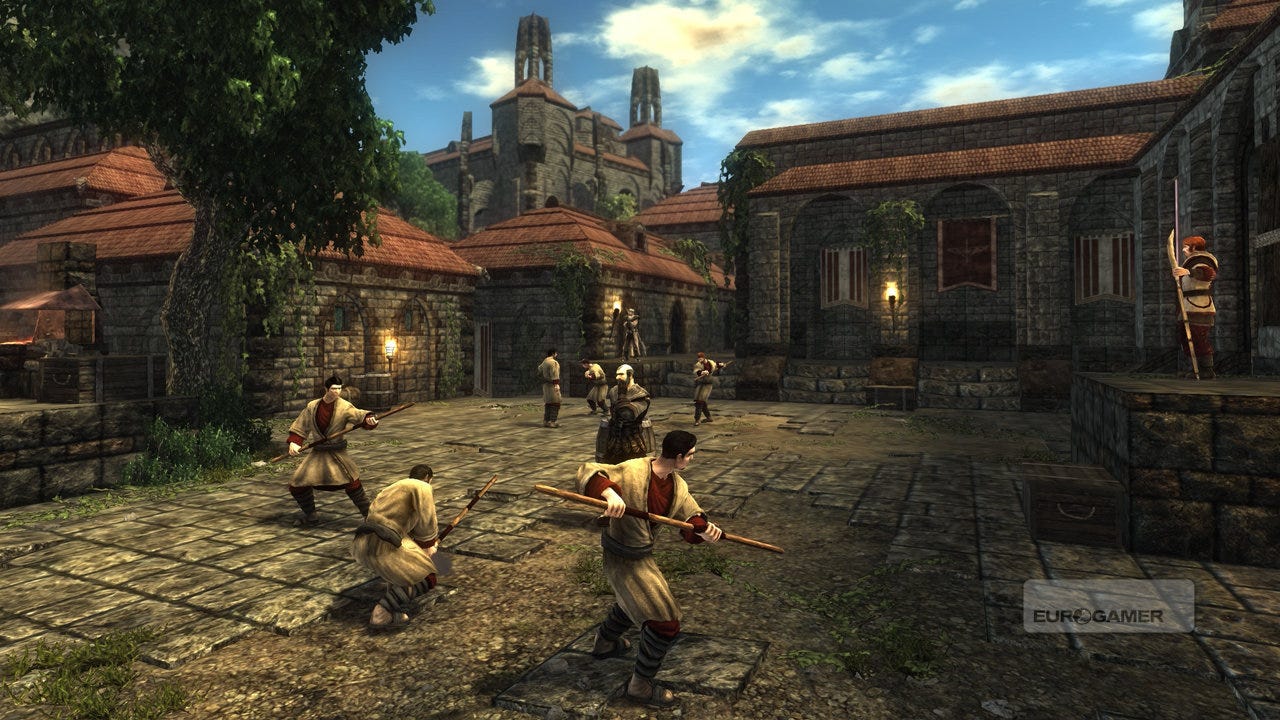
Most obviously, there's a definite benefit to the visuals. Even with settings at maximum it's not going to be the prettiest game around, but simply by eliminating the horribly distracting pop-up and enormous diagonal lines tearing through the distant scenery, the gameworld is easier to immerse yourself in. Draw distance is also improved, and it no longer feels like you're wandering through a half-finished virtual reality countryside.

Also benefiting from the comfort zone of the PC is the game's accessibility. Menus are still rather bland and ugly, but something as simple as the ability to drag and drop items from inventory spaces to equipment slots streamlines what had become a cumbersome obstacle on the 360. From this side of the fence it's easier to see how the 360 setup was crudely cut-and-pasted across, trying to match keyboard functions to d-pad directions, but there's no mistaking that Piranha Bytes was clearly out of its depth in the world of joypad-only game design.
1

The olden days version of pole dancing was very different indeed.

Combat is also less of a fiddle, and seems considerably easier. Whether that's because the mouse and keyboard are more in tune with the game's design, or because I'd already grown accustomed to the peculiar rhythms of its block and strafe fighting style, I couldn't say. The slippery lock-on still proves problematic when tackling more than one foe at a time, however, and while it's possible to become adept at combat through practice, it's never as engaging as it needs to be to sustain the length of a full RPG.

The good points of the game are understandably closer to the surface here, which makes it easier to appreciate the solid script and voice-over work, as well as the numerous, varied and sometimes quite innovative quests. The skill tree is also pleasantly broad, once the game deems you worthy enough to explore it fully, with a range of crafts that wouldn't look out of place in an MMORPG.

Incidental details build along the way, and by the time the story really kicks in you've built up enough of a relationship with various NPCs that it feels like there's something tangible at stake. It's just a shame the character models are so atrocious, blank automatons speaking with expressive voices, while their unnaturally twitchy animation heightens their cheap appearance. Still, Oblivion had some of the worst faces in gaming history and went on to captivate millions, so it's hardly fair to dwell on such surface hiccups.

More problematic is the lumpen structure and a back-end which struggles to make sense of the reams of info you gather along the way. There's nothing wrong with an RPG taking its time, of course, provided that a sense of progress and immersion is maintained. Risen fumbles in this regard, opening with a long-winded tutorial session during which gameplay info and features are introduced in a frustratingly slow drip feed.

Experienced RPG fans, who this game is undoubtedly aimed at, may relish the chance to spend hours just to reach the starting line, but it too often feels like Risen is taking advantage of the innate patience and forgiving nature of the genre's fanbase to pad itself out, rather than doing anything purposeful with its languid pace. "It starts to get interesting after 20 hours," isn't much of a recommendation, other than to pander to the masochistic hardcore who feel that hours served in-game is a goal in and of itself. It takes the game into an unwelcome trainspottery creative cul-de-sac, where painstaking devotion to genre ritual is more important than the game itself.

Compounding this are issues that remain regardless of platform. Navigation around the sizeable map is hampered by a rudimentary map, which makes finding quest markers more of a chore than it should be, while the game's oddball levelling system opts for the long-term grind over more inspiring goals. Forcing players to accumulate gold in order to buy and improve new skills is, admittedly, an interesting twist on something that is usually advanced ambiently during play, but in practice it simply lengthens the already interminable opening of the game.

2

There's never an Argonaut around when you need one.

So, sorry Risen apologists, but even when viewed in its best light, Risen simply isn't anything special. Despite being Gothic 4 in all but name, Piranha Bytes has brought little that is new to its creaking formula and the elements that are worthwhile are all but smothered under a design ethos that confuses length for depth.

Ironically, while the PC version inarguably shows up the flaws in the 360 effort all the more, it also fares far worse when compared to its peers. Consoles have relatively few RPGs in this traditional mould, but on the PC the competition is much fiercer and so well-intentioned failures are harder to tolerate. Adequate rather than inspired, Risen doesn't even match up to the polish and narrative depth of The Witcher, now two years old, so releasing it only weeks before BioWare's Dragon Age is bordering on suicidal. Patient gamers looking to tick off genre standards without being troubled by any surprises will no doubt unearth a few truffles of amusement, but in the grand scheme of things Risen barely manages to rise above the herd.

6 / 10

Read the Eurogamer.net scoring policy

Comments (93)

Comments for this article are now closed, but please feel free to continue chatting on the forum!

  • Loading...hold tight!