Version tested: Wii
For me, Red Steel 2 began with a mini-game: track down the Wii MotionPlus. Under the sofa? Stuck in a box in the hallway? Lodged behind the dim mahogany bulk of my travel luggage? I spent the best part of 30 minutes searching - 30 minutes that served as a reminder that few developers have chosen to take a risk on Nintendo's handy piece of kit. Granted, Ubisoft's latest, which is a genuine MotionPlus exclusive, is hardly the most foolhardy undertaking in the whole sweep of history: after all, Enrico Fermi once built a nuclear reactor on a squash court. That was pretty stupid. He wasn't hoping to charge people to play with it, however.
In this case, though, Ubisoft's strategy is easy to applaud. While Red Steel 2's relationship with the MotionPlus is faintly troubled - at times, you're revelling in things which would have been impossible with the standard Wii remote, while at other moments you could be forgiven for thinking the magical device is merely a new form of credibility tax - you can't question the developer's intentions. Ubisoft Paris has taken the chance to build a 'proper' action experience for the Wii entirely seriously, and while Red Steel 2 is hardly a perfect game, it's often an extremely enjoyable one.
Don't worry if you've forgotten the first Red Steel: so has the sequel. One game in and it's reboot time for the swords-and-shooters franchise. Red Steel 2 has no returning characters, no mediating subtitle (although having spent the best part of a weekend waving the remote around I reckon You'll Never Play the Accordion Again might have been appropriate) and no real links to the first game at all.
There's some very nice block chord piano going on in the score: someone's successfully blended Ry Cooder and Vince Guaraldi.
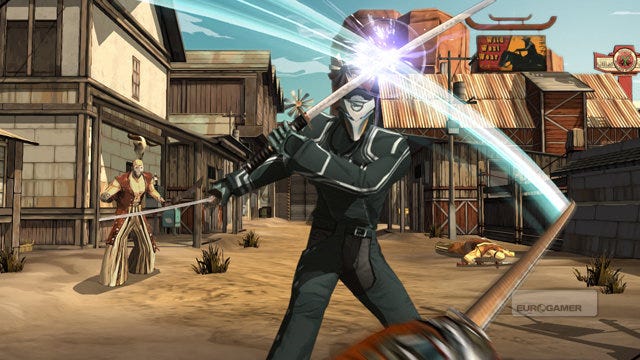
So rather than a Yakuza-riddled tale of modern-day Japan, you'll wake up this time in a weird mish-mash future. It's Kurosawa meets John Wayne, with a little William Gibson slid in between. That's blending films and books together fairly messily, but Red Steel 2 really doesn't seem to have a problem with mess. The game makes no attempt to explain its collision of gunslingers and cyber-ninjas, nor does it ponder why vending machines and black trash bags compete for space with spurs and drafty old saloons, and it's all the better for it.
In fact, the greatest strength of Ubisoft's latest is its curiously entertaining world: wooden temples and Seven-Elevens clip together just as snugly as the Katana you clutch in one hand and the shotgun you wield with the other, and the environments are a sustained pleasure to take in, calling to mind Oddworld: Stranger's Wrath and Borderlands. The character models are equally good too, from the Jackals, who look like S&M farm help, to the Katakara clan, resembling Samurai storm troopers as they spit hot death out of prohibition-era "Johnnyguns".
Clipping is so extreme that it's practically a feature. There's plenty of asset re-use, too.
On top of the smart visual design is a neat quest structure, which sees you moving through most of the game world by taking on missions from sheriff's boards. The objectives themselves soon start to cycle, but it's a system that can exert a unique pull if handled well, and the game is always careful to send you out into the small, warren-like maps with both a story mission and some long-term collection tasks to get on with. Red Steel 2's insistent tug on your attention is definitely not an accomplishment that should be taken for granted: this is one of those games that is very good at giving you a steady sense of achieving something.
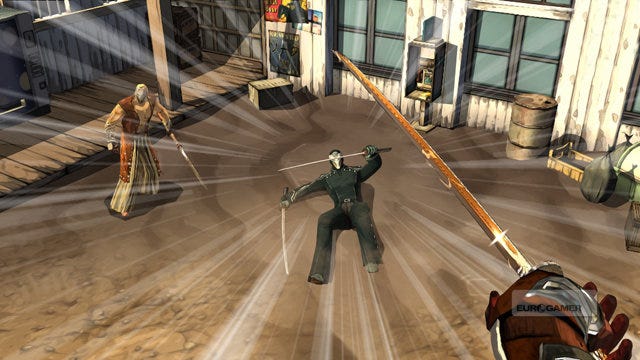
Most of the time, the missions lead to combat, and combat is split between the sword and the gun in an entirely free-form manner. Both are decent enough on their own - shots are fired by pointing the remote and pulling the trigger, while the katana requires a proper slashing movement - but the game really wants you to combine attacks as you take on adversaries who know when to come in close and when to move out of reach.
The switch between weapons is instantaneous, and there's plenty of variety as you start to open up your sword skills and upgrade a small range of very pretty guns. In fact, combat has an almost unnecessary depth at times. Learning so many different gestures is somehow more difficult than consigning strings of button sequences to memory, but you can get by well enough with a few knockdowns, a finisher or two, and something showy and violent like the Eagle move, which blasts people rather amusingly into the air after a charge, allowing you to stick it to them on their return to earth.
There are problems, however. While I'm more than ready to believe that the basic sword move itself would be all but impossible without the MotionPlus in place - Red Steel 2 wants you to really swing, pulling the remote back over your shoulder and giving it some weight, which means the game spends a lot of time relying on information from the MotionPlus' innards alone - the game can still feel imprecise and compromised a little too often. If you're expecting a genuine revelation in terms of combat you might be disappointed.
There's a fair amount of lag when things get busy, meaning that even if there is one-to-one mimicking going on, by the time your moves are reflected on screen they're often already dissociated from your actions. On other occasions, in a real frenzy of activity, you'll actually see enemies registering your hits without the game having time to pencil in the appropriate animation. That's probably a better fudge than having it the other way around, however.
The obligatory train section is a low point, an unlovable collision of environment cloning and crash bugs.
Despite these issues, Ubisoft has still been pretty smart. Most of the time, the developers know when to mimic your actions directly (blocking and basic swings) and when to simply allow you to pull off canned special moves by performing a general input which doesn't have that much in common with what you'll then see on screen. It's a decent system, but is does reinforce the predicament at the game's heart. Good swordsman titles still aren't really possible on the Wii because the technology still gets confused too easily, swapping the sides of the screen if you move too far back, or misinterpreting a few too many manoeuvres to ever truly earn your trust. And more to the point, most Wii players aren't good swordsmen in the first place, so the code will always have to step in and help them out, and thus the illusion will be shattered anyway.
Judged as a MotionPlus game, then, it's hard to get too excited about the future promised by Red Steel 2. Approached purely as an action title for the Wii, however, which seems like the fairer strategy, it's really not bad at all.
There's no multiplayer, but with level challenges available, you probably won't miss it.
There's a pleasant up-grade muddle to lose yourself in, and combat can be brilliant fun once you learn to work within the system's limitations. The automatic lock-on is generally pretty intelligent when picking out enemies, while a full health recharge after each fight encourages you to treat every carefully orchestrated brawl as its own nimble little set-piece. And all of this is enhanced by an almost Halo-esque emphasis on throwing together various enemy types in challenging new configurations, tossing in a handful of straight-up grunts with a more powerful hammer-swinger, and some armoured Johnnygun idiots off to the side.
In the end, you'll likely forgive Ubisoft's game its shortcomings on the strength of its energy, obvious good will, and deep sense of craft. There are some thrilling set-pieces in here, along with moments that rank amongst the Wii's most beautiful, including a midnight rooftop race to catch a train which plays out under a huge cream-coloured moon. It's a lovely sequence.
As with any good Western - or any good samurai film - Red Steel 2 is ultimately about character: it's flawed, certainly, but entirely honourable with it.
7 / 10
